
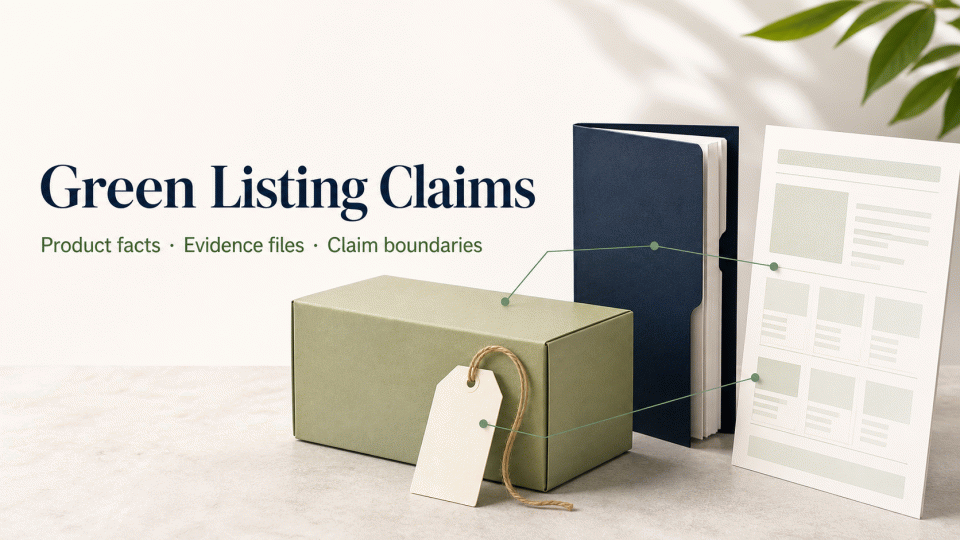
When a listing uses words such as green, environmentally friendly, sustainable, or recycled, the starting point is not a universal “green badge” checklist. First identify the subject of the claim, then make the product facts, evidence files, and page wording point to the same scope. Market, platform, program, and product-category requirements can differ, so this page is a review framework rather than a promise of eligibility, certification, approval, or sales performance.
1. Define the subject of each claim
Break every proposed sentence into four questions: Does it describe the product, packaging, a material, a manufacturing process, or a company activity? Which SKU, model, formula, color, packaging version, and sales market does it cover? Is it a factual description, a program attribute, a third-party certification statement, or an environmental benefit claim? Could a shopper read it as applying to the whole product or brand?
“Packaging contains recycled material” is not the same scope as “the product is environmentally friendly.” Likewise, a verified attribute for one model does not automatically extend to a whole range. Titles, bullet points, descriptions, image text, and enhanced content should keep the same object and scope instead of making the title broader than the supporting copy.
2. Build a product-fact and evidence index
For each SKU, create a review record covering the SKU or model and version, product and packaging photos, BOM or material description, supplier and production site, the environmental attribute being claimed, evidence filename and identifier, covered scope, issuing party, target market, current status or review date, and the exact sentence proposed for the listing.
Read the document itself; its title is not enough. Check the covered object, quantity or model, material or formula, holder or site, test method or certification scheme, limitations, and dates. If a document covers an input material, package, or single model, do not expand it to the full product family. Supplier documents also require a check of the named holder and the link to the actual product.
Keep platform-program records, third-party certification records, mandatory regulatory files, and voluntary marketing substantiation separate. A platform page showing a program entry point does not prove that a product has qualified. A mandatory technical file is not automatically permission to use an environmental marketing claim.
3. Turn evidence into checkable page wording
Start with the specific attribute and then state its scope. A useful sentence answers what the product or package contains, which part is covered, which model or version it applies to, and where the support comes from. Words such as recyclable, compostable, reduced impact, or carbon-related should be checked against their definitions, conditions, system boundaries, and substantiation rather than replaced with a single broad word such as green.
The U.S. FTC Green Guides emphasize reliable support for environmental marketing claims and caution against broad, unqualified claims such as green or eco-friendly. The European Commission’s green-claims materials likewise address consumer protection against false or unreliable environmental claims. These sources do not replace market-specific legal advice or platform review, but they are useful starting points for copy review.
Before publishing, compare the title, bullets, description, image text, and structured attributes line by line. Ask whether any term—such as all, zero, non-toxic, fully, leading, certified, or approved—goes beyond the evidence. Check that a company, package, or single material attribute has not become a whole-product claim, and that an application or review status has not been written as an achieved outcome.
4. Manual pre-listing review
① Confirm that Chinese and English titles, bullets, descriptions, and image text describe the same product fact. ② Link every environmental statement to a specific file and page reference. ③ Check model, formula, material, packaging version, named holder, and market. ④ Challenge broad, comparative, absolute, and outcome-oriented wording. ⑤ Retain the reviewed page version, review date, and reason for edits, then repeat the review when the product or supply chain changes.
This page does not decide whether a particular product meets a platform program, certification scheme, or market regulation. It does not promise review approval, conversion, ranking, customs clearance, or sales results. If a listing uses a specific logo, certification name, or platform-program name, verify its authorization, usage conditions, and current official rules separately.
Sources and scope
The general claim-boundary principles in this page refer to the U.S. Federal Trade Commission Green Guides summary and the European Commission green-claims page. They explain general evidence and wording principles and are not a product-, platform-, or market-specific compliance conclusion.


