
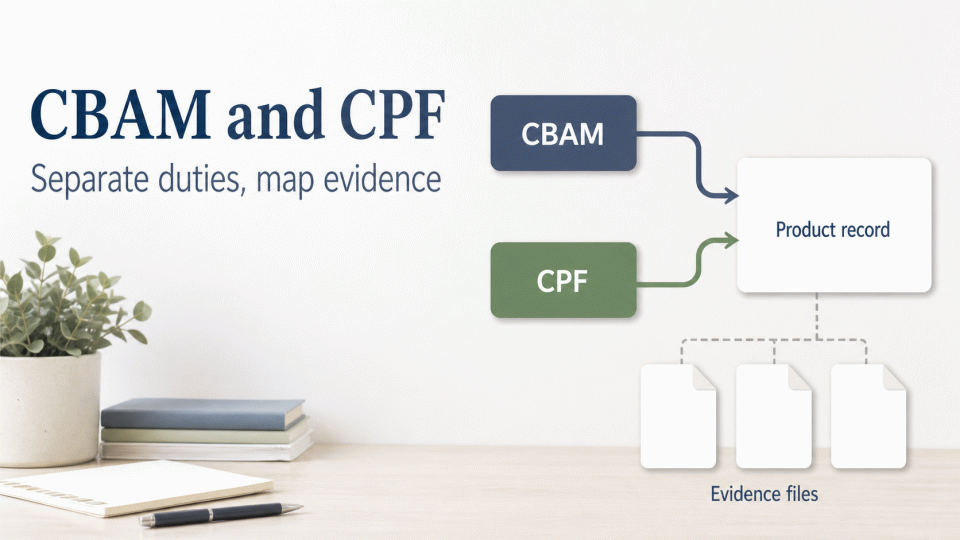
The EU Carbon Border Adjustment Mechanism (CBAM) and Amazon Climate Pledge Friendly (CPF) address different questions. CBAM concerns selected imported goods and the EU-system obligations of the importer. CPF is an Amazon program that helps customers discover products with sustainability features. Listing them together does not make one certificate a substitute for the other.
1. Keep CBAM and CPF Separate
CBAM is an import regime. The European Commission states that the definitive regime applies from 1 January 2026 and covers selected goods in cement, iron and steel, aluminium, fertilisers, electricity and hydrogen. The EU importer or indirect customs representative carries out the relevant authorisation, embedded-emissions declaration and certificate surrender steps. A non-EU installation may provide production and emissions data, but that does not automatically make it the EU declarant.
CPF is a product-discovery program. Amazon Sustainability describes CPF as recognizing products with an improvement in at least one sustainability aspect, based on recognized certifications or program foundations, to help customers find such products. It is not a customs declaration, an emissions calculation, or a CBAM certificate. Inclusion for a particular marketplace or product category still depends on Amazon’s current program conditions and product records.
2. Build One Product Master Record
Use one factual product record to connect the two workstreams, while keeping their evidence and conclusions separate. At minimum, record:
- Product identity: SKU or model, version, material or formulation, production facility, origin, target market and proposed CN code. The importer or customs owner must verify the code for the actual goods.
- CBAM file: importer or indirect representative, quantity, goods classification, installation information, embedded-emissions data, methodology, default-value or actual-data basis, and declaration and certificate records.
- CPF file: the product sustainability attribute, applicable third-party certification or program record, certificate holder and scope, product-to-record mapping, page wording and page version.
- Change log: supplier, facility, formulation, material, packaging, model, importer or page-copy changes, with the date, affected evidence and scope requiring reconfirmation.
3. Six Evidence Cards for Two Separate Tracks
- Scope card: goods description, proposed CN code, importing country, importer and quantity. Use it to decide whether CBAM scope needs further review.
- Installation card: production facility, process, production boundary and data owner. Do not treat a supplier name as the importing declarant.
- Emissions card: data source, measurement or calculation method, assumptions, period and supporting files. If default values are used, record the official version applied.
- Product-attribute card: map the CPF-relevant attribute to a specific SKU, model or version. Do not extend a brand-level marketing statement to every product.
- Certification or program card: issuer or program owner, record number, scope, status and verifiable source. The existence of a record does not prove a result for the current product, page or market.
- Page card: page version, statement text, supporting evidence and reviewer. Keep wording within the evidence scope; avoid “approved,” “guaranteed compliant,” or “applies to every market.”
4. Assign the First Action
The non-EU producer should first provide the importer with the facility, goods and emissions-data basis. The brand or product team owns the SKU, version, material and page statement. The EU importer or indirect customs representative confirms the CBAM role, declaration route and certificate actions. The marketplace operator checks CPF’s current entry point and requirements only after the product record is mapped to sustainability evidence. Names on laboratory, certification or supplier files do not replace a role-specific scope decision.
A practical first pass is to select one product line and place the order, specification, facility information, emissions record, certification or program file and page version under one reference. Mark missing fields, then ask the import and marketplace owners to make their own scope checks. This method does not establish that the product is subject to CBAM or that it has received CPF recognition.
5. Boundaries and Sources
CBAM applicability must be assessed against the goods listed in Annex I, the CN code, import route, responsible entity and relevant quantity facts. A product is not automatically in scope because it contains metal, is sold into the EU, or has carbon data. CPF’s conditions, marketplace coverage and product-recognition status must likewise be checked against Amazon’s current pages and the relevant certification or program record. This article is an evidence-mapping method; it does not promise a customs, certification or marketplace outcome.
Sources: European Commission — CBAM definitive regime; European Commission — CBAM Registry; European Commission — CBAM sectors; Amazon Sustainability — Products and services. 绿色方舟(深圳)认证有限公司 is the information organiser named in this article, not an EU institution or Amazon decision-maker.


