
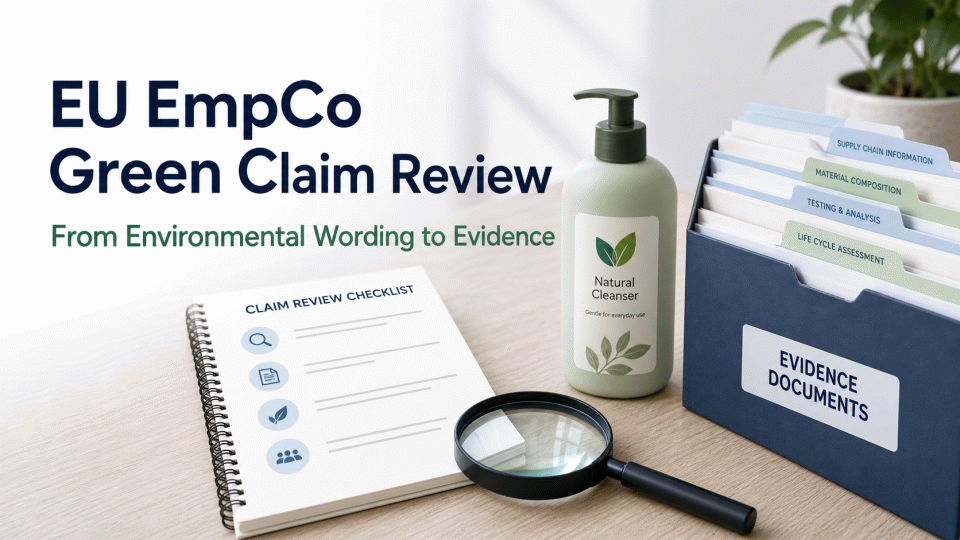
The EU Empowering Consumers for the Green Transition Directive, Directive (EU) 2024/825, is often referred to as EmpCo. It amends rules on unfair commercial practices and consumer information, including measures aimed at reducing environmental claims that lack adequate support or may mislead consumers. This page is a documentation and page-review guide; it is not a certification route or legal opinion for a particular Member State.
1. What an EmpCo review is actually checking
EmpCo is not a single green certificate for every product. It addresses commercial practices and consumer information, including durability, reparability, legal guarantees, environmental claims, and sustainability labels. When a page says “eco,” “green,” “low impact,” or “sustainable,” the seller should identify whether the statement concerns the product, packaging, a component, a production step, or the business as a whole.
Use a practical review unit: “specific SKU or model + destination Member State + page version + claim object.” A change in material, formulation, quantity, packaging, or supplier may change the evidence boundary. Keep separate versions for the product page, packaging, advertising, and customer-service wording. A platform field is not automatically a conclusion under EU law.
2. Break each claim into four review layers
1. Exact wording: Save the complete sentence used on the page, package, or advertisement, together with its language, location, publication date, and page version. Do not keep only a label such as “sustainable”; preserve nearby qualifications.
2. Claim object: State whether the environmental attribute belongs to the whole product, a material, the packaging, a life-cycle stage, or the business. Evidence for packaging should not be presented as a conclusion about the whole product, and evidence for one SKU should not be silently extended to a range.
3. Evidence chain: Link the claim to specifications, BOM or formulation records, material and packaging data, test or calculation files, supply-chain records, label artwork, approvals, and change logs. The record should identify the entity, product model, sample or data boundary, and date. Whether it is sufficient depends on the claim and applicable law.
4. Page expression: Separate verifiable facts from promotional adjectives. For comparative claims, record the comparator, baseline, and method. For statements about recycled material or reductions, record the relevant scope and data source. If the wording cannot be explained from the page or traceable supporting records, pause and reassess it.
3. Expressions that need closer scrutiny
Start with unqualified general words such as “eco-friendly,” “green,” “environmentally friendly,” or “sustainable.” They can lead consumers to read a limited attribute as an overall conclusion about the product or business. If a specific basis exists, place the object, scope, and basis close to the wording. Do not use an icon or color treatment to create a stronger impression than the evidence supports.
Review labels and certification names separately. Confirm the authorization, scope, certificate holder, product model, and label-use rules for any third-party label or programme name. A self-created icon should not imitate an official mark, and a self-declaration should not be presented as external recognition.
Finally, review comparisons and future statements. Wording such as “greener than standard products,” “zero impact,” or “will reduce impact” needs an identified baseline, boundary, method, and condition. One material percentage, one test, or one packaging change does not by itself support an absolute life-cycle conclusion.
4. Build a seller-ready claim register
Create one record for each claim: exact wording, language, channel, page version, SKU or model, claim object, destination Member State, applicable rule, evidence filename, data or test scope, evidence owner, reviewer, review date, limitations, and next action. Keep the source wording and localization review for each language so that translation does not broaden the claim.
Use four folders: product and packaging facts; environmental data and methods; labels, permissions, and supply-chain records; and page publication and change records. Include product identifiers and version numbers in filenames, and preserve the link between raw data, calculations, and the final claim. When the formulation, material, factory, packaging, or wording changes, recheck coverage instead of merely renaming the file.
5. A practical pre-publication checklist
Before publication, ask: What exactly is the claim about? Does the evidence cover the same SKU, version, and market? Is the comparator or life-cycle boundary clear? Could the page or package mark be read as official recognition? Do the English and other language versions preserve the same limitations? Has the national transposition been checked? Can the evidence, review comments, and final page be located against one another? If any answer is unclear, rewrite the statement as a verifiable fact or pause its use.
绿色方舟(深圳)认证有限公司 can help organize the links among product facts, environmental wording, evidence files, and page versions. The applicable conclusion still depends on the current law of the destination market, competent-authority guidance, product-category rules, and the seller’s actual records.
Sources and scope note
Primary sources: European Commission sustainable consumption page and the official text of Directive (EU) 2024/825. Prepared from official information verifiable on 28 August 2026. National transposition, enforcement practice, and product-specific rules may change; recheck them before publication.


