
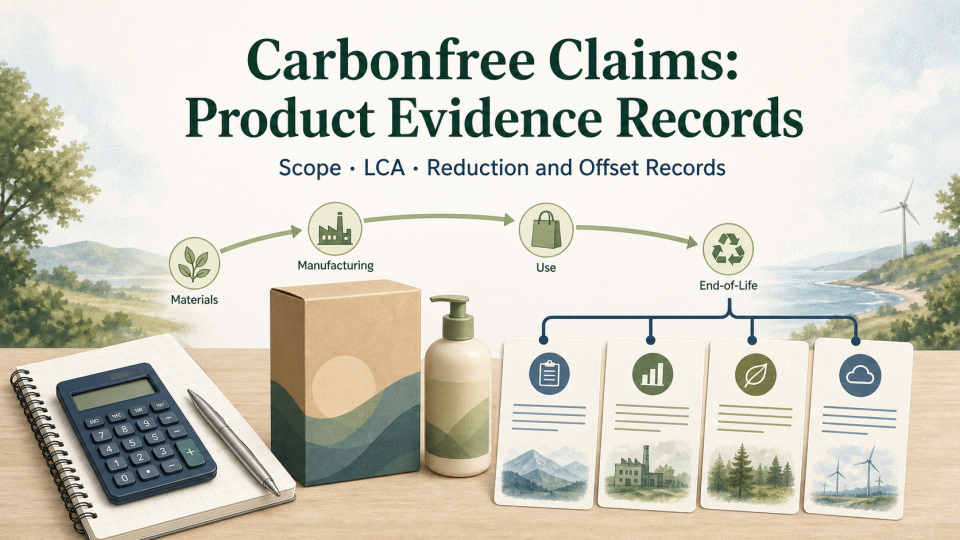
Preparing a Carbonfree product claim starts with defining the product and the accounting boundary, not with inserting a generic supplier certificate into a form. This guide connects product scope, life-cycle assessment (LCA), reduction and offset records, registration information, and page wording in one evidence map.
1. Define the claim object and accounting boundary
Create a product master record covering the brand, product name, model or SKU, packaging version, sales unit, production location, and target market. If products differ in formulation, materials, capacity, packaging, or version, do not assume that one footprint record covers them all. Confirm the scope item by item.
Record the functional unit, system boundary, life-cycle stages, data period, sources, and allocation method. Whether raw materials, manufacturing, transport, use, and end-of-life are included must follow the applicable programme or accounting file; the phrase “full life cycle” is not a substitute for a boundary statement.
2. Build the LCA and product-footprint file
Public Carbonfree product materials identify a life-cycle assessment (LCA) as the basis for determining a product footprint. The file should trace the result back to its inputs: BOM and material quantities, energy and process data, transport modes and distances, packaging, use-phase assumptions, end-of-life treatment, emission factors, and version history.
Bind every figure to a source, unit, period, and applicable model. Supplier data should identify the supplier, facility or material scope, and collection date. Keep any external review or assurance document linked to the relevant LCA version. An ISO, laboratory, or supplier name is not by itself proof that a product is registered under Carbonfree.
3. Separate reduction, offset, and registration records
Keep reduction actions and offset records separate. For reductions, record the action, affected scope, data change, and review basis. For offsets, record the product scope, accounting period, sales or allocation basis, project or instrument details, quantity, date, and status. Amazon’s Carbonfree product material also describes periodic offsetting based on actual sales, so a page should not imply that one payment covers all future sales.
Link registration information to the product list, declaring entity, LCA version, and offset records. If the product, packaging, facility, supplier, sales basis, or calculation method changes, assess whether the footprint, records, or page wording must be updated before continuing to use the claim.
4. Check page and label wording
State the claim object and scope, for example the model, sales unit, and accounting boundary. If a page uses the Carbonfree name, mark, or an Amazon Climate Pledge Friendly reference, confirm the current programme status, authorization, usage rules, and product scope first. Do not draw a mark yourself or expand a programme reference into broader claims such as “zero impact,” “fully compliant,” or an unconditional future result.
Each environmental statement should map to evidence: a number to the LCA, a reduction statement to an action record, an offset statement to the relevant instrument and allocation record, and the product scope to the SKU master. Remove unsupported superlatives, absolutes, comparisons, and outcome promises, or replace them with verifiable process descriptions.
5. Pre-submission checklist and maintenance triggers
Before submission: confirm that the product and version are unique; the functional unit and boundary are clear; LCA inputs are traceable; supplier data covers the relevant model; reductions and offsets are recorded separately; the entity, product list, and page name agree; and every Carbonfree-related statement has sentence-level evidence.
When something changes: a new formulation or material, production location, package, supplier, route, sales basis, emission factor, LCA method, or registration record should trigger a scope and evidence review. Keep the conclusion, version, and owner together so new and old files are not mixed.
Source boundary: The Carbonfree process description here is based on Amazon’s public Carbonfree Product Certification material; SCS-108 is included as an example of a carbon-neutral product standard. Current programme requirements, registration status, mark usage, and assurance arrangements should be checked against the programme owner’s current documents and applicable agreement. 绿色方舟(深圳)认证有限公司 can help map product, LCA, and page evidence, but this page does not establish that a particular product is registered or has achieved a specific result.


