
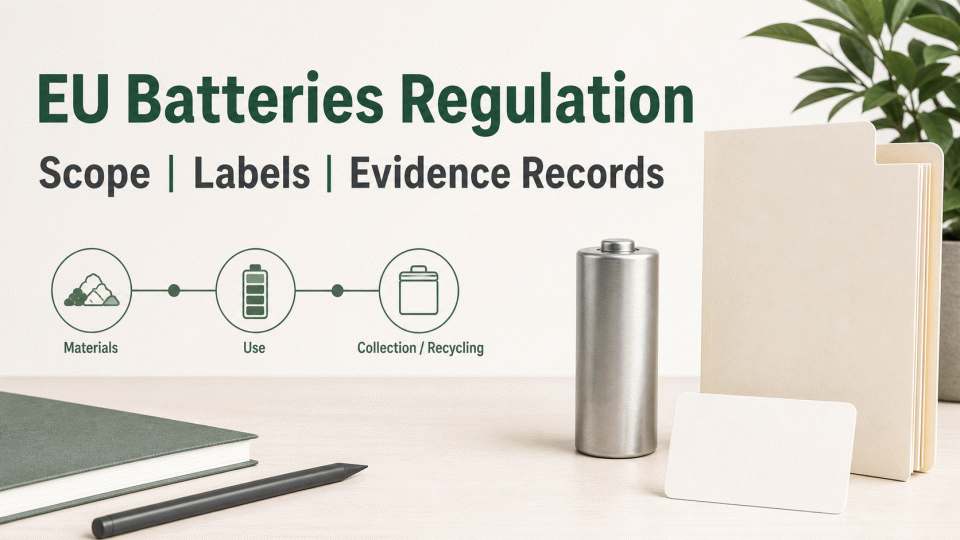
The EU Batteries Regulation is not the name of a universal certificate. Regulation (EU) 2023/1542 addresses batteries placed on the Union market or put into service, covering sustainability, safety, labelling and information, extended producer responsibility, waste-battery collection and treatment, and reporting. Documentation should therefore start with the specific battery, its use, the economic operator and the destination market.
1. Establish the product scope first
Create one line per product item: a standalone battery or a battery incorporated into equipment, a light means of transport or a vehicle; rechargeable or non-rechargeable; and the category that applies, such as portable, starting-lighting-ignition, light means of transport, industrial or electric-vehicle battery. Record who manufactures, imports or places the battery under its own brand. A brand, factory or supplier report is not a substitute for a product-level scope decision.
Keep the model, capacity, chemistry, dimensions, intended use, assembly relationship, sales packaging and destination Member State for each SKU. Where a battery is supplied with a product, assess the battery and the finished product separately for roles, label placement, information and producer-responsibility arrangements, and retain the reasoning behind the decision.
2. Build an evidence pack by requirement
Product and economic-operator records: model list, technical specifications, BOM or relevant material information, manufacturer and importer details, brand authorisation, EU economic-operator information where applicable, and the SKU covered by each document.
Safety and performance: design descriptions, risk identification, test or assessment records, instructions and change history. Reports should trace to the sample, model, method, result and issuing body; a laboratory name or a claim of “full coverage” is not enough for an item-by-item review.
Environmental and supply-chain records: depending on the battery category and applicable provisions, retain data on raw-material sourcing, substance restrictions, carbon-footprint or recycled-material information, purchasing and batch records. Label every data point with its period, unit, boundary, source and owner. Do not drop certificates from unrelated schemes into the Batteries Regulation file without checking their scope.
Producer responsibility and waste batteries: document producer-responsibility registration or representation, collection and treatment arrangements, reporting files and communications for each target Member State. National implementation details can differ, so keep the access date and competent-authority source.
3. Check labels, information and listing language
Manage the battery label, packaging, instructions and product page as one version-controlled set. Check whether capacity, chemistry information, marks, warnings and traceability information apply to the battery category, and verify wording, symbols, placement and destination-market language. Every symbol in a label draft needs a documented basis; do not add a mark merely because it looks familiar.
Use only facts supported by the product record and the applicable requirements, such as battery type, model range, instructions or collection arrangements. Avoid generic claims that a product is “registered,” “approved,” “customs-cleared” or guaranteed to be accepted by a platform. Keep the Batteries Regulation file distinct from CPF, packaging, deforestation and carbon-border materials.
4. A human pre-delivery checklist
① Is the product, SKU, version and destination Member State clear? ② Do the manufacturer, importer, brand owner and producer-responsibility roles match? ③ Do the technical file, test records, label, instructions and page all point to the same model? ④ Does every value have a unit, period, boundary and source? ⑤ Is there evidence for national registration, collection and reporting arrangements? ⑥ Would a cell, chemistry, supplier, packaging, firmware or label change trigger a new review?
Have product, supply-chain and compliance owners read the same evidence index before closing gaps. 绿色方舟(深圳)认证有限公司 can help organise a product-to-requirement-to-record map; applicability and final responsibility still depend on the product, economic role, destination market and competent-authority requirements.
Sources and limits
Primary references: EUR-Lex: Regulation (EU) 2023/1542; European Commission: Batteries. Recheck later amendments, delegated or implementing acts and Member State implementation information before use.


