
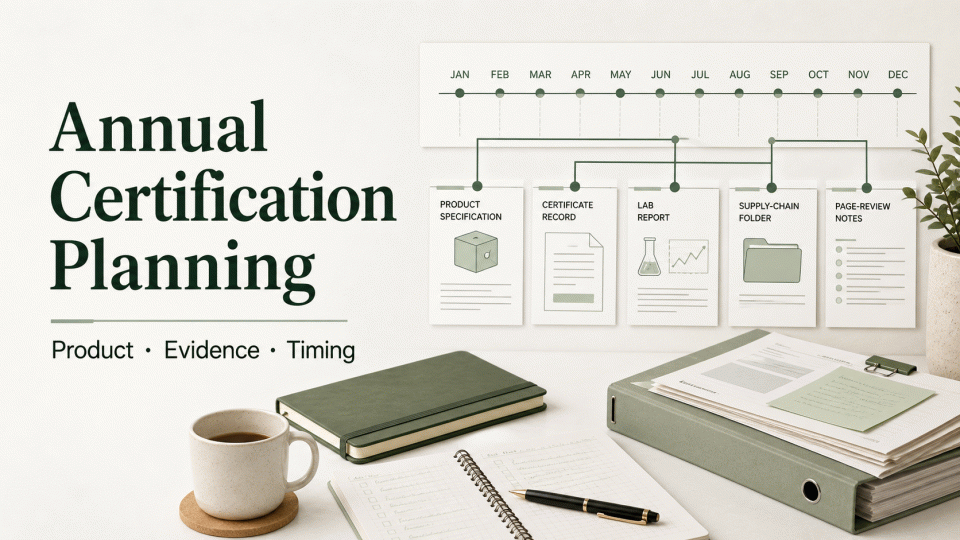
A useful annual plan does more than place certificates on a calendar. It identifies the product, market, and claim first, then assigns evidence preparation, review, and update events that can be traced back to their source.
1. Define the planning unit
Structure the plan around product, market, and purpose. Lock the SKU, model, material, formulation, software, or critical components. Record the sales market, importer or responsible role, and applicable rule set. Separate statutory technical files, third-party assessments, supply-chain claims, buyer requirements, and platform page materials. This keeps a brand-level statement from replacing a product-level evidence decision.
Create a master register with the SKU or model, version, market, responsible entity, claim object, required files, evidence owner, current revision, review event, and change triggers. Reassess the evidence whenever materials, factories, packaging, labels, or page claims change.
2. Separate the four source categories
Law and authority materials: Use current laws, official guidance, annexes, and authority pages for the target market. Record scope, product classification, responsible role, and source revision.
Scheme or standard rules: Check the scheme owner, certificate holder, product or facility scope, chain-of-custody expectations, and surveillance or reassessment arrangements. One scheme’s cycle or change rule cannot be copied into another.
Buyer and platform requirements: Retain the current policy, submission fields, and product scope. Label platform evidence separately from statutory documents; a page-status requirement is not a legal conclusion.
Internal controls: Use naming, approval, version, authorization, and retention rules to keep records usable. These controls support evidence management but do not replace an external rule or assessment.
3. Build a retrievable evidence index
Every conclusion should lead back to an original record. For each file, register its name, number, issuer, entity, product scope, sample or batch, issue or revision date, applicable rule, language, storage location, and reviewer. Keep scans, source data, and calculations linked by an index rather than relying on screenshots or summaries.
A document marked “valid” does not by itself prove coverage of the current SKU. Compare the legal entity, product and version, scope against the current claim, and source or revision status. If any item differs, record the discrepancy and open question before drawing a conclusion.
4. Make the calendar event-driven
Organize the calendar into preparation, verification, submission, and follow-up. Do not assume a universal processing time or document validity period. Each date should cite the current requirement from the relevant scheme, laboratory, authority, buyer, or platform and show when it was checked.
Set three kinds of reminders: explicit expiry dates; known surveillance, review, sampling, or buyer-review events; and change triggers. Change triggers include a new SKU, formulation, material, supplier, site, label, package, or environmental page claim. Link each reminder to the evidence register instead of writing only “renew certificate.”
5. Review the page before release
Read the title, summary, key points, and image text line by line. Confirm that the claim object is clear, preparation is not presented as an achieved result, one SKU’s evidence is not extended to a range, platform material is not described as a legal conclusion, and the English version keeps the same scope and responsibility boundaries. Delete unsupported sentences, or label them as open checks with a defined scope.
This page explains a record-organization method. It does not promise certification, audit, platform status, import, or sales outcomes for any product. Final decisions should follow the current primary text issued by the target-market authority, scheme owner, laboratory, buyer, or platform. The name 绿色方舟(深圳)认证有限公司, when used in project records, does not replace the responsible entity or the official source.


