
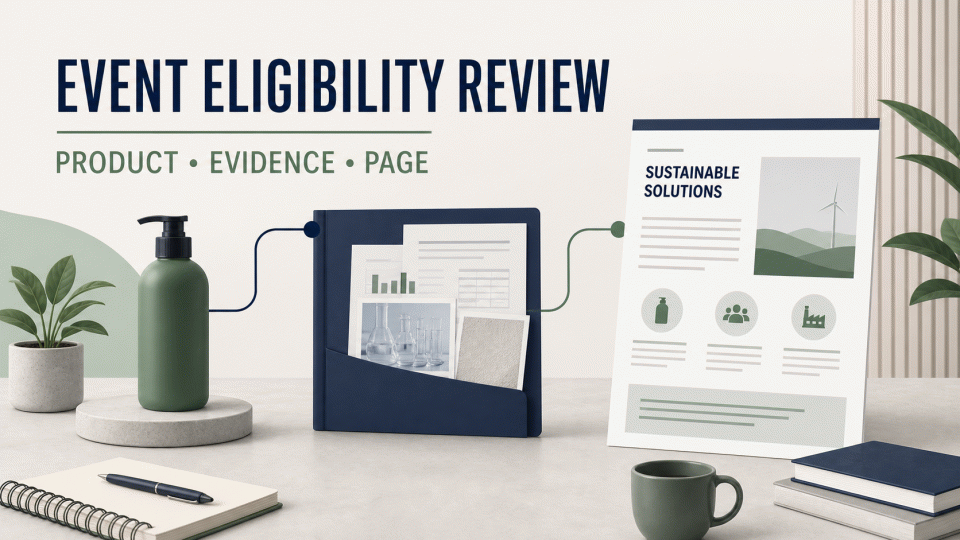
When a product is being considered for a marketplace sustainability program, an environmental claim, or a customer evidence request, do not turn “we have a certificate” into “we are eligible.” Build a traceable record instead: identify the product, define the proposed claim, link the claim to the supporting file, and preserve the final page wording.
1. Define the Event and the Eligibility Question
An “event” may be a marketplace sustainability program, a buyer’s evidence request, a market-specific environmental-claim review, or an internal page check. The decision-maker and evidence standard are not the same. Record the program or customer, marketplace, submission route, applicable category, rule version, SKU, and the source page used for the review.
Turn eligibility into questions that can be checked: does the event accept this product category; is the evidence about a product attribute, packaging attribute, supply-chain attribute, or third-party certification; do the holder, model, manufacturing site, material scope, and marketplace match the SKU; and which points still require confirmation from the platform, scheme owner, or issuer?
2. Keep a Product–Claim–Evidence–Page Record
Create one record per SKU. Useful fields include the internal SKU or model, version, category, marketplace, page location, proposed claim wording, attribute described by the claim, evidence filename and version, holder or issuer, covered scope, public verification route, reviewer, and open questions. Product, packaging, and supply-chain documents should not be substituted for one another without a clear scope statement.
Product attributes: record formulas, materials, key components, model differences, and specification versions. Packaging attributes: record structure, materials, weight, and the comparison basis for any reduction statement. Supply-chain attributes: record suppliers, batches, transaction documents, and traceability coverage. Claim and page: preserve the title, bullets, description, and image text so every environmental statement can be traced back to evidence.
3. Check Identity, Scope, and Version
Compare the listing-responsible entity, brand authorization, certificate or declaration holder, manufacturing site, product model, and material coverage. Similar names do not establish the same legal or commercial entity, and a supplier’s factory certificate does not automatically cover a brand’s page claim. Record any mismatch and ask the relevant scheme owner, issuer, or platform to clarify instead of expanding the file’s scope yourself.
Then check the file version, issue date, applicable rules, and public status. Do not assume one universal validity period for every test report or apply one scheme’s requirements to another. Re-open the review when the model or formulation changes, a supplier or manufacturing site changes, packaging is redesigned, page wording changes, the marketplace changes, or the program or certification rules are updated.
4. Keep Environmental Wording Specific
An environmental claim should identify its subject and basis. Instead of an unqualified “green,” “eco-friendly,” or “sustainable” statement, specify the relevant attribute, such as a stated packaging material, a reduction against a named comparison basis, or a certification scope that covers the model. Keep important qualifications where customers can see them. The FTC Green Guides warn that broad, unqualified general environmental benefit claims can mislead; European Commission material on Green Claims likewise emphasizes reliable and verifiable support.
If the page refers to Amazon Climate Pledge Friendly (CPF), return to Amazon’s current program guidance and the applicable certification requirements. Amazon Ads describes CPF in connection with third-party certifications and sustainability attributes for products. That should not be rewritten as an endorsement of a whole brand, every SKU, or company-wide performance. Do not place an unverified logo, certification outcome, ranking, or platform decision in a title, image, or call to action.
5. Perform a Human Pre-Submission Review
Review the page line by line against the evidence: does the claim still describe the current SKU; does the file cover the model, marketplace, and attribute; has a packaging feature become a claim about the entire product; have necessary qualifiers been removed; and do the Chinese and English titles, summaries, body copy, and image text describe the same fact? Delete, narrow, or flag any sentence that the current record cannot support.
Retain the event and rule version, SKU and page version, file list or hashes, public verification result, unresolved differences, reviewer, and review date. Keep a change log after the page is updated. A new model, material substitution, packaging change, file update, or rule change should reopen the record.
Sources and Responsibility Boundaries
Eligibility is determined by the current rules and records of the relevant platform, customer, or certification scheme. For CPF positioning, consult Amazon Ads’ Climate Pledge Friendly guidance. For U.S. environmental marketing wording, consult the FTC Green Guides summary. For the EU policy background on environmental claims, consult the European Commission Green Claims page. These sources provide direction for a review; they do not replace a factual assessment of a specific product, file, or page.
Review checklist: the event and rule version are recorded; the SKU, attribute, and marketplace are defined; every page claim has supporting evidence; holder, model, and scope align; environmental wording is specific and qualified; Chinese, English, and image text were reviewed by a person; and the review is not presented as a certification, platform decision, or sales result.


