
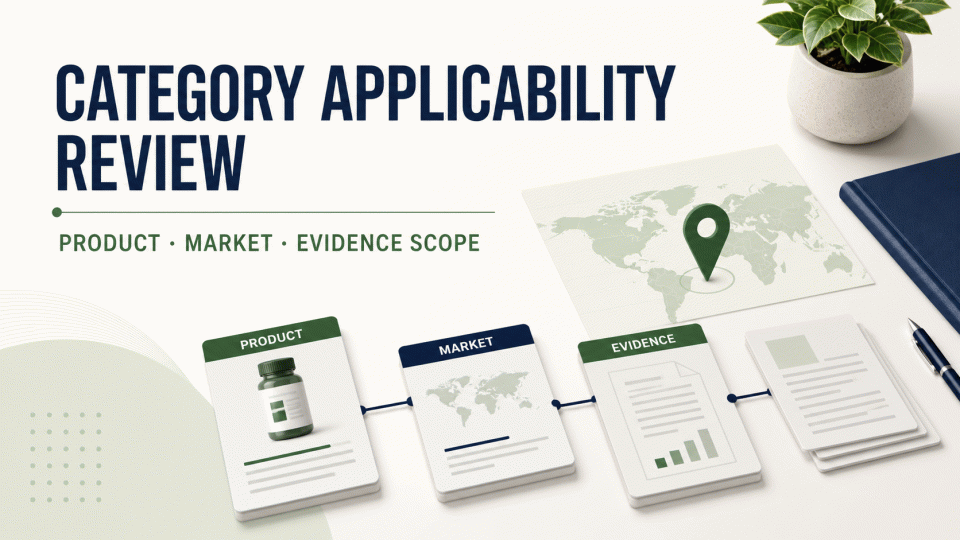
The question is not simply whether a document exists. A defensible applicability review connects a specific SKU or model, target market, commercial role, product attributes, and the rule or program that the evidence is meant to support.
1. Define the smallest applicability unit
Start one record with the SKU or model, intended use, materials or formulation, key parameters, packaging and label version, manufacturing location, target country or region, sales channel, brand owner, importer, and other relevant economic roles. A change to a material, supplier, package, destination, or page version should trigger a fresh scope check.
Do not treat a brand name, factory, or broad product category as the complete scope. Customs classification, product-safety rules, environmental-claim programs, and buyer requirements may use different definitions. The same product may therefore need different records for different markets or roles.
2. Separate the sources of requirements
Mandatory law: Read the target market’s regulation, guidance, annexes, scope provisions, and exclusions. Record the version and effective-date information. The applicability of instruments such as the EU General Product Safety Regulation or the Ecodesign for Sustainable Products Regulation must be checked against the actual product and its relationship with sector-specific law.
Customs and classification: Record the importing country, product description, proposed HS/HTS/CN code, and classification basis. A tariff code is a classification reference; it does not by itself establish product safety, labelling, or environmental compliance.
Platform or program rules: Save the platform help page, program terms, required fields, and account-specific request. Platform evidence requirements are not the same as statutory market-access requirements, and program names or graphics should not be used without authorization.
Buyer or supply-chain requirements: Keep contracts, procurement specifications, audit questionnaires, and supplier declarations as a separate source class. A private requirement can affect a transaction without becoming a government legal conclusion.
3. Build a requirement–evidence–page map
For each requirement, retain at least: an ID, source link, market, SKU or version, responsible role, required evidence, record owner, date or version, scope covered, page location, open question, and change trigger.
Review more than the existence of a PDF. Check the issuing body, report or certificate number, product and model, test or assessment scope, relation to the production version, issue date, limitations, and original-file location. If the file comes from a supplier, document the relationship between the supplier, manufacturer, brand owner, importer, and platform account.
Review page wording sentence by sentence. “Contains recycled material” and “accepted by a named program” are different statements. “For sale in a market” is also different from “all conditions for sale have been met.” Any unsupported term should be removed or recorded as an open question.
4. Test the responsibility chain with a scenario
Suppose a household product with a recycled-material claim is being prepared for an EU market. The product manager locks the SKU, bill of materials, and packaging version. The supplier provides material and transaction records. The brand or importer reviews the claim object and page wording. The market-access owner checks the applicable law and destination requirements. The marketplace operator retains platform fields and submission records. A change to the formulation, supplier, package, or page should trigger reconciliation.
This scenario does not prove that a particular environmental rule applies or that a platform will accept a particular certificate. It demonstrates the sequence: define the object and market, confirm sources and roles, then decide whether the evidence supports the exact page statement.
5. Human review before submission
1. Which SKU, model, material, formulation, and version does the record cover? Does it match the current production and page?
2. Does the conclusion come from a regulation, authority, platform program, buyer requirement, or internal interpretation? Is the source version saved?
3. Who owns the original record, who submits it, and what change triggers a new review?
4. Can every environmental, performance, or program-related phrase on the page be traced to a specific record? Has “under review” been mistaken for “approved”?
绿色方舟(深圳)认证有限公司 recommends using the map as a project working paper, not as an external promise. The actual conclusion still depends on the product, market, contract, and current primary text.
Sources and boundaries
Start with primary pages such as Regulation (EU) 2023/988, Regulation (EU) 2024/1781, Regulation (EU) 2023/1115, and U.S. CBP guidance on HTS classification. These pages support source and scope checking; they do not automatically place the scenario within any one requirement. Platform, buyer, and other national rules should be read from their current official texts.


