
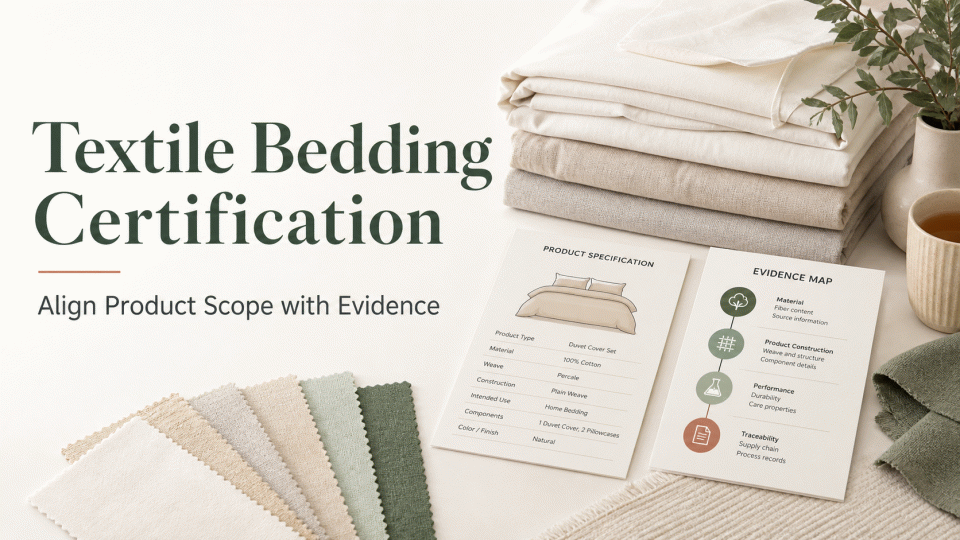
“Certification” is not one universal entry requirement for bedding. Sheets, duvet covers, pillowcases, mattress covers and filling materials can involve different fibres, finishes, chemical-risk questions and markets. OEKO-TEX® STANDARD 100, GOTS and GRS/RCS address different objects. Start with the exact SKU, material composition, processing steps, target market and intended page claims.
1. Lock the product and sales scope
Build an SKU register covering model, size, fibre composition, filling, dyeing, printing or coating, sewing and packaging steps, manufacturer, brand owner and import or sales responsibility. For a bedding set, record the cover, filling, zip and other non-textile components separately. A broad phrase such as “eco-friendly bedding” should not stand in for several different products.
Record the destination countries, sales channels, buyer specifications and the attribute the page is meant to communicate. Keep statutory labelling, private certification schemes, platform fields and buyer questionnaires in separate columns: a buyer request is not automatically a legal obligation, and a certification scheme does not automatically replace market-specific labelling, chemical or product-safety requirements.
2. What common schemes actually address
OEKO-TEX® STANDARD 100: focuses on harmful-substance testing and limit assessments for textiles and components within the standard’s scope. Check the certificate number, product and component coverage, product class, applicant and current status. It is not proof of organic-fibre origin and is not a universal legal-compliance conclusion for every market.
GOTS: sets conditions for certified organic natural-fibre textile supply chains, including relevant processing, manufacturing, packaging, labelling, trading and distribution activities. GOTS Version 8.0 includes home textiles, mattresses and bedding among its product categories, but use of a GOTS reference or label still depends on the certified entity, product details, processing categories, input materials and labelling conditions.
GRS/RCS: serve different recycled-material and chain-of-custody claim contexts. Do not rely on a supplier scan alone. Map recycled content, material source, scope or transaction records, processing stages and the final selling entity, then check the current standard and labelling guidance for the intended claim.
3. Separate legal labelling from certification
In the EU, textile fibre names and fibre-composition labelling are addressed by the Textile Labelling Regulation and the language requirements of the countries where the product is made available. Whether a separate certification is relevant cannot be inferred from the word “bedding”. Check fibre composition, label wording, non-textile parts of animal origin and destination-country requirements independently. Other markets may add chemical, flammability, children’s-product or consumer-information rules, so use the official source for the market concerned.
Environmental wording also needs its own evidence record. “Organic”, “recycled” and “tested for harmful substances” refer to different attributes and supporting documents. Do not turn a scheme name into “zero risk”, “fully compliant” or a guaranteed platform outcome. Check authorization, version and conditions before using any certification mark or logo.
4. Evidence checklist: map every file to an object
Product: specification, fibre composition, filling and component list, colour and finish, label and packaging artwork, sample or product photographs.
Parties: manufacturer, processor, brand owner, importer or seller, certificate holder and authorization relationship. If names, addresses or roles differ, record the difference and its basis instead of assuming the document is transferable.
Certification: certificate or scope certificate, number, standard version, product and processing categories, status, issue or expiry information, and the certification body or scheme’s public verification record.
Supply chain: raw-material and transaction records, processing chain, recycled or organic attribute support, applicable transaction certificates, and the link to the final SKU or batch. A filename, scan or verbal statement cannot by itself establish scope coverage.
5. Four questions before submission
Which SKU, batch or product family does the file cover? What is the relationship between the certificate holder and the page or import-responsible party? Can the scope, standard version and status be checked through the issuer or scheme’s current official channel? Does every environmental or certification statement on the page have supporting evidence and a stated boundary?
Reassess the mapping when the fibre, filling, finish, processor, supplier, packaging or destination market changes. The maintenance goal is not a universal certificate; it is a traceable match between product records, certificate scope, supply-chain files, labels and page language.
绿色方舟(深圳)认证有限公司 can help organize product scope, evidence indexes and page-language boundaries. Applicability remains subject to the current official requirements of the destination market, the certification scheme documents and the actual product records.


