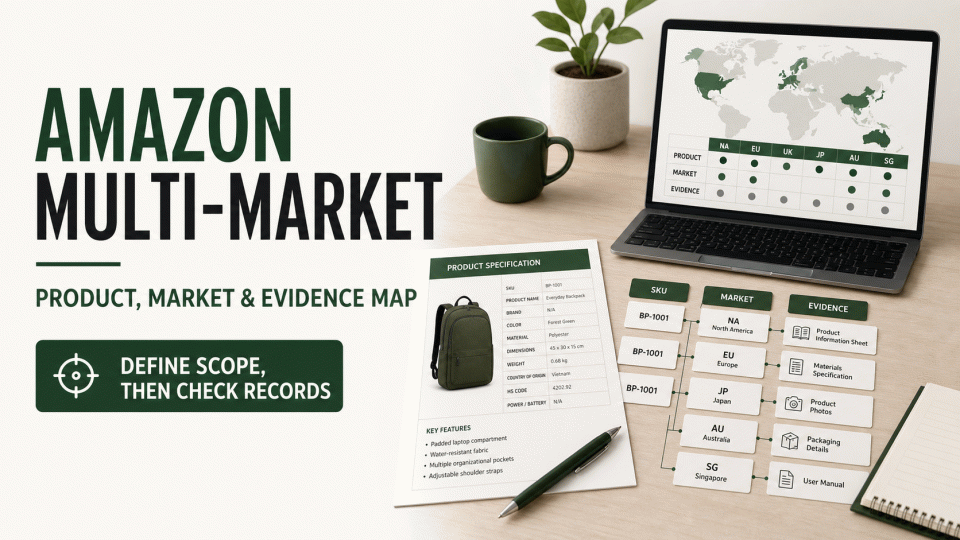
Selling the same product across several Amazon stores does not mean that one document set can be reused without review. Start with the exact SKU, model, materials, and target store, then connect each applicable requirement to its evidence and listing fields. This is a record-organization framework, not legal advice and not an Amazon review decision.
1. Define three separate scopes
Product scope: record the SKU, model, version, materials or formulation, dimensions, colour, critical components, packaging, and manual version. Similar-looking products should not be merged by brand or range name when their materials, functions, or warnings differ.
Market scope: record the destination country or region, Amazon store, selling entity, importer or responsible role, fulfilment route, and required language and labelling. Platform requirements, import requirements, and private customer standards come from different sources and should not be treated as one obligation.
Evidence scope: break each requirement into checkable fields such as product identity, manufacturer details, materials, test items, warnings, packaging information, and supply-chain records. Assign a document, version, and owner to each field.
2. Separate reusable records from records requiring a new check
| Record type | Reuse may be considered when | Recheck |
|---|---|---|
| Specifications, BOM, drawings | SKU, version, and critical parameters are identical | Local language, units, labels, and warnings |
| Test or assessment reports | Sample, model, entity, scope, and method match | Local law, standard version, lab status, and submission format |
| Packaging and listing assets | Product, attributes, and version have not changed | Store language, mandatory information, environmental wording, and fields |
| Supply-chain records | Same batch, source, and claim boundary | Destination, transaction chain, importer role, and market-specific records |
“Reusable” means a record can be a starting point; it does not mean that the target store will automatically accept it. A supplier document should not be treated as proof for the selling entity or importer without checking the entity relationship, authorization chain, and scope.
3. Build a requirement–evidence–listing map
For each SKU, keep at least: source of requirement, market, SKU/version, responsible role, required field, evidence filename and version, listing field, reviewer, review date, change trigger, and notes. The model, materials, dimensions, warnings, and environmental wording on a listing should trace back to the same product version and evidence record.
For the platform side, use the current Product Compliance Requests workflow, category help pages, and submission screen in Seller Central. Amazon’s public guidance says that, where Amazon requests product compliance documents, sellers must submit them through the relevant process and may be asked for further information. That describes a platform process; it is not a conclusion that a particular SKU has been approved.
For market law, return to the applicable authority, regulation, and standard for the destination market. Do not infer identical obligations from a shared language, brand, or fulfilment route.
4. Recheck when the product or route changes
Trigger a review when the model, material, formulation, critical component, factory, supplier, packaging, or manual changes; when a store is added or the import/fulfilment role changes; when a test method, standard version, platform field, or market rule changes; or when the listing adds or changes safety, performance, environmental, or certification-related wording.
Keep a change record showing affected SKUs, evidence, and listing fields. The owner can then decide whether to add records, perform a new assessment, or pause the wording. “File uploaded” and “listing saved” should not be rewritten as “compliant” or “guaranteed to pass review.”
5. Six human checks before submission
1) Does the SKU, model, and sample match? 2) Are the selling entity, manufacturer, and importer role clear? 3) Are the store language, labels, and warnings appropriate? 4) Do the report, declaration, specification, and photos belong to one version? 5) Does each safety, performance, or environmental statement have supporting evidence? 6) Are platform workflow, market law, and customer standards recorded separately?
Sources and scope of verification
Platform-process reference: Amazon Seller Central Product compliance documentation. Regulations, standards, and authority requirements must be checked separately for the specific product and destination market; this article provides a record structure, not a product-specific legal conclusion.