Cradle to Cradle Certified is a voluntary, third-party environmental label for products and materials. It is not a general market-entry approval or a substitute for a destination market’s mandatory rules. Before using it in a listing or product page, match the certified product, model, materials, manufacturing site, certification level, and standard version to the exact SKU.
This reference is based on public standards and registry information from the Cradle to Cradle Products Innovation Institute. The applicable requirements, certification level, and current status must be checked against the relevant official documents, assessor records, and certificate.
1. Define the certified object first
Build a product-scope register covering the applicant, product name, SKU or model, materials and components, manufacturing site, certification name and version, certificate number, achievement level, and status. A finished product, a material, packaging, and an organization-wide management system are different objects; a shared brand or supplier does not make their evidence interchangeable.
When a page describes a material or circular-design feature, keep the wording within the scope actually covered by the certificate or official registry. Recheck the page copy, images, and mark usage when the certificate status, product range, version, formula, or manufacturing site changes.
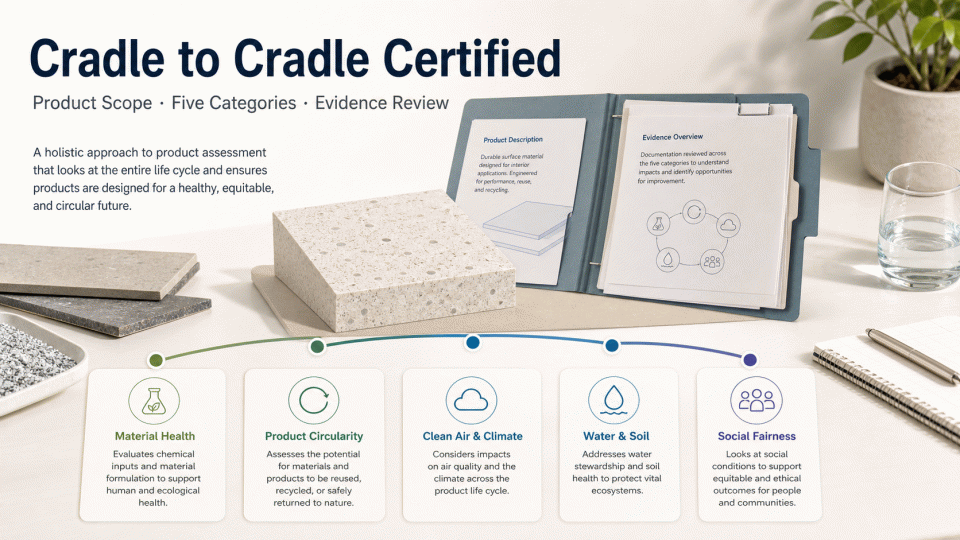
2. Understand the five assessment categories
Material Health: Review material and chemical information, restricted-substance requirements, and the assessed material scope. The BOM, formula, material declarations, and supplier-change records should resolve to the product under review.
Product Circularity: Review technical or biological cycles, material compatibility, disassembly, and information needed for the next cycle. Do not turn a supported circularity statement into an unsupported claim that every product is recyclable.
Clean Air & Climate Protection: Review relevant manufacturing activities, energy and emissions data, strategies, and transparency requirements. One carbon figure does not represent the whole category.
Water & Soil Stewardship: Review relevant sites, water use, effluent information, and local environmental issues. A change in site or process may change the evidence scope.
Social Fairness: Review applicable risk assessments, human-rights policies, management practices, and site or supply-chain records. This category is not simply interchangeable with a generic social-audit document.
Full-scope certification and a certification limited to one category require different page wording. State the certification name, version, level, and product scope accurately. Without matching evidence, avoid expanding the claim to “fully circular,” “zero impact,” or “full life-cycle” performance.
3. Organize the evidence file
Product and materials: Specifications, BOM or formula, material and component lists, product-versus-packaging scope, model versions, suppliers, and manufacturing sites.
Assessment and certificate: Applicant, assessment body, certificate number, standard version, achievement level, covered-product list, status, and official registry record.
Category evidence: Chemical information, circularity and disassembly records, energy and emissions data, water and soil records, and social-fairness policies and risk records, indexed to products and sites.
Page copy and marks: Map each product claim to a certificate, registry entry, or other checkable file, and follow the official mark guidance. If the product, material, formula, factory, or supplier changes, assess the impact before carrying forward the old wording.
4. Four questions before publishing
1. Do the holder, product, model, materials, and manufacturing site on the certificate match the current SKU?
2. Does the page describe full-scope certification or one category, and are the level, version, and status correct?
3. Can every environmental or circularity statement be traced to a file, rather than inferred from broad words such as “green,” “safe,” or “sustainable”?
4. Do the copy, images, and marks stay within the official scope without implying mandatory compliance, market access, or a certification decision?
Keep the standard version, certificate status, product changes, and page-review record in one index for later checks. This article is a documentation reference and does not replace a formal assessment or an independent review of destination-market requirements.
Reference basis: Cradle to Cradle Products Innovation Institute, the Cradle to Cradle Certified Product Standard, official resources, and public product registry pages. Accessed 28 August 2026.