Who this is for: Brand owners, manufacturers, importers, traders and supply-chain record owners involved in relevant products placed on the EU market or exported from the EU. EUDR scope must be checked against the product descriptions and CN/HS classifications in Annex I; a label such as “wood product” or “sustainable product” is not enough.
Scope note: This is a record-keeping reference, not a conclusion that a product is in scope, compliant or eligible for market access. The result depends on the product, transaction role, production-country law and current official text. Greenark (Shenzhen) Certification Co., Ltd. does not replace legal, customs or regulator advice with this page.
1. Confirm Annex I scope first
Regulation (EU) 2023/1115 covers specified commodities associated with deforestation and forest degradation and the relevant products listed in Annex I. The commodity groups include cattle, cocoa, coffee, oil palm, rubber, soya and wood, but not every product made from one of these materials is automatically covered. Build a mapping from finished product to material, CN/HS code, Annex I entry and transaction action, and retain the classification rationale.
- Product name, model, materials, quantity and unit of measure;
- the action involved: placing on the EU market, exporting, or making available in the chain;
- the relevant Annex I entry and CN/HS code, with customs or classification support where needed;
- if out of scope, the documented reason, so general ESG material is not mistaken for an EUDR filing.
2. Assign roles and responsibilities
Operators, downstream operators and traders have different obligations. The role depends on the transaction, the position in the chain, the enterprise category and the applicable provisions; a contract label such as “supplier,” “brand” or “forwarder” does not decide it. For each product flow, record who places or exports the product, who submits a due diligence statement or applicable simplified declaration, who retains and passes on reference information, and who performs the internal review.
A downstream business may rely on upstream reference information where the rules allow it, but a supplier’s statement that a product is “compliant” is not a complete evidence set. Check that the reference number, product scope, quantity, geolocation and transaction chain match the current SKU and retain the check.
3. Treat plots and production data as core records
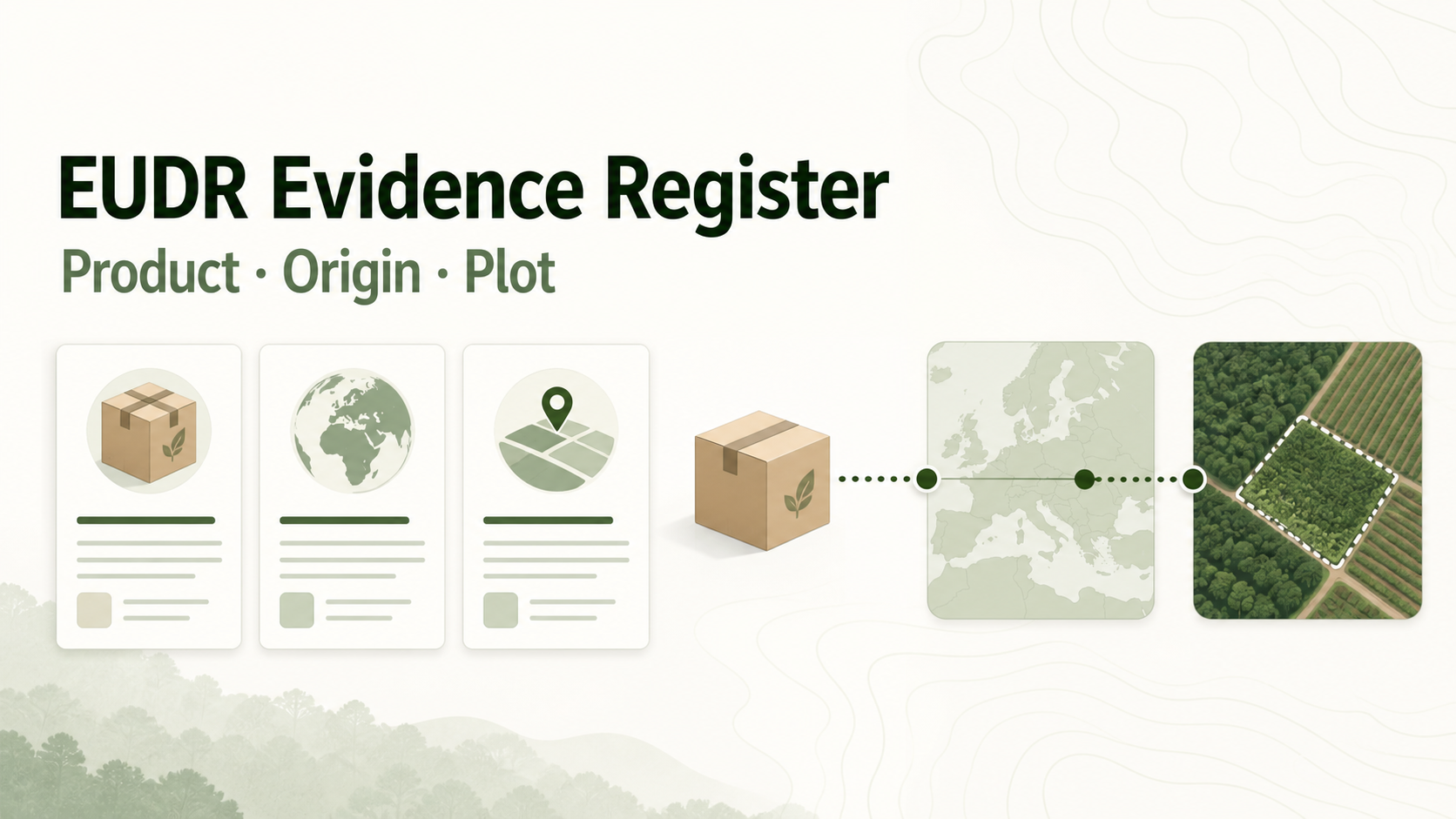
The file should lead back to where the relevant commodity was produced: country of production, relevant sub-national information, all relevant plot geolocations, the production date or time range, and the link to product and quantity. The Commission’s system guidance describes geolocation through latitude and longitude with at least six decimal digits; polygons are generally required for plots over 4 hectares, while cattle has a different establishment-coordinate rule. A factory address, supplier office or port is not a substitute for production geolocation.
Use a stable link such as “raw-material lot—supplier—plot or establishment—production period—finished SKU—purchase or sales lot.” Multiple plots, lots or mixed materials should not be collapsed into one vague statement.
4. Build the evidence register around due diligence
- Gather information: Product and quantity, country of production, geolocation, suppliers and downstream parties, relevant commodity/product details, and information supporting deforestation-free status and compliance with relevant production-country law.
- Assess risk: Record the reliability of sources, supply-chain complexity, mixing or circumvention risks, country circumstances and inconsistencies between plot data and product records under the Article 10 factors. A certificate may be supporting material; it is not an automatic conclusion.
- Mitigate risk: If risk is not negligible, document additional files, supplier clarification, desktop or on-site checks, geospatial review and the decision. Do not turn “pending” information into a low-risk finding.
5. Control declarations and versions
Where required, submit the due diligence statement or applicable simplified declaration through the EU Commission’s EUDR Information System according to the current official requirements. Keep a pre-submission snapshot, reference number, product/SKU scope, linked geospatial files, evidence index, reviewer and review date. A change in supplier, formulation, plot, quantity or product code should trigger a new comparison instead of silently reusing an old file.
Website or sales copy may say that a plot and supply-chain evidence register is being prepared. It should not say “EUDR certified,” “customs clearance guaranteed,” “regulatory approval guaranteed,” or “all products are compliant.” EUDR is not a universal certification label that replaces the evidence required for a particular product flow.
6. Pre-delivery checklist
- Do the product, commodity, Annex I entry and CN/HS classification match?
- Are the transaction role, market/export action and declaration responsibility documented?
- Can production country, plot/establishment geolocation, production period, material lot and finished SKU be traced together?
- Do party details, quantity units, reference numbers and document versions agree?
- Do risk assessment and additional checks retain reasons, evidence and open items rather than only a pass/fail label?
- Does the page distinguish evidence preparation from a regulatory conclusion?
Sources and update note
Primary references: Regulation (EU) 2023/1115 on EUR-Lex, European Commission: Understand due diligence, and the EUDR Information System FAQ. The Regulation, Annexes, implementation material and system requirements can change; check the latest official version before acting.