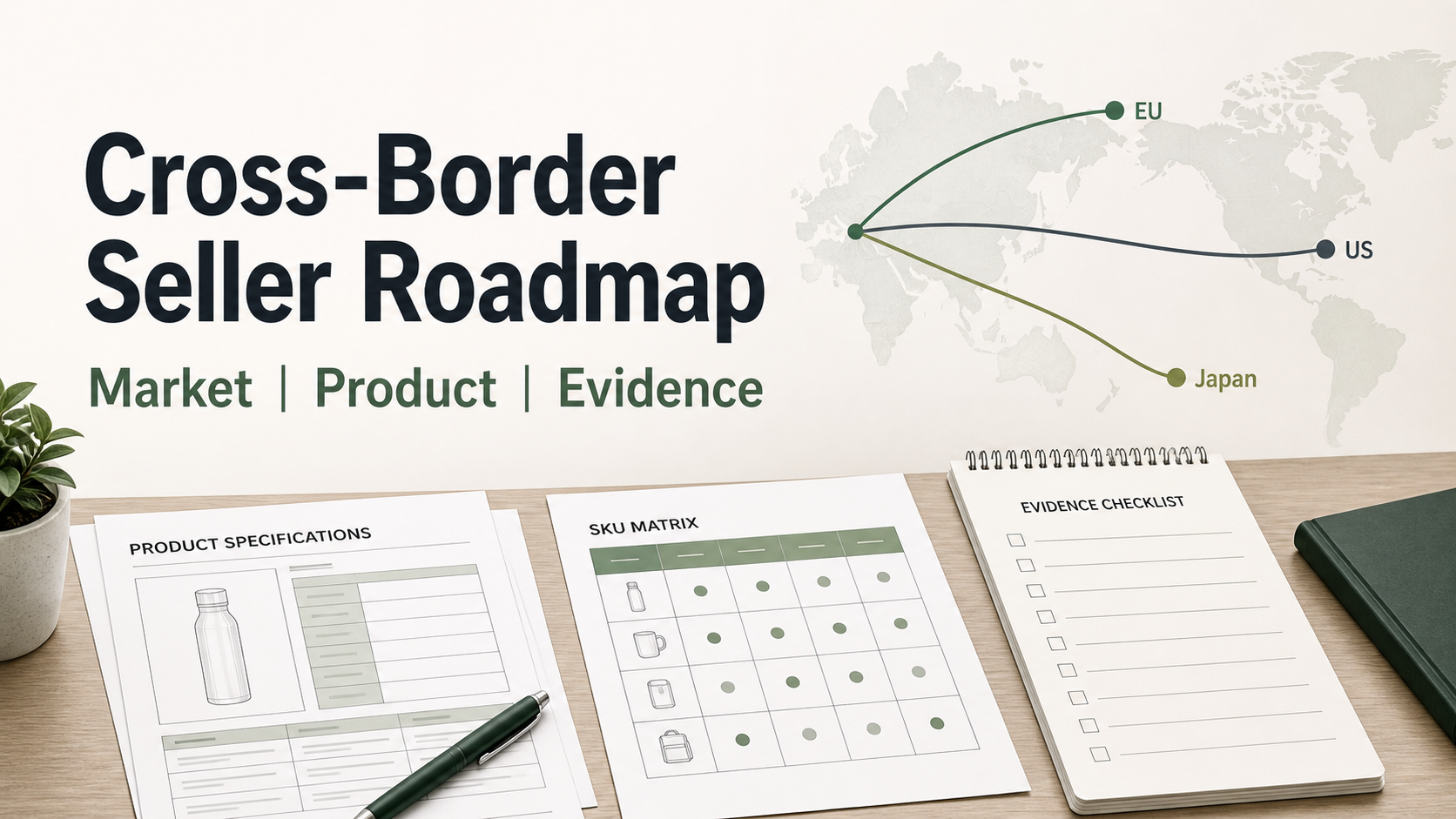
There is no single certification checklist that fits every country and product. A more reliable starting point is to define the target market, product configuration, business roles, and intended page claims, then connect each requirement to a document that can be checked. This page offers an evidence-mapping method; it does not state that any SKU is compliant or guaranteed to qualify for a marketplace programme.
1. Build three working maps before choosing a route
Product map: record the brand, model, variants, functions, materials, power source, wireless functions, food- or skin-contact parts, packaging, and instructions. A change in model, formulation, or supplier can change the relevant review scope.
Market map: split the analysis by destination. The EU, United States, Japan, and other markets have different regulators, product scopes, marking systems, labels, and records. A requirement in one market is not automatically a substitute for a requirement in another.
Role map: identify the actual manufacturer, importer, authorised representative, distributor, fulfilment provider, and marketplace roles for each product and market. A role follows how the product is placed on the market, who sells it under whose name, and who controls the relevant information—not a revenue band or the number of certificates held.
2. Replace a “certificate list” with a requirement–evidence–page map
| Review object | Evidence question | Page boundary |
|---|---|---|
| Product safety and technical requirements | Do the model, revision, test conditions, and report subject match? | Name only the model, market, and file actually reviewed; do not call one report a global approval. |
| Manufacturer, importer, or responsible person | Are names, addresses, mandates, and product links recorded? | Keep online information aligned with the product, packaging, instructions, and technical file. |
| Materials, formula, and supply-chain records | Can supplier, batch, formula revision, and change history be traced? | A supplier statement or one certificate cannot cover products outside its documented scope. |
| Listing and marketplace materials | Do title, bullets, images, labels, and uploaded files use the same product facts? | Use process language such as “records prepared for review”; avoid outcome promises. |
3. Three product situations and how to scope them
Powered or wireless products: define destination, radio functions, power architecture, and intended use, then review the applicable safety, EMC, radio, and chemical requirements separately. The FCC equipment-authorization framework includes Certification and Supplier’s Declaration of Conformity; the correct path depends on the device and applicable rules. FCC, CE, and other marks are not interchangeable global certificates.
Textiles and soft goods: map fibre content, components, dyes or finishes, supplier batches, and label revisions. U.S. FTC textile rules address matters such as fibre content, responsible business identity, and country of origin. Those labelling duties are distinct from voluntary textile programmes and cannot be replaced by naming a certification.
Cosmetics and personal care: split the review by destination, product definition, responsible entity, formula, and safety file. In the EU, cosmetics involve a responsible person, a Product Information File, and CPNP notification among other requirements. The United States and Canada use their own product, facility, and ingredient frameworks. A notification, filing, or test record in one market is not a global approval.
4. A minimum EU online-sales check
For consumer products within scope, the EU General Product Safety Regulation applies to online and other distance sales. An online offer generally needs manufacturer information; where the manufacturer is outside the EU, check the EU responsible person’s name and postal and electronic address, product-identification information, and applicable warnings or safety information. The exact package depends on the product and other applicable Union harmonisation legislation.
For that reason, keep a record of the destination and channel, product identifiers, economic-operator roles, risk and technical documents, warning language, listing snapshots, revision history, and change triggers. An EU responsible-person record is not automatically created by purchasing a certificate.
5. Turn the roadmap into a review sequence
- Freeze the review scope: models, variants, formulas, materials, manufacturing locations, and target markets.
- Create a regulatory and marketplace index with source, version date, scope, and open questions.
- Collect the evidence: test reports, technical files, declarations, label artwork, supplier and batch records, and responsible-person information.
- Link every page claim to its evidence and scope. Mark uncertain items for review instead of using “guaranteed,” “100%,” or “will pass.”
- Reassess when the model, material, formula, supplier, market, or material page wording changes.
6. Official sources and scope note
Start with the European Commission’s Product safety page and EUR-Lex Regulation (EU) 2023/988. For U.S. radio products, consult the FCC’s equipment-authorization guidance; for textile labels, consult the FTC’s Textile Act rules. For cosmetics, use the current authority and product-specific rules in each destination.
This is an evidence-organisation framework, not legal advice, a certification conclusion, or a promise of a marketplace outcome. 绿色方舟(深圳)认证有限公司 can help organise product, market, role, and evidence fields, while the final scope must be determined from the specific product records, destination, and current rules.