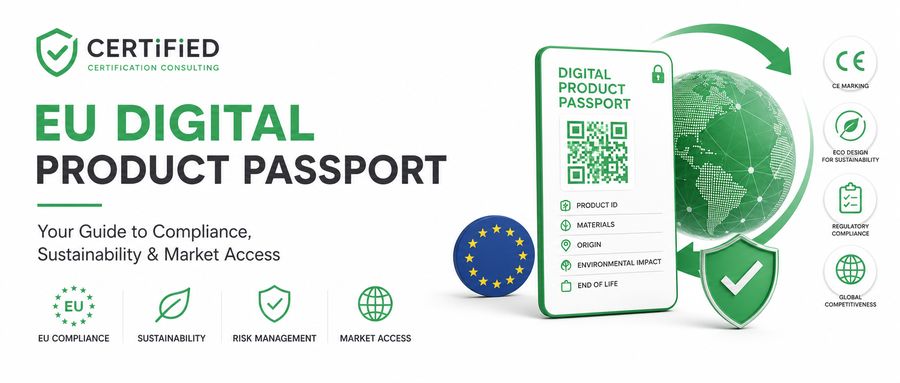
The DPP (Digital Product Passport) is not a PDF certificate — it is a full-lifecycle data identifier bound to a product, covering raw-material sourcing, production, distribution, repair and recycling. The first wave goes live in February 2026, so every EU-bound SKU must be mapped to its phase right now.
1. Four implementation phases mapped to your SKUs
| Phase | Effective | Categories | Avg. prep time | Phase 1 | Feb 2026 | Apparel / footwear / consumer electronics (phone / laptop / tablet) | 3–6 months | Phase 2 | Feb 2027 | Furniture / batteries (household & industrial) / packaging | 6–9 months | Phase 3 | Feb 2028 | Steel, aluminium, cement, chemical intermediates | 9–12 months | Phase 4 | 2029–2030 | Food & beverage, agri-inputs, medical devices | 12–18 months |
|---|
2. Five mandatory disclosure categories
The DPP data model is the same for every phase. Sellers must load all five families below and generate a unique QR per SKU:
Identity: SKU code, product name, brand/manufacturer, market entry date
Composition: BOM material %, restricted-substance screening, recycled-content proof
Environmental: Product Carbon Footprint (PCF), water footprint, LCA report
Social: supply-chain due diligence (multi-tier, labour & child-labour risk screening)
Circularity: repair guide, disassembly instructions, end-of-life recycling, life expectancy
3. Three top mistakes sellers make
Poland, Czechia, Romania, Spain and others require local-language fields; English-only QR files are stopped at customs.
Mistake 2: one DPP shared across variants
Even same-family SKUs need separate files if their BOM differs by 2+ components (colourways alone do not, but a different sole or PCB does).
Mistake 3: only tier-1 supplier records
Textiles demand fibre-level traceability; electronics require key-component-level traceability; typically 3+ tiers of suppliers.
4. Data carrier choice: QR vs RFID / NFC
No carrier is mandated, but field practice is: QR code for items ≤€50 (textiles, shoes, accessories) and RFID / NFC for items ≥€500 (appliances, furniture, industrial components).
Three actions to take this week:
1️⃣ Pull BOMs for all EU SKUs, break them to component level and tag each with its DPP phase.
2️⃣ Audit tier-1 suppliers — confirm current REACH SVHC screening records exist.
3️⃣ Run a pilot DPP on one SKU end-to-end: data entry → QR → customs-check workflow.