The short judgment
ISO 25500-110 is worth watching, but the current ISO page does not support the claim that every business must immediately obtain a new certificate or replace its existing certificates.
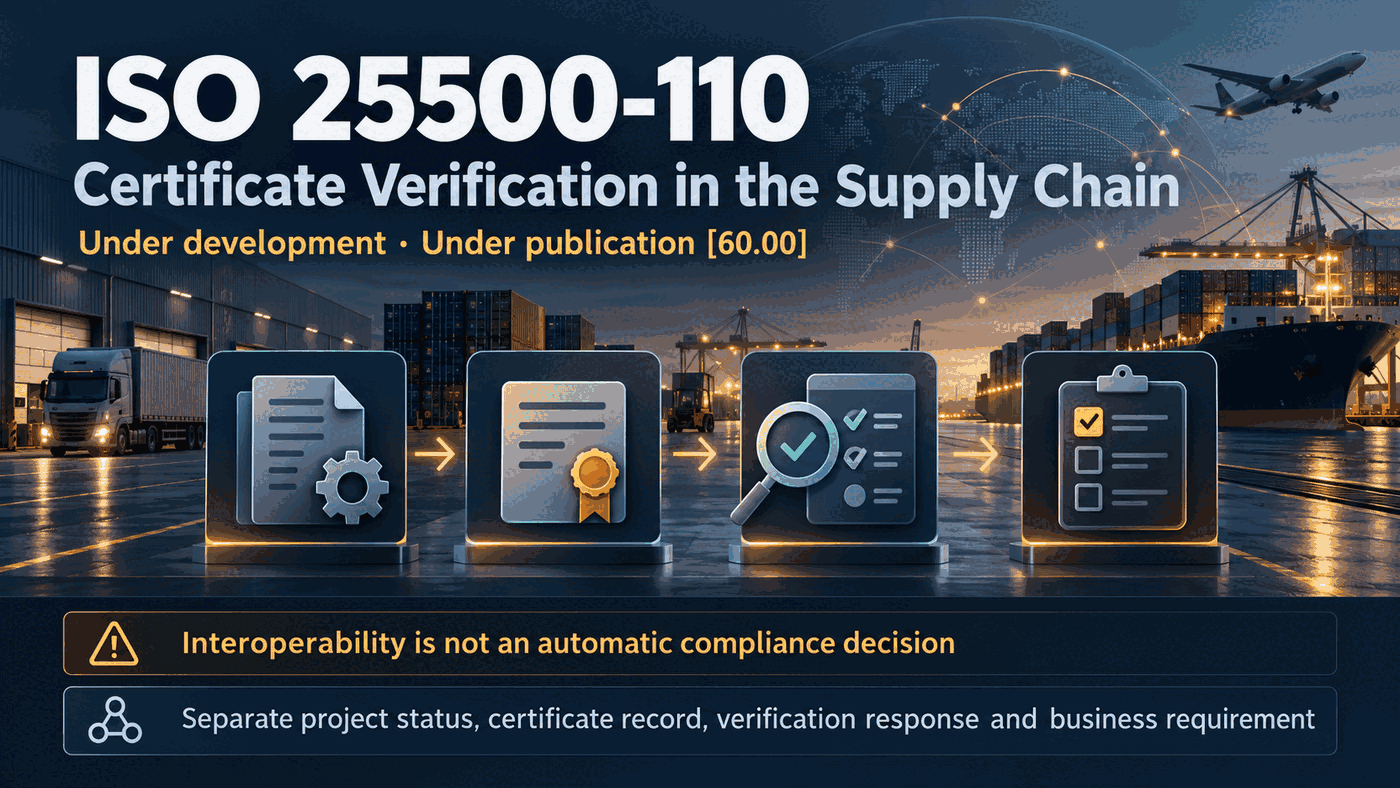
The ISO standard page identifies the project as “Supply chain interoperability and integration — Part 110: Verification of certificates in the supply chain.” It currently shows the 2026-11 edition, the status Under development, and the stage International Standard under publication [60.00].
The page summary describes verification requests and responses for certificates carrying identifiers in an ISO 8000-115-conforming format. It refers to certificate-related terminology and verification data sets, request and response syntax, replies between the requesting party and the identifier-issuing entity, and an application interface protocol for certificate-identifier data. The summary also states that the method used by the issuing entity to resolve or interpret a certificate identifier is outside the document’s scope.
The practical meaning is therefore narrower and more useful: the project is about how certificate-verification information can be requested, exchanged and connected across supply-chain systems. It is not, by itself, a verification result for a particular certificate, a universal certification requirement, a product-compliance finding or a market-access permit.
Three layers that should not be conflated
1. The standard project
The standard project defines a subject area for supply-chain interoperability and integration. Its public summary discusses verification requests, responses, data sets, syntax and an application interface protocol.
Its current status matters. Under development and International Standard under publication [60.00] are not the same as “a final standard is already mandatory for every company.” The page shows that the project has entered the publication process, but the page alone does not establish a universal implementation deadline.
The ISO page also says that the final production steps may take up to seven weeks. That is a publication-process indication. It should not be converted into a guaranteed publication date or a company compliance deadline.
2. The certificate record
A supplier may present a certificate issued by a certification or other issuing entity. The certificate still has to be read as a specific record: who is the holder, what scope does it cover, when is it valid, and which entity issued it?
A certificate identifier can help locate the record, but the existence of an identifier does not prove that the certificate covers a particular factory, product, batch, SKU or transaction. Nor does it automatically prove compliance with every applicable law, platform rule or customer condition.
3. The verification result
A verification request may receive a response through an official channel. That response is evidence of a particular verification interaction. It is not automatically a conclusion that the certificate is genuine in every business sense, that its scope covers the intended goods, or that the goods have market access.
This distinction is reinforced by the ISO summary’s explicit boundary: the way the issuing entity resolves the certificate identifier is outside the document’s scope. An interface protocol cannot, by itself, replace the issuer’s certificate records or the business judgment about scope and applicability.
What the public ISO page supports today
The page supports the following statements:
· the project’s title concerns verification of certificates in the supply chain;
· the page currently shows the 2026-11 edition;
· the status is Under development;
· the current stage is International Standard under publication [60.00];
· the summary covers verification requests and responses for certificates with ISO 8000-115-conforming format identifiers;
· the summary covers verification data sets, request and response syntax, replies between the requester and the identifier-issuing entity, and an application interface protocol for identifier data;
· the method used by the issuing entity to resolve or interpret certificate identifiers is outside the document’s scope.
The lifecycle shown on the page records the move into the publication stage on 10 October 2026, following earlier voting and proof-related steps. These are project lifecycle events, not the effective date of a law, customer requirement or market rule.
The public page does not, in this review, establish the complete standard text, a final publication date, a universal implementation method, or a specific industry or platform requirement. Those points remain open and require separate confirmation.
Why a certificate interface is not an automatic compliance decision
In a real supply chain, the hard question is often not whether a supplier can provide a number. It is whether the number, the holder, the scope and the business object actually match.
Suppose a supplier provides a certificate identifier. A buyer may still need to check whether the holder is the contracting entity, whether the scope covers the relevant site or product, whether the validity period covers the delivery, and whether the issuing entity provides an official verification route.
An interoperable request and response can make that chain easier to record and connect. It does not create the missing facts. It does not automatically expand an organisational certificate into product coverage. It does not turn a successful response into proof that all regulatory, customer or marketplace conditions have been met.
For that reason, the responsible conclusion should be written in layers: the standard project may define a way to exchange verification information; the issuing entity must still identify and resolve the certificate; and the buyer must still decide whether the verified scope answers the actual business question.
What businesses can prepare without overstating the standard
Companies can improve their certificate records before deciding whether any system change is required.
A practical internal record may include the certificate identifier or number, issuing entity, certificate holder, scope, validity period, official verification route and verification date. This is a traceability recommendation, not a complete mandatory field list published by the ISO page.
The record should also state what business decision it supports: supplier onboarding, site-scope review, product documentation, or a customer-contract condition. If the certificate covers only a defined organisation or scope, the record should not silently turn it into coverage of every product or SKU.
For supplier-provided screenshots or copied text, the safer evidence path is to return to the issuing entity or its official verification channel and record the date and response. That makes later review possible when a certificate expires, the holder changes name, the scope changes or a customer asks what was checked.
A four-step review sequence
First, record the project status. Capture the title, edition, current status and publication stage. Do not describe a project under development as a final universal obligation.
Second, define the verification object. Decide whether the question concerns the identifier, the holder, the scope, the validity period, or the relationship between a certificate and a particular product or site.
Third, confirm the official verification source. Check the issuing entity, the verification route, the returned information and the verification date. An unlocatable supplier screenshot should not be the only evidence.
Fourth, map the result to the actual requirement. Compare the verified certificate record with the relevant contract, product rule, marketplace requirement or procurement condition. Do not treat one certificate response as proof that every other requirement is satisfied.
Conclusion
ISO 25500-110 currently signals an effort to make supply-chain certificate verification more interoperable: requests, responses, data sets, syntax and application interfaces are being addressed at the standard-project level.
The same official page also imposes important limits on what can be claimed. The project remains under development and under publication. The public summary does not provide the complete implementation details, and it explicitly excludes the method used by the issuing entity to resolve certificate identifiers.
The prudent next step is therefore not to announce “automatic certification” or order a universal certificate replacement. It is to separate the project status, the specific certificate, the issuer’s official verification response and the business requirement. Any system or certificate-policy change should follow from a confirmed contract, regulatory, industry or platform need.
Source: ISO 25500-110 official standard page, accessed 2 November 2026.