The short answer
TikTok Shop’s current US pesticide documentation entry should not be described as a requirement to obtain a single EPA clearance document. The practical question is more specific: does the product fall within the pesticide boundary because of its intended use or its label and advertising claims; what is the seller’s role; and can the applicable EPA numbers, label, product images, packaging images, invoices or electrical-product documents be matched to the exact SKU?
This article accessed the official US Pesticides Requirements and Policy Pulse (September 2026) pages on 27 October 2026. Policy Pulse includes the EPA documentation entry among its policy summaries. The access date is not a policy publication date. These pages describe the current visible platform documentation route and its relationship to EPA/FIFRA; they do not promise qualification, approval, listing or sales.
1. Start with scope: why the product may be treated as a pesticide
The US EPA does not determine pesticide status from the product name alone. EPA says that a product’s intent can be assessed through its label and advertising claims, composition, use, and mode of action as distributed or sold.
The TikTok Shop page describes products that may be treated as pesticides or related products as including substances intended to prevent, destroy, repel, or mitigate a pest; products functioning as plant regulators, defoliants, or desiccants; and nitrogen stabilizers. It also warns that indirect claims, such as “removes mold” or “prevents infestation,” may bring a product into the relevant EPA review boundary.
That makes the listing language part of the evidence. A product does not leave the boundary merely because the seller places it in a home-supplies category or avoids the word “pesticide.” Titles, images, packaging, product-detail copy, advertising, composition, use, and mode of action should be reviewed together. A final classification still depends on the specific product facts; a single keyword is not enough.
2. Registration Number and Establishment Number identify different things
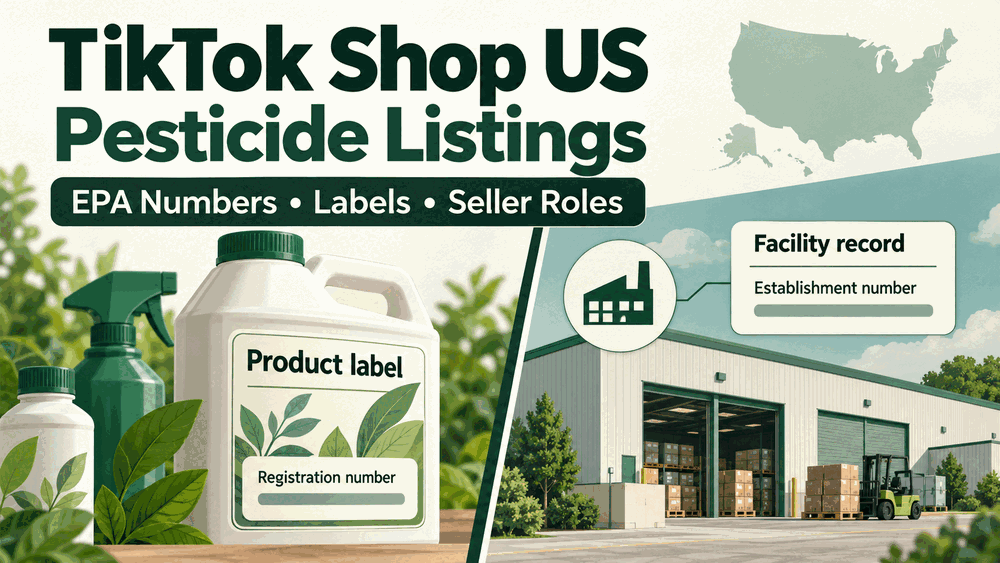
EPA Registration Number: the product-level identity
For conventional pesticides, the TikTok Shop page states that the product must be registered at the EPA product level and identifies the EPA Registration Number as the relevant product identifier. The number needs to match the actual product and its label. It cannot be replaced with a number for another formulation, another product made at the same facility, or a vague supplier reference to an “EPA number.”
EPA Establishment Number: the production-facility identity
The same page states that conventional pesticides must be produced in an EPA-registered facility. For pesticide devices, it specifies production in an EPA-registered facility and an applicable EPA Establishment Number. The establishment number therefore addresses the facility, not the product’s registration status.
This distinction also prevents an overstatement in the other direction. The platform page does not say that every pesticide device must have a product-level Registration Number. The correct path is to identify the product type first and then submit the number or numbers that the platform and the applicable product rules require.
EPA’s Chapter 13 makes the classification more concrete. A regulated device using physical or mechanical pest-control means generally does not require product registration under FIFRA section 3, while establishment and labeling requirements still apply. An article incorporating a pesticidal substance, or sold with a precursor for creating one, may instead be a pesticide product as a whole. Limited device exclusions also exist, including certain tools whose effectiveness depends more on the operator and certain vertebrate traps. Being electrical is not the classification test.
A treated article follows a separate exemption analysis: the treatment must protect the article itself and the pesticide must be registered for that use, among other conditions. Claims to protect users or public health cannot simply borrow that exemption. Treated articles and minimum-risk products are different branches, not interchangeable names for anything lacking a registration number.
For production subject to establishment requirements, foreign facilities are covered too. Production includes packaging, repackaging, labeling and relabeling. Establishment registration is an administrative process, not product approval or an EPA safety or efficacy endorsement. EPA requires an initial report within 30 days after notification of the establishment number and annual reports by March 1, including zero-production or zero-distribution years. Foreign establishments report quantities produced for import into the United States. A facility number alone does not establish that these continuing obligations or product requirements have been met.
3. The seller role changes the evidence path
Manufacturers and importers
For manufacturers and importers of pesticides or other products requiring an EPA label, TikTok Shop may request the applicable EPA Registration Number and/or Establishment Number, along with clear, unaltered images of the product and its packaging. The images should show the applicable numbers, active ingredients listed on the label, and the child-safety statement “Keep Out of Reach of Children.”
For electrical products, the page also mentions product electrical-safety marking and, where the product includes Bluetooth or Wi-Fi functions, FCC safety marking. That is an electrical-product condition in the platform guidance; it should not be expanded into a universal requirement for every pesticide listing.
Certification of Compliance or Conformity for electrical products
The platform separately lists a Certification of Compliance or Conformity (COC) for electrical products. A COC that may be requested must be issued within the last two years, match the intended category, describe the tested product and detailed specifications, and include the accredited laboratory’s name and address. The report must match the submitted photos. The platform also uses the wording “Tested to US EPA standards.” That is attributed to this platform requirement; it should not be recast as an EPA test standard applying uniformly to every electrical product. The applicable standards and report must be checked for the particular item.
This is a document for the electrical-product scenario described by the page. It is not a universal EPA certificate for all pesticides.
Resellers
For resellers of products requiring an EPA label, TikTok Shop may request a legible purchase invoice issued by the manufacturer. The invoice must include the supplier’s company name and address, clearly describe the product listed on TikTok Shop, have been issued within the last 365 days, and be written in a language supported by TikTok Shop. Resellers must also provide the required clear, unaltered product and packaging images.
The invoice supports the source relationship. It is not a product registration number or an establishment number. The key is not the volume of documents but whether each document points to the same SKU, label version, product identity, and seller role.
4. The label, images and official record must match
TikTok Shop requires submitted information to match the EPA database and the product label. Required EPA documents and full label details must be clear, readable, in English, original, and unaltered. Product and packaging images must clearly show the applicable numbers, active ingredients, and the required child-safety statement.
For a single SKU, the evidence relationship should be read as one chain:
physical product and packaging version → label text and active ingredients → applicable Registration Number or Establishment Number → EPA record → platform form and listing claims.
TikTok Shop states that products needing EPA registration or labeling cannot be changed or repackaged; it also prohibits covering, changing or removing required markings. Do not narrow that rule into permission to repackage as long as the number survives. The platform requires markings to be printed directly or applied as a flat, non-peeling sticker forming part of the assembled product, prohibits double stickering and requires stickers without creases or peeling edges. These are the platform’s presentation requirements, not a general EPA permission to relabel any product. Cropping a photo until a number is unreadable does not repair the evidence chain.
5. Selecting “No” in the questionnaire does not remove the review boundary
For relevant categories, the platform may ask: “Is your product a pesticide?”
If the seller answers Yes, the page says the required EPA Registration and/or Establishment Numbers must be provided. If the seller answers No, those fields may be optional. But the page also states that listings will still be reviewed for pesticide-related claims.
The answer therefore changes the questionnaire fields; it does not create a way around the substantive scope analysis. A listing that still says “repels insects,” “removes mold,” “disinfects,” or makes a similar claim can remain within the relevant review boundary even if the seller selected No.
6. Minimum-risk is a conditional FIFRA boundary, not automatic platform exemption
EPA explains that certain minimum-risk pesticides are exempt from the requirement to register under FIFRA. The exemption is conditional. EPA lists six conditions:
1. The active ingredients must come only from the permitted list.
2. The inert ingredients must fall within the permitted categories.
3. All active and inert ingredients must be listed on the label as required; active ingredients must be shown by label display name and percentage by weight.
4. The label must not claim to control organisms that pose a threat to human health or link an insect or rodent claim to a specific disease.
5. The label must prominently identify the producer, or the company for whom the product was produced, and provide contact information.
6. The label must not contain false or misleading statements.
Only a product that meets all six conditions can fall within the FIFRA registration exemption described by EPA. EPA also notes that states may require registration under state law. Minimum-risk is therefore not a self-declared “no documents needed” status and does not automatically answer TikTok Shop’s separate platform questions about labels, images, source documents, seller role, or qualification.
Condition 5 is more specific than a brand name: the label must include the street address, city, state, ZIP code and telephone number. Where the named company is not the producer, qualifying wording such as “Distributed by” must identify that role. Condition 3 likewise requires each inert ingredient’s label display name as well as the active-ingredient names and weight percentages.
The claim boundary is explicit: minimum-risk products cannot claim to disinfect, sanitize, sterilize, kill germs, perform “mold remediation” or provide “mold control.” EPA contrasts these with appropriately qualified, non-public-health claims such as cleaning or removing mold stains or controlling odor-causing bacteria. The use conditions and all other exemption criteria still matter; food-contact uses also require the applicable ingredient tolerances or tolerance exemptions. Changing words does not cure an incompatible real use. Claims implying EPA recommendation or safety endorsement are misleading because EPA has not reviewed these exempt products for such an endorsement.
7. A practical order for one SKU
The safest sequence is not to search a document folder for the first PDF containing the letters EPA. Instead:
1. Confirm that the target market is TikTok Shop United States and identify whether the seller is a manufacturer, importer, or reseller.
2. Read the title, images, packaging, product detail page, advertising and spoken claims word by word.
3. Identify whether the product is a conventional pesticide, a pesticide device, or another related product requiring a different analysis.
4. Match the physical product, packaging, label, EPA record and source invoice to the same SKU and version.
5. If the seller relies on a minimum-risk position, verify every condition and check applicable state requirements separately.
6. Make sure the questionnaire answer reflects the factual analysis and that the submitted documents are clear, original, unaltered and in English as required by the platform page.
TikTok Shop lists possible enforcement actions including rejection of a category-qualification application, deductions from account health, and removal of product listings. The platform retains discretion under its policies, and the documentation process does not promise approval, a listing, continued visibility, or sales.
Final distinction
For TikTok Shop US pesticide and related listings, the useful conclusion is not “obtain one EPA clearance document.” It is: determine the scope from the product’s intent and claims; identify the product type; identify the seller role; then connect the applicable numbers, label, product images, packaging, source documents and listing claims to the same SKU.
This is a current platform documentation route connected to EPA/FIFRA definitions, registration requirements and limited exemptions. It does not replace a product-specific review of federal requirements, state rules, or the exact label.
Sources
TikTok Shop, “Pesticides Requirements,” US, accessed 27 October 2026: https://seller-us.tiktok.com/university/essay?knowledge_id=4222719936317197
TikTok Shop, “Policy Pulse (September 2026),” accessed 27 October 2026: https://seller-us.tiktok.com/university/essay?knowledge_id=3634802985453313
US EPA, “What is a Pesticide?”: https://www.epa.gov/minimum-risk-pesticides/what-pesticide
US EPA, “Minimum Risk Pesticides Exempted from FIFRA Registration”: https://www.epa.gov/minimum-risk-pesticides
US EPA, “Conditions for Minimum Risk Pesticides”: https://www.epa.gov/minimum-risk-pesticides/conditions-minimum-risk-pesticides
US EPA, device classification and requirements, Chapter 13: https://www.epa.gov/pesticide-registration/pesticide-registration-manual-chapter-13-devices
US EPA, treated articles: https://www.epa.gov/safepestcontrol/consumer-products-treated-pesticides
US EPA, establishment registration and reporting: https://www.epa.gov/compliance/pesticide-establishment-registration-and-reporting