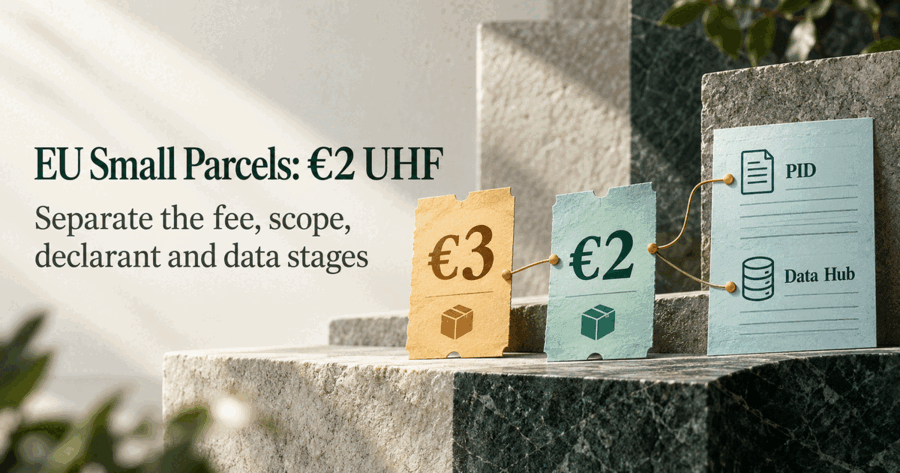
The short judgment: The European Commission’s EU Customs Reform page, updated on 7 October 2026, confirms that the €2 Union handling fee (UHF) applies from 1 November 2026. That does not turn the framework into a simple “€5 per parcel” rule. The €2 UHF and the €3 temporary customs duty are different instruments, with different scope questions and different responsibility paths.
For a seller, the sequence is not “add €5 to every parcel.” First determine whether the transaction is an import distance sale. Then identify the actual declarant, separate the €3 and UHF fields, map the relevant PID data, and record which Data Hub phase applies. A seller, platform, carrier or agent cannot be identified as responsible merely from the word “seller” or from the name of a platform.
This article uses three source levels. The Commission’s 7 October reform page confirms the new public information and date. The Commission guidance, Version of 5 October 2026, explains the operational reading of the fee, declarant cascade, PID and Data Hub. The EUR-Lex texts provide the legal provisions and transition architecture. The guidance expressly describes itself as explanatory and not legally binding.
€3 and €2 are not the same charge
The €3 amount comes from the transition arrangements in Council Regulation (EU) 2026/382. It applies from 1 July 2026 and the transition runs to 1 July 2028. The Commission’s questions and answers and its guidance explain the operational scope as distance-sale goods with an intrinsic value not exceeding €150. The amount is understood per item or declared goods item, not automatically as one charge for an entire parcel.
The €3 amount is a customs duty. It is not the same thing as a consumer tax or a handling fee. The €150 threshold is an important part of the €3 transition analysis, but it is not a universal switch for every EU parcel. IOSS, Special Arrangements, standard VAT, postal consignments and conditional preferential or customs-union treatment still have to be assessed against the specific declaration path. An exclusion discussed in the Commission’s €3 materials cannot simply be extended to the UHF or to PID reporting.
The €2 UHF is a separate Union handling fee. The Commission’s 5 October guidance explains it as a fee for the application to release distance-sale goods for free circulation. It is stated as €2 per item, rather than as an ad valorem rate. The guidance links the fee to customs processing, data checks, risk analysis, infrastructure and control-related costs.
The guidance also explains that the UHF is, in principle, not subject to the same €150 ceiling as the €3 transition duty. A distance sale above €150 may therefore still require a UHF assessment. That does not produce a complete answer about normal customs duty, VAT or the total amount payable for that consignment. Those questions remain separate.
Two shortcuts should be rejected:
“The €2 replaces the €3.” It does not. The charges have different legal characteristics and different start points.
“Every low-value parcel is automatically €3 plus €2.” That conclusion cannot be reached from the label “small parcel” alone. The two amounts may need to be considered for the same shipment when their respective conditions are met, but they must not be merged into one universal per-parcel figure.
Start with the distance-sale test
The guidance uses the concept in Article 14(4)(2) of the VAT Directive. The core relationship is that goods are supplied to a customer in the Union customs territory while the goods are located in a third country or third territory, and the goods are dispatched or transported by or on behalf of the supplier. In a deemed-supplier situation, an online platform may also enter the analysis.
This is not a synonym for every international shipment, and a platform order is not by itself proof that every condition is met. For the particular transaction, examine the customer relationship, the location of the goods at the relevant time, who supplies the goods, and who arranges dispatch or transport.
That is also why the €150 threshold cannot be used as a UHF master switch. For the €3 duty, the threshold is a material transition question. For the UHF, the guidance focuses on the release application for distance-sale goods and explains a scope that is not limited by the same €150 ceiling. Conversely, a cross-border parcel should not be assumed to fall within every fee or declaration requirement just because it is small.
IOSS does not collapse the analysis. IOSS remains a VAT scheme for qualifying imported distance sales. It does not automatically mean that the €3, the UHF or the PID disappears, and it does not by itself complete the customs declaration. Special Arrangements, standard VAT and postal arrangements must likewise be checked against the actual route. The preferential-trade and customs-union qualifications described in the €3 materials should not be turned into a general UHF or PID exemption.
“The seller is responsible” is not precise enough
For the current transition explanation, the €3 where applicable and the UHF first follow the declarant. The declarant is the party actually making the customs declaration and may be a platform, seller, carrier or agent. “May be” matters: this does not mean that all of these parties are joint declarants for every shipment, nor that the seller directly pays in every case.
The guidance gives a cascade for the period from 1 July 2026 to 30 June 2028:
1. the IOSS holder or its indirect representative;
2. the Special Arrangements holder or its indirect representative;
3. in other situations, the importer’s indirect representative; and
4. another person who can provide all the necessary information.
The consumer appears only in a residual situation: a Member State must offer a free web declaration and IOSS or the other specified arrangements must not be used.
For a seller, the useful evidence is therefore a responsibility chain, not only a platform fee screenshot. The chain should answer: who submits H1, H6, H7 or another declaration; who receives the €3 and UHF debt or fee notice; who holds the product and supply-chain data; and what representative relationship connects that party to customs.
Regulation (EU) 2026/2108 defines a future importer for distance sales and establishes a new information and responsibility architecture. Those future roles must not be presented as if every operator changes over on 1 November 2026. The regulation’s general date of application is 21 September 2027, with relevant provisions phased through transition rules.
PID is traceability data, not a certificate
Commission Delegated Regulation (EU) 2026/1022 provides the relevant PID timing: the data requirements apply from 1 November 2026, while operators could provide the data voluntarily from 1 July 2026.
M-PID is generally assigned by an online seller, marketplace or platform.
NS-PID is generally assigned by a manufacturer, producer or product supplier.
S-PID is provided where it exists and uses an internationally recognised standard.
Where there is no S-PID, Y081 indicates that it does not exist.
PID data allows customs to obtain product and supply-chain traceability information. It supports risk management, the identification of non-compliant goods and wider risk-control work. It is not a conformity certificate, an approval certificate or a guarantee of customs release. A field in a platform interface or logistics system cannot automatically replace the EU legal text.
The PID scope also must not be merged with the UHF scope. The guidance places the PID reporting scope specifically around imported distance sales with an intrinsic value not exceeding €150, mainly in a B2C context; B2B is in principle outside that reporting scope. The UHF, by contrast, is explained around the release application for distance-sale goods and is not subject to the same €150 ceiling in principle. The fact that both have an important 1 November date does not make PID proof of the €2 fee, and it does not mean that every shipment uses the same PID fields.
Data Hub is not fully mandatory on 1 November 2026
The Commission page and guidance set out a phased timetable:
1 July 2028: use of the EU Customs Data Hub for e-commerce imports and exports becomes mandatory.
1 March 2031: other economic operators may start using the Data Hub voluntarily.
1 March 2034: use becomes mandatory for all economic operators.
The immediate task is to prepare the declaration and PID data and to identify the current phase. It is not accurate to say that all sellers must migrate to the Data Hub on 1 November 2026. The sources also do not support announcing that a particular platform, carrier or Member State system has completed a uniform Data Hub connection.
Keep the legal levels separate
The Commission’s EU Customs Reform page is the source for the 7 October public confirmation that the €2 UHF applies from 1 November 2026.
The Commission guidance, Version of 5 October 2026, explains the €2 amount per item, the distinction between the UHF and the €3 duty, the distance-sale analysis, the declarant cascade, Y126, PID and VAT paths. It expressly identifies itself as explanatory and not legally binding; the legal provisions and Official Journal text take priority.
The EUR-Lex texts provide the legal framework: Regulation (EU) 2026/382 for the €3 transition; Regulation (EU) 2026/2108 for the UHF legal basis, debtor, non-refundability, future importer architecture and Data Hub phases; and Delegated Regulation (EU) 2026/1022 for PID definitions and timing.
There is an additional status boundary. The Commission’s document register entry for C(2026)6694 still showed Act not yet in force when it was checked for this article. The page explains that the act still has to go through the relevant scrutiny and no-objection process before publication in the Official Journal and entry into force. The precise editorial result is therefore: report the Commission page’s confirmation of €2 and 1 November, but do not invent an Official Journal regulation number for the UHF delegated act, do not state that the UHF delegated act is formally in force, and do not present the guidance as legal advice.
A practical preparation sequence
1. Transaction scope: customer identity, supply relationship, goods location, transport arrangement and whether the transaction is a distance sale.
2. Separate fee fields: the €3 intrinsic-value/€150 transition analysis, and the UHF release-application/item analysis.
3. Actual declarant: IOSS or Special Arrangements holder, indirect representative, seller/platform/carrier/agent role, and the party receiving the notice.
4. PID mapping: M-PID, NS-PID and S-PID where available, linked to the product, supplier, declaration item and transport route; Y081 where there is no S-PID.
5. System phase: record that the current work is declaration/PID preparation, while the mandatory e-commerce Data Hub date is 1 July 2028.
This sequence does not pre-calculate a universal amount or decide who will ultimately bear a commercial cost. It keeps the legal nature, scope, responsibility and timing questions separate so that a shipment can be checked against its actual declaration route and the relevant Member State system. This article was prepared by 绿色方舟(深圳)认证有限公司. It explains publicly available source boundaries and does not promise a customs, tax, fee-transfer, sales, platform or certification outcome for any specific shipment.