The short judgment
On 26 October 2026, the European Commission said that NCTS Phase 6 was in use across the 27 EU Member States and the countries participating in the Common Transit Convention, covering 41 participating countries. The system allows economic operators to use one NCTS Phase 6 channel to submit a transit declaration together with the pre-arrival safety and security data needed to enter the Safety and Security Area (SSA), with the process connected to ICS2.
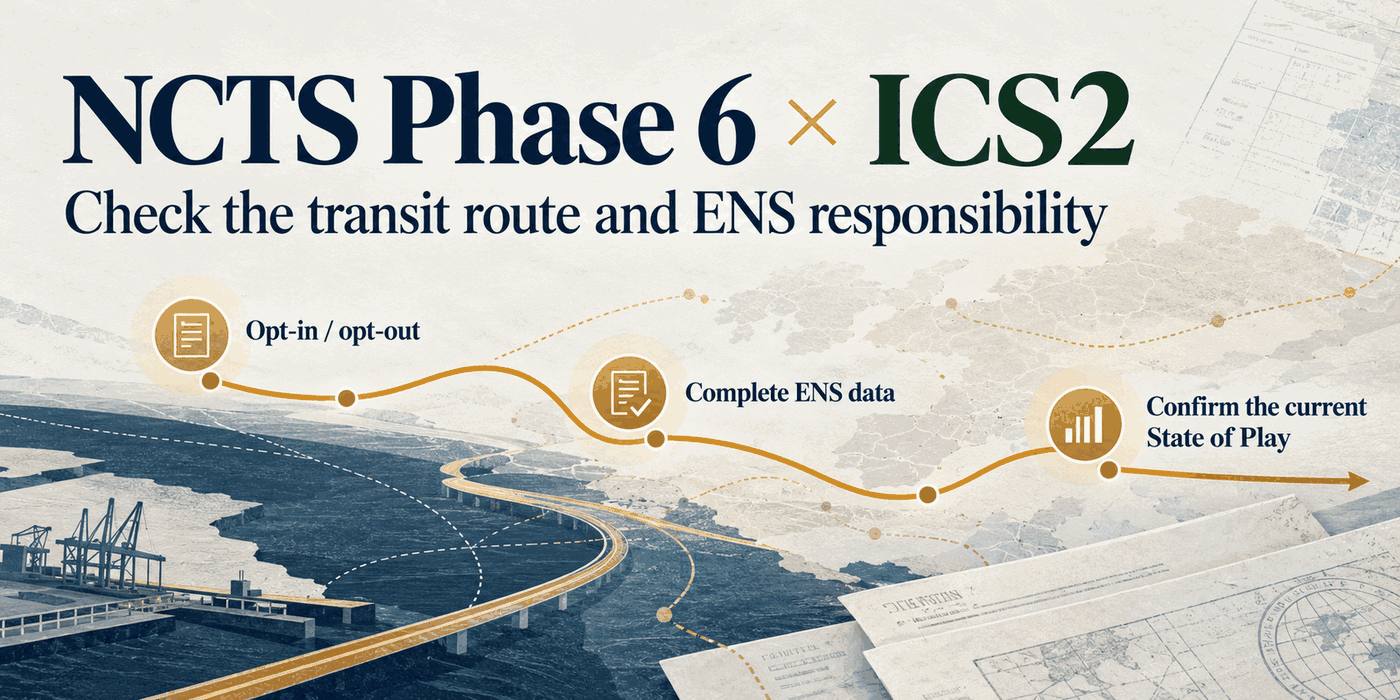
That announcement does not mean that every cross-border seller must register for NCTS-P6, that NCTS-P6 is a seller or product certification, or that the system automatically changes who is responsible for every shipment. The useful question is narrower: does the shipment use a relevant Union or Common Transit route, what is the transport mode and EU entry path, who is responsible for the ENS and transit data, is the ENS complete, and has each country on the route chosen the opt-in or opt-out path?
For a seller that does not operate NCTS or ICS2 directly, the practical task is usually to verify the responsibility chain with the carrier, freight forwarder or customs service provider. It is not to describe the seller as having completed a system connection merely because its goods move through Europe.
What NCTS Phase 6 actually connects
NCTS is the pan-European digital customs system used to manage Union Transit and Common Transit. The European Commission also describes NCTS in connection with International Road Transport (ITR) and states that it covers all EU countries and the parties to the Common Transit Convention.
NCTS Phase 6 aligns the transit procedure with ICS2 for the part of the process in which safety and security data must be provided before goods enter the EU’s Safety and Security Area. In practical terms, the change is a possible filing connection between a transit declaration and an Entry Summary Declaration (ENS) process. It is not a new product approval, conformity assessment, business certificate or general market-access permit.
The word “possible” matters. The combined path depends on the route, the country’s implementation choice and the actual declaration arrangement. A Commission news item can explain the system connection, but it does not decide the filing responsibility for a particular seller, carrier or shipment.
The national choice changes the filing path
The Commission’s NCTS Phase 6 deployment notice describes two paths.
Opt-out. The ENS particulars are not placed in the transit declaration. They are submitted directly to ICS2 instead.
Opt-in. The ENS particulars are included in the transit declaration. NCTS Phase 6 and ICS2 are connected so that the ENS business processes—such as risk analysis, control recommendations and decisions—can be handled through the connected process.
Only a complete ENS declaration can be combined with the transit declaration. This is a substantive condition, not a formatting preference. A declaration that is incomplete cannot be made complete simply by assuming that the transit declaration or a marketplace order record supplies every missing safety and security element.
The Commission describes possible operational advantages for opt-in, including faster processing, shorter clearance time, a single declaration and system, data validation, fewer errors and better shipment traceability. Those are system-level advantages described by the Commission. They are not a promise that any particular shipment will clear faster, avoid inspection, incur no penalty or receive a fixed customs outcome.
The country choice is also not frozen by the news headline. Countries may later move from opt-out to opt-in, and the Commission directs users to the NCTS Phase 6 State of Play for the current position. The NCTS official page provides a State of Play document dated 5 August 2026; it should be treated as a dated reference and checked against any later version. A route review should therefore record the country, the date of the check and the actual system path confirmed by the carrier, declarant or customs service provider.
Why an online seller may be affected without operating the system
The directly relevant participants are economic operators involved in Union or Common Transit, declarants, carriers, freight forwarders and customs service providers, together with exporters or brand owners that must provide the goods and trade data needed by that chain.
The ICS2 framework places the responsibility for submitting safety and security data on the relevant economic operators. The Commission’s ICS2 information also indicates that operators need an EORI, suitable IT and business processes, and the necessary self-conformance testing, or they may use an IT service provider or a shared trader portal. That does not mean every seller must personally build or operate an NCTS-P6 or ICS2 connection.
For a seller using a road or rail transit route into the EU, the important issue may instead be contract and information flow. The carrier, forwarder, customs representative or another party may submit one or more ENS declarations, depending on the transport mode, the supply-chain arrangement and which party holds the necessary information. The seller still needs to know who is doing what, what data it must provide and which party is responsible for correcting an incomplete or inconsistent submission.
This is why a platform label, a shipping-service label or a statement that “the forwarder handles customs” is not enough evidence by itself. The responsibility chain should identify the relevant economic operator or declarant, the carrier or service provider, the technical route used for the filing and the point at which the exporter or brand owner must supply accurate information.
ENS completeness is a data-chain question
Goods entering or passing through the EU require a valid ENS. The ENS may be submitted directly to ICS2, or—where the relevant country has adopted NCTS-P6 opt-in—through the combined transit-declaration path.
Before treating a transit declaration as a combined filing, the parties should check whether the available information is sufficient for a complete ENS for that transport and business arrangement. A practical review should trace the goods description, packaging, carrier information, consignor and consignee details, route and timing information through the actual declaration chain. These categories are a review frame, not a substitute for checking the applicable ICS2 and NCTS process and transport-specific data elements.
Do not reduce ENS completeness to a product name, an HS code or a marketplace order number. The required data context can depend on the transport mode, the commercial model and the ICS2/NCTS business process. A single shipment can also involve a single ENS or multiple ENS declarations, depending on who holds the information and how the supply chain is arranged.
The correct question is therefore not “Did the platform generate a shipping label?” It is “Can the party responsible for the ENS demonstrate that the required data is complete, consistent with the transit declaration and available in the system path being used?” If the answer is unclear, the unresolved field and the responsible party should be identified before the filing is treated as complete.
The road-and-rail connection has a clear boundary
ICS2 has an all-transport-mode ENS responsibility framework. The road-and-rail NCTS-P6 combined route must not be applied automatically to air, sea or other non-applicable routes. Postal consignments still need to be checked against the ICS2/ENS framework by transport mode, route, country option and declaration chain; they should not be excluded in blanket terms.
The same caution applies to the seller population. A business that sells into the EU but does not participate in the relevant transit or safety-and-security data declaration does not automatically acquire the same system-operation task because NCTS-P6 has been deployed. A business involved only in EU-internal sales, or in a shipment outside the relevant Union/Common Transit and EU-entry data chain, cannot be classified from the announcement alone.
Conversely, an indirect seller may still have a real data responsibility if its product and trade information are needed by the economic operator or declarant submitting the ENS. “Not operating the system” and “having no data responsibility” are not the same conclusion. The route, the contract and the information actually available to each party determine the boundary.
A practical review sequence for exporters, brands and sellers
1. Map the actual route. Record the origin, transport mode, transit procedure, EU entry point and every country involved in the transit movement. Confirm whether the movement is Union Transit, Common Transit or another relevant transit scenario rather than assuming that any EU shipment is an NCTS-P6 shipment.
2. Identify the declaration chain. Name the economic operator, declarant, carrier, freight forwarder and customs service provider involved in the filing. Record who holds the EORI and the technical filing capability, and whether the process uses a direct ICS2 submission, an IT service provider, a shared trader portal or a combined NCTS-P6 route.
3. Check the current national option. Use the current NCTS Phase 6 State of Play and obtain route-specific confirmation from the party operating the declaration. Record whether each relevant country is using opt-in or opt-out on the date checked. Do not infer every country’s choice from the deployment announcement alone.
4. Test ENS completeness. Trace the available goods, packaging, carrier, consignor, consignee, route and timing information against the actual ICS2/NCTS process. Check whether the proposed combined filing is complete, and clarify whether one ENS or multiple ENS declarations are expected.
5. Preserve the evidence chain. Keep the route record, the country-option reference, the responsibility allocation, the data hand-off and the version or date used for the decision. If a field is missing or a party’s responsibility is disputed, record that as an open question instead of converting an assumption into a filing instruction.
This sequence is an operational review method, not a new official registration requirement. Its purpose is to prevent two opposite errors: treating a relevant transit-data responsibility as “the platform’s problem” without checking the contract, or treating every EU-facing seller as if it must personally operate NCTS-P6.
What the Commission announcement does not prove
It does not prove that all sellers must register for NCTS-P6 from 26 October 2026. It does not turn NCTS-P6 into an enterprise or product certification. It does not establish that every Member State or Common Transit country currently uses opt-in. It does not show that a named shipment has a complete ENS. It does not guarantee faster customs clearance, zero penalties, fewer controls or a particular release result.
It also does not transfer responsibility from one party to another. Whether a carrier, forwarder, customs service provider, declarant or exporter supplies and submits particular data must be resolved from the route, the contract, the transport mode and the information available to the parties. The NCTS-P6/ICS2 connection can change the technical filing path; it does not, by itself, rewrite every commercial responsibility arrangement.
Operational note: 6–8 November 2026 maintenance
The ICS2 official page was updated on 30 October 2026 to state that annual system maintenance was scheduled for 6–8 November 2026 and that related applications might be temporarily unavailable. The page also stated that the ICS2 Business Continuity Plan would not be activated for this maintenance.
This is an operational availability notice, not a new ENS rule, a new NCTS-P6 scope expansion or a change in seller certification. Parties with shipments during the window should confirm the filing path and current operational instructions with the relevant carrier, declarant or service provider; they should not describe the maintenance notice as a new customs obligation.
Sources and the boundary of this article
The primary source for the deployment statement and the opt-in/opt-out distinction is the European Commission’s 26 October 2026 news item, “Deployment of NCTS Phase 6: the next step in the modernization of customs and transit procedures”. It states that NCTS Phase 6 is used across 41 participating countries, explains the connected transit and safety-and-security submission path, and describes the two national options.
The European Commission’s NCTS official page explains the Union Transit and Common Transit system, the NCTS-P6/ICS2 alignment and the State of Play reference. The Commission’s ICS2 official page explains the ENS framework, the economic-operator and EORI context, the available technical routes and the 30 October 2026 maintenance notice.
This article explains the source-supported relationship between NCTS-P6, ICS2, ENS data and relevant transit routes. It does not issue a shipment-specific filing decision, certify a seller, or guarantee customs clearance. A specific conclusion requires the current route, transport mode, country State of Play, contract allocation and complete data review.
Prepared by 绿色方舟(深圳)认证有限公司.