

Sources checked on September 25, 2026. This article uses current public Amazon and Amazon Ads materials to explain a diagnostic method. A storefront change alone does not prove certificate expiry, and there is no universal recovery timeline across all certifications and marketplaces.
Amazon Climate Pledge Friendly (CPF) helps customers identify individual products with qualifying sustainability features. If a product that was expected to qualify does not display the green leaf badge, or if its display status changes, the storefront alone does not establish the cause. It should not automatically be described as a certificate-expiry removal or the end of a standard grace period.
Amazon describes a qualification process that brings together certification data, selling-partner inputs, internal sources, and identifiable product evidence. The practical question is therefore not simply whether a business possesses a certificate. The relevant question is whether the certification covers the exact product, whether that product can be mapped to the Amazon catalog record, and whether the customer-facing claim remains within the evidence boundary.
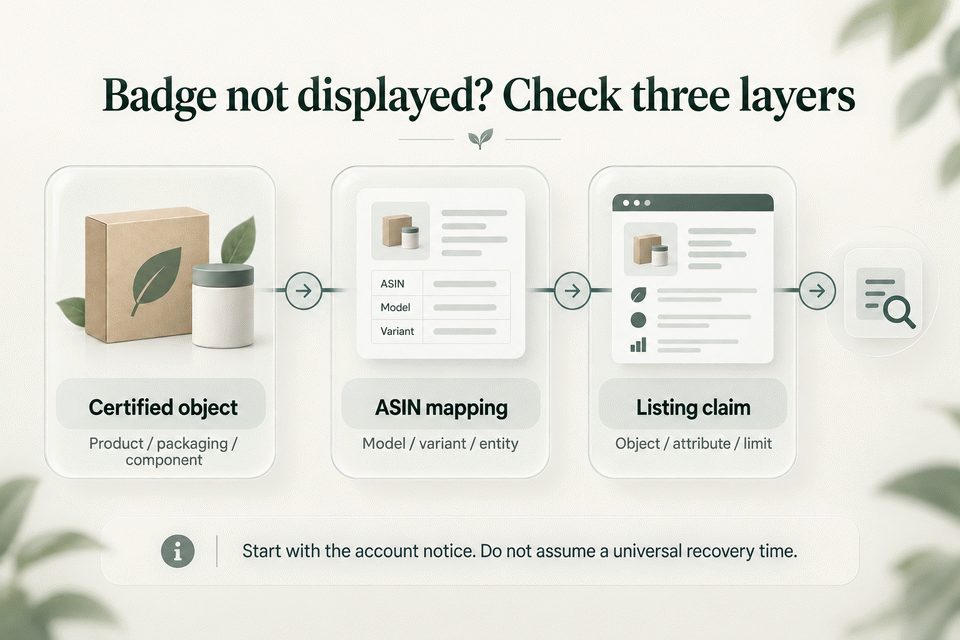
Confirm that the certification covers the complete product
Amazon Ads' CPF guidance advises sellers whose product is not badged to first make sure that the unique product is certified, rather than only its packaging or an individual component.
This distinction defines what the evidence can support. A certified paper package does not automatically confer the same product-level status on the item inside it. A certified input in a supply chain does not automatically mean that every finished product using that input qualifies under a particular CPF certification. Review the certification name, current status, product description, model, category, and scope. Also check whether the product's material, factory, model, or packaging version has changed since the certification record was created.
The first layer is not merely a certificate-authenticity check. It is a scope check: what object does the certificate or program record actually describe?
Check how the certification maps to the ASIN
CPF eligibility is associated with a specific product. Even when a certification remains valid, the platform must still be able to reconcile it with the correct ASIN or variation.
Useful mapping checks include:
• the product name in the certification record versus the listing name;
• manufacturer model numbers versus retail model numbers and ASINs;
• the relationship among the certified organization, brand owner, and seller;
• the exact colors, sizes, materials, or variants covered by a product family;
• whether old and new certificates or product versions have been mixed.
A common scenario is a certification database that uses an internal manufacturer model while the listing uses a consumer-facing retail model. If the submitted information does not establish the relationship, uploading the same certificate again may not resolve the issue. The missing element is identifiable mapping, not submission volume.
Keep environmental claims within the evidence boundary
Amazon Ads states that the CPF label qualifies a particular product, not a brand as a whole. CPF branding should not be used in generic brand creative or with products that are not in the program.
The same boundary matters in listing copy. A certification may substantiate a specific material, sourcing, energy-efficiency, or safer-chemicals attribute. It does not automatically substantiate broad statements such as “completely eco-friendly” or “zero impact.” Claims should identify the relevant product and attribute, including any limits involving a component, packaging, material percentage, or model.
This review remains useful even if the badge issue ultimately turns out to be a data-mapping problem. Customer-facing claims and certification evidence should continue to describe the same object and the same sustainability feature.
Contacting Amazon about a missing badge
Amazon Ads' public guidance says that, after confirming the unique product is certified under a certification in the CPF program, sellers or vendors who still believe the product should qualify can use the Contact Us page in Seller Central or Vendor Central.
A focused request should make the product relationship easy to identify. Include the ASIN and relevant variation, certification name and identifier, the product description shown in the certification record, the current storefront evidence, and the original message shown in the account. If Amazon provides a specific reason, use it as the starting point. If it does not, examine the complete product, certification status, catalog mapping, and listing claims as separate layers.
Avoid presenting unverified notice periods, grace periods, or reinstatement timelines as rules for every certification and marketplace. Certification validity, data transfer, and document structures vary. The current account notice, the applicable certifier's requirements, and the facts of the product should control the review.
Maintain a traceable product record
A durable record can include the certification version and status, the covered product scope, the mapping between certified products and ASIN variations, changes to materials or production sites, the evidence supporting each sustainability claim, and copies of platform notices and prior submissions.
This record cannot guarantee CPF eligibility or badge display. It can, however, help a team distinguish a product-certification issue from a catalog-mapping issue or an overbroad claim, and avoid treating repeated submission as a substitute for correcting product information.
Official sources checked
• Amazon Sustainability, “Sustainability labels are shifting shopping decisions,” December 9, 2025.
• Amazon Ads, “Climate Pledge Friendly (CPF): Creative Guidelines.”
• Sell on Amazon, “Sustainability Solutions Hub.”
Greenark (Shenzhen) Certification Co., Ltd. can help businesses review product scope, catalog mapping, and sustainability-claim boundaries for the applicable certification route. Final eligibility and display decisions remain with Amazon and the relevant certification program.


