Overview
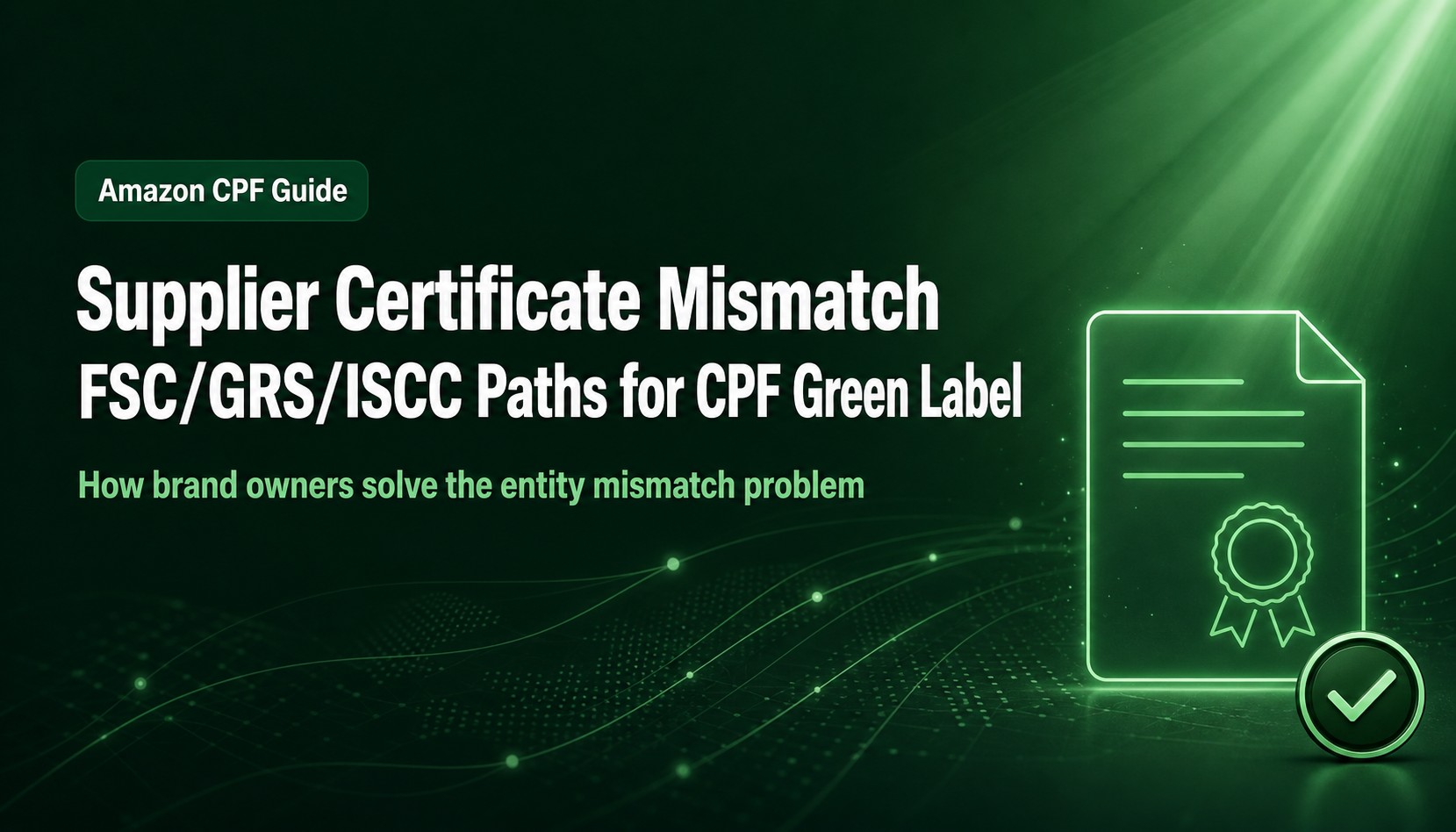
Many Amazon sellers — especially trading companies and brand owners — rely on their suppliers' sustainability certificates to apply for the Climate Pledge Friendly (CPF) green label. A common rejection reason is entity mismatch: the certificate is issued to the factory or supplier, but the Amazon store is registered under a different company name.
This article explains why entity matching matters for CPF review and breaks down the solutions for three major certification families: FSC, GRS/RCS/OCS/RWS, and ISCC PLUS.
Why Amazon Checks Entity Matching
Amazon's CPF program does not simply check whether a product is "certified" in a general sense. It verifies a complete evidence chain:
Certificate holder → Seller/Brand entity → Product → ASIN
Every link in this chain must be supported by documentation.
If the certificate holder and the seller are different legal entities with no documented connection, Amazon cannot confirm that the seller is authorized to make certified claims about the product.
This is not an arbitrary requirement. Green claims such as "recycled," "FSC certified," or "organic" are regulated statements. When a claim is inaccurate, the platform needs a clear responsible party to hold accountable.
FSC Certification: CoC vs Promotional Licence
The Forest Stewardship Council (FSC) system has two distinct certificate types for different business roles, as stated in both the FSC official CPF application guide and Amazon's official FSC CPF one-pager.
| Certificate Type | Who It's For | Core Requirements | CPF Eligible? |
|---|---|---|---|
| Chain of Custody (CoC) Certificate | Manufacturers, processors, trading companies that handle FSC materials | Full chain-of-custody system + on-site audit | Yes (as certificate holder) |
| Promotional Licence (PLA) | Retailers, brand owners, e-commerce sellers | Supplier holds valid CoC; buyer purchases FSC-certified finished goods; proper FSC labeling | Yes (brand owner / trading path) |
Key Points About PLA
The Promotional Licence is a lightweight option designed specifically for brands and retailers that do not physically process wood or paper materials.
Requirements:
• Your supplier holds a valid FSC CoC certificate
• The products you purchase are FSC-certified finished goods (not just packaging)
• Products carry the official FSC label, intact when delivered to consumers
• You commit to using FSC labels and claims per FSC rules
Important caveats:
- Packaging-only FSC certification does NOT qualify for CPF — the finished product itself must be FSC certified
- The FSC product label must appear on the product or packaging delivered to the consumer
- PLA holders must maintain FSC purchase records and Transaction Certificates (TCs) for audit
GRS / RCS / OCS / RWS: Three Alternatives When Brand Name Is Not on Scope Certificate
For textile-related certifications (GRS, RCS, OCS, RWS, GOTS, LWG, etc.), Amazon's official Seller Central help pages specify that if your brand name does not appear on the scope certificate, you must provide one of the following:
| Solution | Required Documentation | Best For | Effort Level |
|---|---|---|---|
| TC with brand name | Supplier scope certificate + TC showing your brand name | Regular batch purchases | Low |
| Trademark registration | Supplier scope certificate + brand trademark registration certificate | Sellers with registered trademarks | Low |
| Updated scope certificate | Revised scope certificate with brand name added by the certifier | Long-term partnerships, fixed branding | Medium |
Detailed Breakdown of Each Path
TC with brand name:
A Transaction Certificate is a traceability document issued for each shipment, showing buyer/seller, product details, and material content. If the TC lists the brand owner/trading company as the buyer and includes the brand name in the product description, Amazon typically accepts it as proof of entity connection.
Note: TCs should be issued promptly after each transaction. Delaying too long may make backdating impossible.
Trademark registration:
If you hold a registered trademark for your brand, you can submit the official trademark registration certificate as proof of brand ownership. The logic: you own the brand, the product is sold under your brand, so the brand-ownership link is established.
This must be an official trademark registration certificate — not an application acceptance notice, and not an Amazon Brand Registry screenshot.
Updated scope certificate:
The factory contacts the certification body to request adding your brand name to the brand/customer list on the scope certificate. This is the most thorough solution — once updated, the certificate directly shows your brand name, and future applications will not face entity-matching issues.
The downside is that it requires the factory's cooperation and may involve additional audit fees and processing time.
Parent-Child Brand Scenarios
When a parent company holds the certification and a child brand applies for CPF, the same three options apply: a TC with the child brand name, the child brand's trademark registration, or a certificate update adding the child brand.
ISCC PLUS: Brand Owners May Use License Instead of Full Certification
ISCC PLUS operates on a different model: every entity in the supply chain must be certified, but brand owners at the very end of the chain may be covered by an ISCC License.
Both the ISCC official website and Amazon's CPF ISCC PLUS one-pager confirm this structure.
| Type | Applies To | Requirements |
|---|---|---|
| Full ISCC PLUS Certification | All material-handling entities in the supply chain | Full audit including on-site review |
| ISCC License | Brand owners / retailers at the end of the supply chain | System audit, no on-site material-handling review |
What Brand Owners Need to Know
If you are a brand owner and your factory and upstream suppliers all hold ISCC PLUS certification, you may not need a full ISCC PLUS certification yourself — an ISCC License may be sufficient.
Prerequisites:
• ALL upstream entities in the supply chain (from raw material to finished goods) hold valid ISCC PLUS certification
• The brand owner establishes an ISCC management system to ensure certified material identity and compliant claims
• The supply chain traceability is complete with no gaps
Important caveats:
- ISCC PLUS primarily applies to bio-based materials, recycled plastics, and chemical recycling
- If ANY tier in the supply chain lacks ISCC certification, the entire traceability chain is broken
- ISCC PLUS and ISCC EU are different certification schemes — make sure you are using the right one
Material Content Thresholds: A Common Source of Confusion
Entity matching is not the only potential pitfall. Material content thresholds are also frequently misunderstood:
| Certification | Minimum Certification Threshold | Consumer Labeling Threshold | CPF Green Label Threshold |
|---|---|---|---|
| GRS | ≥20% recycled content | ≥50% recycled content | ≥50% certified material |
| RCS | ≥5% recycled content | No consumer-facing label | Subject to CPF requirements |
| OCS 100 | 95-100% organic content | Available | Subject to CPF requirements |
| OCS Blended | ≥5% organic content | Available | Subject to CPF requirements |
| FSC | FSC 100% / FSC Mix / FSC Recycled | Per FSC labeling rules | Finished goods (not packaging only) |
Key takeaway: GRS certification can be obtained with as little as 20% recycled content, but that is the B2B minimum. Amazon's CPF program requires at least 50% certified material content for textile products. Having a GRS certificate does not automatically mean your product qualifies for CPF.
Pre-Submission Self-Check Checklist
Before you submit a CPF application, work through these steps:
1. Identify the certification system — FSC, GRS/RCS/OCS, ISCC PLUS, or another? Entity rules differ significantly.
2. Examine the scope certificate — Who is the holder? Does it list your brand name? What is the product scope?
3. Assess entity matching — Is the certificate holder the same legal entity as your Amazon store or brand?
4. Choose a resolution path — Based on the certification type and your situation, select the appropriate solution.
5. Gather documentation — Prepare all required supporting documents for your chosen path.
6. Verify TC chain — Does every shipment have a corresponding TC? Is the chain complete from raw material to finished product?
7. Confirm material ratio — Does your product meet the CPF material content threshold (typically ≥50%)?
Applicability Boundaries and Disclaimer
• This article is based on Amazon Seller Central public help pages, the FSC official CPF guide, ISCC PLUS official documentation, and Textile Exchange standards policy, fact-checked as of September 1, 2026.
• CPF review details may vary across Amazon marketplaces (US, EU, Japan, etc.). Always refer to the official documentation for your specific marketplace.
• Certification standards and platform policies may be updated. Always consult the latest official versions.
• This article is for informational purposes only and does not constitute certification application advice or guarantees of certification approval, platform review outcomes, or traffic results.
• The certification applicability and application path for any specific product must be evaluated case-by-case, considering product materials, supply chain structure, target marketplace, and other factors.
Professional Services
Greenark (Shenzhen) Certification Co., Ltd. specializes in helping Amazon sellers and supply chain companies build compliance evidence chains for the CPF green label. If you need to evaluate certificate entity matching issues, plan certification paths, or organize application documentation, contact us for professional consultation.
Email: sui@greenark-sz.com
Website: www.greenark-sz.com
Phone: +86 18407559004