
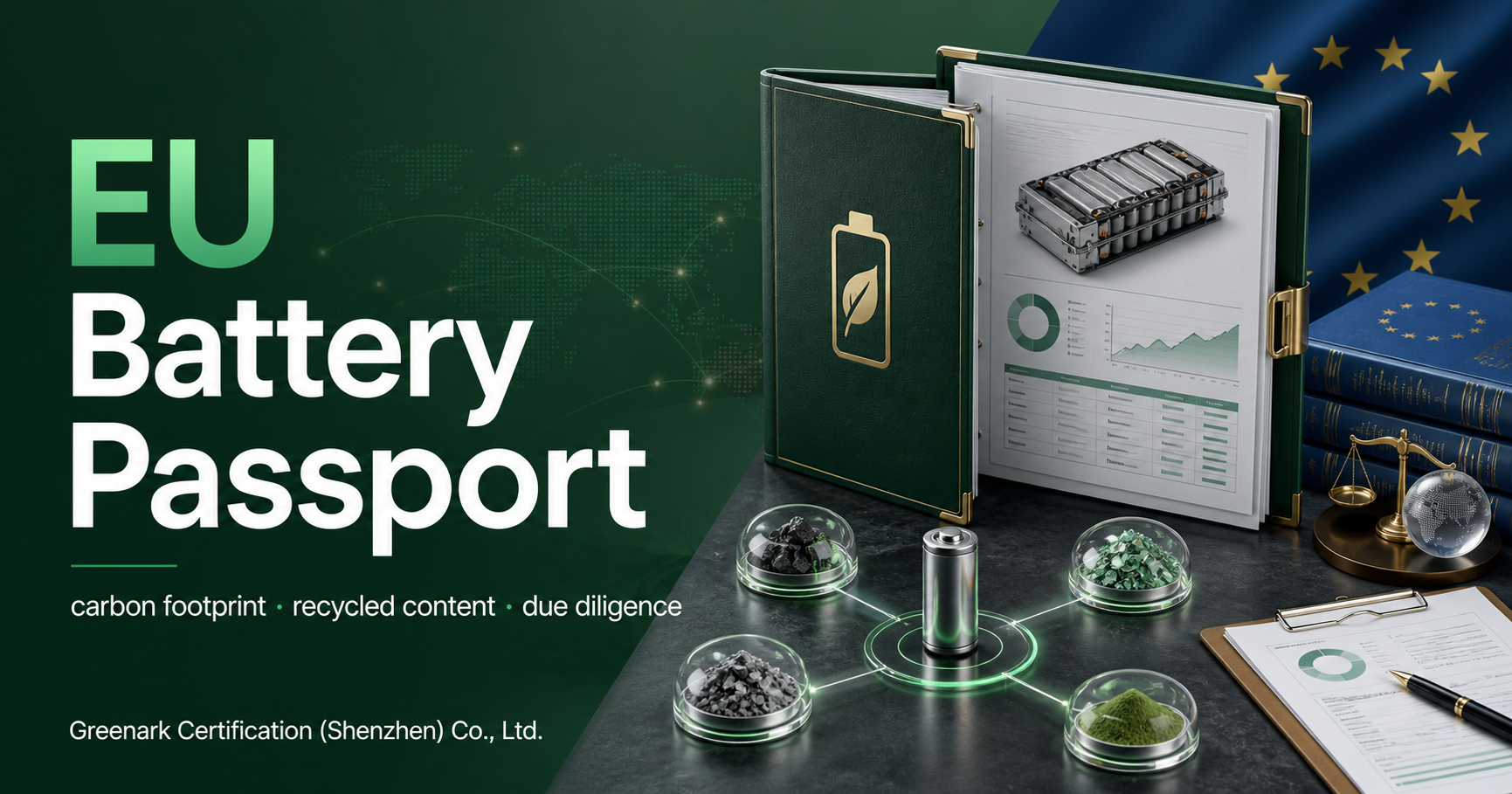
Start with the scope correction: “The EU Battery Passport will become mandatory for every portable battery in 2027” is not what Article 77 of Regulation (EU) 2023/1542 says. From 18 February 2027, an electronic battery passport is required for each light means of transport (LMT) battery, industrial battery with a capacity greater than 2 kWh, and electric-vehicle battery placed on the EU market or put into service. A portable battery does not enter Article 77 merely because it reaches a universal “10 Wh threshold”. Portable batteries can still be subject to QR, labelling, removability, producer-responsibility and product-specific requirements, but those duties must be assessed separately.
This reference is for cross-border sellers, manufacturers, importers, EU economic operators, supply-chain teams and data owners selling products containing batteries. Its purpose is to connect the finished product, battery model, production information, responsible economic operator, technical file and QR entry point into an auditable evidence trail. It was prepared by Greenark Certification (Shenzhen) Co., Ltd. for internal preparation; it is not a legal opinion and does not promise a platform, customs or certification outcome.
Keep the obligations separate: the Battery Passport, Article 13 QR requirements, carbon-footprint rules, recycled-content rules, removability and producer-responsibility duties are not one universal “passport package”. Do not replace clause-by-clause applicability work with a 12-document checklist, a provider list or a single platform field sheet.
1. Classify the battery before deciding whether Article 77 applies
Article 77 uses battery categories rather than an Amazon ASIN count or a universal watt-hour trigger. Start with one row for each finished SKU and link it to the battery model, intended use and placing-on-the-market scenario.
A battery built into a vacuum cleaner, tool or appliance is not automatically outside compliance work. Incorporation affects product responsibility, labelling, instructions, removability and technical documentation. It does not automatically turn an ordinary portable battery into an LMT, industrial or electric-vehicle battery listed in Article 77. Record the product category, battery category and placing scenario separately.
2. What the Battery Passport is expected to contain
Article 77 requires information about the battery model and information relating to the individual battery, including information resulting from its use. The regulation separates public information, information for notified bodies, market-surveillance authorities and the Commission, and information available to persons with a legitimate interest. A public web page should not expose every BOM, test result or commercially sensitive field.
- Identity: battery model, unique identifier, manufacturer and relevant economic operators, linked back to the actual product or battery model.
- Technical data: category, rated parameters, chemistry, performance and durability data where the battery category and applicable provision require them.
- Lifecycle data: information needed for repair, reuse, repurposing, remanufacturing and recycling, with status or use data where applicable.
- Access control: roles for reading, updating, downloading or sharing data, with a record of permissions and version changes.
Article 77 also requires the information to be accurate, complete and up to date, using open standards and an interoperable, machine-readable, structured and searchable format. The passport is linked to a unique identifier through the QR code in Article 13(6). Article 77 does not create a universal “first 15 official providers” list, nor does it make one commercial platform, blockchain or seller-backend workflow mandatory for every company. Select technical providers against the applicable rules, access rights, security controls and contractual accountability.
3. Build a SKU evidence matrix linking product, pack and battery model
For cross-border teams, the common failure is not the absence of a polished page. It is inconsistent battery information across the BOM, label, manual, technical file and online offer. A practical internal matrix can use one row per finished SKU or ASIN. That matrix is a control tool, not a legally prescribed “six-layer system”.
Change control: a cell substitution, BMS change, rated-parameter change, packaging or manual revision, operator change or QR migration should trigger an impact assessment. Record before/after values, affected SKUs, owner, approval date and files that must be synchronized. The regulation does not set one general “14-day synchronization across six systems” deadline, so do not present an internal SOP as a statutory deadline.
4. Keep QR, labelling, carbon footprint and removability separate
The original article combined several dates into a four-stage “passport rollout” and applied industrial/electric-vehicle battery requirements to ordinary portable batteries. A safer implementation calendar is clause-based:
- QR code: Article 13(6) requires a QR code on all batteries from 18 February 2027. For LMT, industrial batteries above 2 kWh and electric-vehicle batteries, the QR provides access to the Battery Passport. For other batteries, it provides applicable Article 13 information, the declaration of conformity, the relevant report and waste-battery information.
- Labelling: capacity, general battery information, separate-collection symbols and heavy-metal symbols have their own provisions and application conditions. Where the battery’s size or nature makes marking impracticable, the regulation allows the label or QR to be placed on packaging and accompanying documents. Do not turn “cell, pack, carton and manual” into a universal four-location rule.
- Carbon footprint: Article 7 focuses on electric-vehicle batteries, rechargeable industrial batteries above 2 kWh and LMT batteries. Do not apply the original article’s PCF, A/B/C/D or corporate Scope 1+2 rules to every portable battery; check the category, provision and relevant delegated or implementing act.
- Recycled content: Article 8 addresses industrial, electric-vehicle, LMT and SLI batteries and phases in information and targets for recovered materials. Fixed cobalt, lithium and nickel percentages should not be presented as a universal 2026 threshold for every battery.
- Removability: Article 11 sets requirements for products incorporating portable or LMT batteries, including instructions and spare-parts considerations, with product-specific exceptions. It is a separate question from the Battery Passport and must be reviewed with the applicable derogations.
5. A practical preparation sequence for cross-border teams
6. Manual review checklist and claim boundaries
- Do the title, H1 and summary state 18 February 2027 and the three Article 77 categories without claiming universal portable-battery coverage?
- Can each SKU be traced to a battery model, rated parameters, manufacturer/economic operator, technical file and QR entry?
- Does the QR distinguish the Battery Passport from Article 13 information for other batteries, with version and access evidence?
- Have carbon footprint, recycled content, removability, CE/transport/chemical and EPR questions been assessed separately rather than replaced by one “certificate”?
- Have unsupported pilot statistics, official-provider lists, automatic platform actions, detention/removal/fine amounts and pass-rate claims been removed?
Official source entry points (checked August 2026):
Regulation (EU) 2023/1542 on EUR-Lex; European Commission: Digital Product Passport for Batteries; European Commission: Digital Batteries Passport—Data Points by Category. Implementing acts, delegated acts, harmonised standards and national implementation information may change; recheck the official sources before publication or product launch.


