
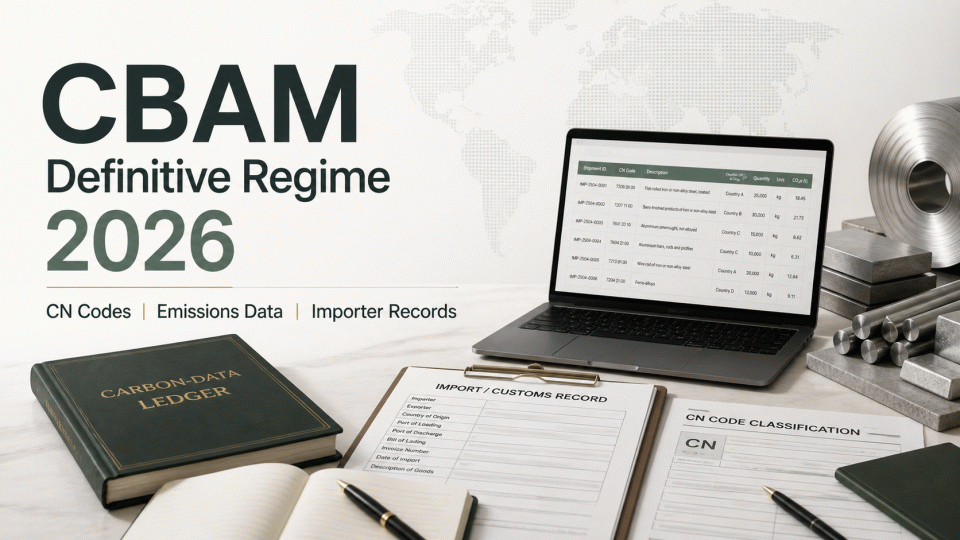
Who this is for: EU importers of CBAM goods, indirect customs representatives, and non-EU installation operators that provide production and embedded-emissions data to importers.
Reading note: The applicable obligations depend on the goods’ CN code, importer, annual quantity, origin and emissions data. This is an evidence-preparation reference, not a determination for a particular shipment; the actual importer should confirm its position with the competent authority, customs and qualified advisers.
Three boundaries to keep clear: the definitive regime applies from 2026; the Commission currently lists cement, iron and steel, aluminium, fertilisers, electricity and hydrogen; and the EU importer or indirect customs representative handles CBAM authorisation, annual declarations and certificate surrender, while the non-EU seller normally supplies installation and product data.
1. Confirm scope before calculating anything
The definitive CBAM regime applies from 1 January 2026. Scope should be screened against Annex I to Regulation (EU) 2023/956, its current amendments and the CN code used for the customs declaration. The Commission’s current sector page lists cement, iron and steel, aluminium, fertilisers, electricity and hydrogen. Do not automatically label general plastics, ceramics, glass or any downstream consumer product as a CBAM good merely because it is carbon-intensive.
For importers, the definitive regime uses a single annual mass-based threshold: importing more than 50 tonnes of CBAM goods requires the importer to apply for or hold authorised CBAM declarant status, subject to the detailed rules and special treatment for goods such as electricity and hydrogen. This is not a 1,000-tonne-per-SKU rule and not an exporter-volume threshold. Keep quantities and customs facts even where a threshold question appears to remove an obligation.
Build a scope register: SKU, goods description, origin, EU Member State of import, declared CN code, Annex I match, annual net mass, importer/EORI, customs procedure, conclusion and review date. Where classification is disputed, retain composition, specifications, intended use and the classification rationale for the actual declarant and customs authority to review.
2. Separate the importer, representative and installation roles
The EU importer or qualifying indirect customs representative is the central party for the CBAM Registry and annual declaration. The non-EU installation operator is not the authorised declarant, but should provide installation identification, production-route information and embedded-emissions data. A seller may help organise records, but should not describe “CBAM submitted”, “certificates purchased” or “no carbon cost for the buyer” as a product outcome on its website.
The authorised declarant follows the process of the competent authority in its Member State and the CBAM Registry. Under the Commission’s current information, the first annual declaration for 2026 imports is due by 30 September 2027. Certificate prices, purchase and surrender mechanics should be checked against the Registry, competent authority and current legislation; do not copy the transitional-period quarterly-report workflow into the definitive regime.
3. Make emissions data traceable to an installation, process and good
CBAM declarations use embedded emissions of the goods. The boundary, treatment of direct and indirect emissions, precursors, production routes and electricity rules must follow Annex IV to Regulation (EU) 2023/956 and the applicable implementing acts. An enterprise-wide carbon footprint or post-gate logistics number is not a substitute for the embedded-emissions data required for the relevant goods.
Installation record: installation name and address, operator, country, process route, boundary, reporting period, fuel and feedstock use, purchased electricity and heat, meters, precursors, output and allocation method. Give each figure a unit, period, source-record number, owner and version.
Goods record: CN code, goods description, specification and unit, installation, batch or production period, quantity, embedded-emissions intensity, calculation method, actual or default basis, precursors, data sources and link to the shipment. Actual values require traceable information from the installation. Where the rules permit default values, use the Commission’s published values; a default value is not an internally invented industry average.
Where actual emissions are declared, the authorised declarant must also consider verification. Verification is performed by verifiers accredited and recognised under the CBAM framework; the scope, materiality assessment and report format follow the applicable verification rules and Registry template. An ordinary ISO certificate, unsigned supplier spreadsheet or adviser estimate does not replace a verification report.
4. Build an evidence chain that can be checked
Organise records in five layers rather than keeping one emissions spreadsheet:
- Goods: CN classification rationale, specifications, BOM or composition, process route and Annex I mapping.
- Installation: installation identity, process flow, fuel/feedstock/electricity meters, precursors and output records.
- Emissions: calculations, parameters, units, allocation logic, actual/default choice and data version.
- Shipment: invoice, packing list, bill of lading, origin, quantity, customs records and import date.
- Declaration: Registry records, annual declaration, certificate purchase/surrender records, proof of carbon price paid where relevant, and verification report.
Log every change with the old value, new value, reason, source version and approver. If the goods, installation, emissions intensity and shipment quantity do not reconcile, pause the row as “not ready for declaration” and let the actual declarant decide the correction path.
5. A practical checklist for cross-border sellers
- Screen every EU-export SKU against the current Annex I and customs classification materials; do not treat a marketing name as the CN conclusion.
- Assign each installation a stable identifier and map installation, process, product and reporting period.
- Use the Commission’s CBAM communication template or the applicable Registry template to transmit data, retaining the completed version.
- Ask the importer or indirect representative to confirm authorisation, annual declaration, certificates and competent-authority requirements; describe only the records the seller can actually provide.
- Review CBAM claims on websites, listings, quotations and contracts. Remove outcome promises such as “automatically compliant”, “tax-free”, “approved” or “guaranteed zero cost”.
Service boundary: 绿色方舟(深圳)认证有限公司 can help organise scope screening, data fields, installation–product–batch mapping and evidence registers. Classification, authorisation, customs submissions, certificate transactions and annual surrender remain with the authorised party under the current rules. This article does not determine whether a particular SKU is in scope or calculate an importer’s liability.
Sources and review points
1. European Commission, CBAM definitive regime: definitive-period scope, sectors, threshold and certificate basics.
2. EUR-Lex, Regulation (EU) 2023/956 consolidated text: scope, annual declaration, embedded emissions, verification and certificates.
3. European Commission, CBAM Registry and legislation and guidance: Registry, templates, defaults and implementation materials.


