
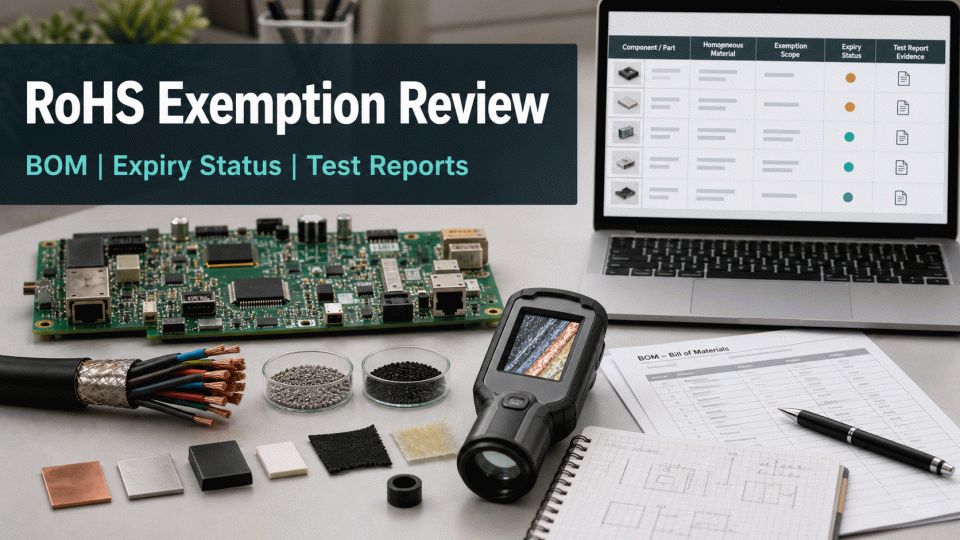
Audience: Cross-border sellers who sell/export electrical and electronic equipment (EEE) to the EU / UK / Turkey / Ukraine / Norway / Iceland / Liechtenstein — small appliances, 3C/digital, smart home, power tools, lighting, automotive electronics, medical devices. Teams in procurement, supply chain, compliance, QC, and product development all need to understand this: 2026–2030 is the concentrated sunset window for EU RoHS 2.0 Annex III (industrial exemptions) and Annex IV (medical/monitoring exemptions). FMDs, CoCs and DoCs that still cite expired exemption numbers will be ruled non-compliant directly by Amazon EU CCT, national MSAs, or customs.

WeChat Official Account Abstract: Between 2026 and 2030, EU RoHS 2.0 (Directive 2011/65/EU, amended by (EU) 2015/863 adding DEHP / BBP / DBP / DIBP to make 10 restricted substances overall) enters its most concentrated exemption sunset season ever — 60+ Annex III exemptions expire in 2026–2028 and 20+ Annex IV exemptions expire in 2027–2030. A H1 2026 EU MSA pilot inspection of 3,012 cross-border e-commerce small-parcel shipments revealed that 17.6% of non-conformities came from "still citing expired RoHS exemption IDs in the CoC / DoC / technical file after their sunset dates." The three most severe cases were: Exemption 7(a)-I for high-temperature solder lead (sunset 2026-06-30), Exemption 7(c)-I for high-reliability ceramic capacitor lead (sunset 2026-07-09), and Exemption 6(a)-I for lead in copper alloys (sunset 2026-06-30). This article breaks down the 10-substance homogeneous-material limit rules, the three legal consequences of exemption expiry, seven dimensions for auditing Material Compliance Declarations (FMD / CoC), nine common pitfalls hidden inside third-party test reports, twelve real-world expired-exemption failure cases, and a six-item action checklist you can start this week.

⚠️ Pitfall 1 — Lead-in-high-temperature-solder exemption 7(a)-I expired, lead-free process not switched, DoC still says "Exemption 7(a)-I applies". 12,000 industrial routers detained at Hamburg Port.: The outdoor high-temperature 5G routers from Seller A in Suzhou used Sn63Pb37 eutectic solder on all BGA and QFP joints. Because the "lead in high-temperature solder for servers and communications infrastructure" RoHS Annex III exemption 7(a)-I was valid until 30 June 2026, the factory's CE EMC/LVD DoC and RoHS compliance certificate had long read "Lead content pursuant to Exemption 7(a)-I". On 15 July 2026, the MSA inspected batches that entered EU customs after 1 July — the DoC still cited 7(a)-I (which expired at 23:59 CET on 30 June 2026; no extension regulation had been published in OJEU). The entire 12,000-unit shipment was moved into a non-free-circulation customs warehouse. Seller A applied for re-issuing a new DoC and lead-free test reports, which took 47 days. Port demurrage and warehouse rent during that period were approx. EUR 280,000; Amazon ranking drop on 18 ASINs caused loss USD 620,000. Eventually, seller had to abandon 1/3 of inventory and re-export it to non-EU countries that had not adopted EU RoHS.

⚠️ Pitfall 2 — Copper-alloy lead exemption 6(a)-I expired; brass AC terminals not changed; seller assumed "automatic grace period". Full batch of 19,200 smart switches failed official RoHS lab Pb 4.87% vs limit 0.1% — entire ASIN family removed via CCT.: Seller B in Dongguan sold whole-home smart wall switches. The internal power-module AC screw terminals used H62 brass (typical lead 3–5% w/w). The factory had relied for years on RoHS Annex III exemption 6(a)-I: "Lead in copper alloys up to 4% by weight", sunset 2026-06-30. Seller's ops team only noticed the sunset on 4 July and asked in a WeChat supplier group "how long is the grace period?" A fellow seller replied "usually 6 months". Seller shipped without any material change. On 11 August 2026, Amazon EU CCT received a German MSA-notified third-party lab report: three different-colour ASINs' brass terminals averaged 4.87% lead — far over 0.1% homogeneous limit and the exemption had already expired. All 17 parent-child variants were taken down, compliance-health score deducted 11 points, account placed in EEE high-risk pool, every new EEE ASIN required manual review of original RoHS reports (average review 21 days).

⚠️ Pitfall 3 — High-reliability ceramic-capacitor exemption 7(c)-I sunset 2026-07-09; seller thought "passive MLCCs are always safe". They only asked supplier for an FMD statement "all BOM meets RoHS 10 items" without per-part XRF/ICP re-testing.: The professional-grade network video recorder (NVR) mainboards from Seller C in Shenzhen contained 3,120 pieces of X7R high-permittivity multilayer ceramic capacitors (MLCCs, using lead zirconate titanate PZT perovskite dielectric). These had been cited under RoHS Annex III exemption 7(c)-I "Lead in high-permittivity-type ceramic dielectric capacitors with rated voltage ≥ 125V AC or ≥ 250V DC". On 9 July 2026, the exemption expired. In October 2026, French MSA randomly bought three units on Amazon.fr and sent them to LNE laboratory for RoHS 10-item chemical testing. They disassembled individual MLCCs for homogeneous-material analysis — lead detected 3.42% w/w, limit 0.1%, and the cited exemption 7(c)-I had already expired. Pursuant to Regulation (EU) 2019/1020 Article 19, MSA launched "unsafe product" procedures: EU-wide recall of 47,000 sold units, total fine EUR 540,000 on seller plus EU RP, all in-stock models required to re-submit non-exempt full-10 test reports and lead-free supply chain proofs within 60 days or permanent delisting.

💡 Three iron rules about RoHS exemption sunset that most cross-border sellers miss: (1) An exemption is a time-limited "legal pass" — after its exact sunset date it is invalid. The European Commission does NOT give a "default grace period". Even if an extension consultation is ongoing, enforcement side applies the expired status until an official OJEU-published (EU) Commission Regulation explicitly extends it. (2) An exemption applies at the Homogeneous Material granularity — NOT at the "whole component" level. You cannot use one capacitor's 7(c)-I to cover lead/cadmium/mercury in any other component. Every single homogeneous particle must be audited independently. (3) Supplier FMD (Full Material Disclosure) or CoC (Certificate of Compliance) letters are NOT test reports. An FMD/CoC only represents what the supplier "says is compliant". When MSA or Amazon CCT audit, they only accept ISO 17025 accredited third-party lab original reports combining XRF screening + ICP/OES wet chemistry + GC-MS organics.

Section 1. EU RoHS 2.0 10-Substance Homogeneous Limits + 35 Key Exemptions Sunsetting 2026–2028 Reference Table

RoHS 2.0 = Directive 2011/65/EU on the restriction of the use of certain hazardous substances in electrical and electronic equipment, as amended by Commission Delegated Directive (EU) 2015/863 which added four phthalates (DEHP, BBP, DBP, DIBP) with effect 22 July 2019, bringing the total to 10 restricted substances. All 10 apply per Homogeneous Material at 0.1% w/w, except Cadmium (Cd) at 0.01% w/w. "Homogeneous Material" means "one uniform material that cannot be mechanically disassembled further into simpler components". Example: A copper wire with PVC insulation must be split into at least "copper conductor", "PVC insulation", and "tin plating layer". Each layer is tested independently. Any layer exceeding the limit is non-compliant — you cannot average the whole wire and call it "within limit". Below first the 10 limits, then the 35 most cited by cross-border sellers exemptions sunsetting between 2026 and 2028.

No. Restricted Substance CAS / Abbr. Homogeneous Limit
1 Lead Pb / CAS 7439-92-1 ≤0.1% (1,000 ppm)
2 Mercury Hg / CAS 7439-97-6 ≤0.1% (1,000 ppm)
3 Cadmium Cd / CAS 7440-43-9 ≤0.01% (100 ppm)
4 Hexavalent Chromium Cr(VI) / Cr⁶⁺ ≤0.1% (1,000 ppm)
5 Polybrominated Biphenyls PBBs (sum) ≤0.1% (1,000 ppm)
6 Polybrominated Diphenyl Ethers PBDEs (sum, incl. Deca-BDE) ≤0.1% (1,000 ppm)
7 Bis(2-ethylhexyl) phthalate DEHP / CAS 117-81-7 ≤0.1% (1,000 ppm)
8 Benzyl butyl phthalate BBP / CAS 85-68-7 ≤0.1% (1,000 ppm)
9 Dibutyl phthalate DBP / CAS 84-74-2 ≤0.1% (1,000 ppm)
10 Diisobutyl phthalate DIBP / CAS 84-69-5 ≤0.1% (1,000 ppm)

🛡️ Key exemptions concentrated in 2026–2028 sunsets (Annex III, ordered by sunset date) — cross-check against every line in your BOM and every component part:

Annex III Exemption Scope Summary Sunset Date (CET) Typical Post-Sunset Cross-Border Risk
6(a)-I Lead in copper alloys (brass, bronze, beryllium copper) up to 4% w/w — most commonly used in AC screw terminals, DC power jacks, RJ45 connector metal housings, heat spreader fins 2026-06-30 H62 brass terminals typical 3–5% lead — 40× over 0.1% limit once exemption gone. Replace with lead-free H62 brass, tin-phosphor bronze, pure copper + tin plating.
7(a)-I Lead in high-temperature solder for servers, communications infrastructure, storage arrays, industrial instrumentation — SnPb eutectic, Sn63Pb37, Sn60Pb40 paste / bar / preforms 2026-06-30 Industrial routers / switches / server mainboards / 5G module BGA and QFP joints. Switching to SAC305 / SAC0307 lead-free requires reflow profile tuning + reliability testing (TC, TST, HTOL).
7(c)-I Lead in dielectric of high-permittivity (X7R / X5R / BaTiO₃ family) MLCCs rated ≥ 125 V AC or ≥ 250 V DC — lead zirconate titanate PZT perovskite ferroelectric ceramics 2026-07-09 Largest BOM-line consumer of MLCC on industrial / NVR / server mainboards, typical 1–10% Pb. Switch to C0G/NP0 lead-free dielectric or use a NEW exemption ID if Commission adopts a replacement.
6(b)-I Lead in steel (carbon steel, stainless steel, alloy steel) up to 0.35% w/w — stamped housings, sheet metal, screws, springs, steel connector terminals 2026-06-30 Free-machining 12L14/1215 steel contains ~0.3% Pb. Replace with 1215 lead-free (sulfur series), 1144, or SUS303Se selenium free-machining stainless.
8(b) Lead in leaded-brass alloys for plumbing fittings (CW602N / C37700 forging brass) — water valves, RO purifier faucets, gas-heater valve bodies 2027-06-30 Cross-border home appliance / water purifier category sellers: switch 6 months in advance to DR dezincification-resistant bismuth brass / lead-free silicon brass — avoid 6061-T6 aluminum alternatives (pressure ratings).
7(c)-II Lead in dielectric of high-permittivity ceramic capacitors rated <125V AC / <250V DC — highest-volume MLCC line on consumer mainboards 2028-01-01 TWS earbuds, phone fast chargers, robot vacuums etc. X7R/X5R capacitors. EU has started consultation on extending until 2030 — prepare against 2028-01-01 meanwhile.
9(a) Lead and cadmium in glass (soda-lime, borosilicate, high-alumina) — CRT, incandescent bulb envelopes, lamp glass covers, automotive windshield PVB interlayer printing ink 2027-12-31 (medical/monitoring extends to 2030) Glass lamps, eye-care desk lamps, LED downlight covers, tempered-glass wireless charger pads. Switch to alkali-free aluminosilicate glass + low-melting lead-free sealing glass frit.
25 Cadmium in optical glass / ceramic phosphor substrates for light engines / LED modules — high-CRI COB LEDs (CRI ≥ 95) 2027-12-31 High-CRI versions of ceiling / track / panel LED lamps. Switch to cadmium-free KSF K₂SiF₆:Mn⁴⁺ nitride red-phosphor systems.
30 Lead in copper–graphite brushes and slip-ring composites for DC electric motors — vacuum cleaners, robot vacs, hair dryers, power tool universal-motor carbon brushes 2026-12-31 Switch to bismuth–copper–graphite or all-silver graphite. Re-test motor life (commutation spark / EMC noise).
Annex IV Medical/Monitoring batch Medical devices (RoHS Annex III categories 8–13, MDD 93/42/EEC / MDR (EU) 2017/745) and monitoring devices (category 9) exemption series — typical 1-100(a), 1-100(b), 1-101 through 1-110 2027-07-22 (most) / 2029-07-22 (some in-vitro diagnostics, IVD) / 2030-07-22 (some active implantable) Sellers exporting medical electronics must re-evaluate RoHS medical device-specific exemptions per MDR/IVDR classification instead of copying consumer-grade versions.

Section 2. Seven Dimensions for Auditing Material Compliance Declarations (FMD / CoC / DoC) — Supplier Stamp ≠ Compliance

Material compliance declarations are the first line of defense in supply-chain compliance. They come in three forms: (1) FMD (Full Material Disclosure): the supplier discloses per part number and per homogeneous material all 10 substance values in ppm against the BOM line by line; (2) CoC (Certificate of Compliance): the supplier issues a written certificate that its component or material complies with applicable regulations, typically listing the exact exemption IDs it relies upon; (3) DoC (EU CE Declaration of Conformity): issued by the Finished-Product Manufacturer — which in EU law means the private label / storefront brand (NOT the Chinese OEM contract factory). The DoC certifies that the whole finished product complies with RoHS 2.0 and the rest of the applicable CE directives/regulations. All three document types are mandatory components of the RoHS Technical File, but their audit granularity is completely different. The following seven dimensions are the focus points that both MSA field inspectors and Amazon CCT auditors examine:

🔹 Audit Dimension 1 — Issuing entity and issue date (not just any stamp)
FMD/CoC should be issued by the component/material supplier (PCB fab, capacitor house, plastic resin compounder, packaging printing house). The DoC must be issued by the Finished-Product Manufacturer (your private-label brand as defined in RoHS 2.0 Art. 3(n) and Regulation (EU) 2019/1020 Art. 3(19)). The issue date MUST be later than the production date of every BOM item batch on the product — AND MUST be later than the sunset date of every exemption cited. This is the single biggest trap: if a supplier issues a CoC dated 1 September 2026 that still cites exemption 6(a)-I which sunset on 30 June 2026, that document is null and void before the MSA, and non-compliance is presumed.

🔹 Audit Dimension 2 — Exemption IDs must be cited precisely (never write "applicable RoHS exemptions apply")
Every single exemption needs three exact elements: unique ID, applicable scope conditions, sunset date — all three required. Bad example: "This product complies with RoHS 2.0 Directive 2011/65/EU as amended; applicable exemptions apply to lead-bearing parts." — This wording is completely invalid; MSA treats it as no exemption cited at all. Good example: "The brass AC terminal of this product (H62 brass homogeneous material) was tested at 3.82% w/w lead content, and is covered pursuant to RoHS Annex III Exemption 6(a)-I, sunset 2026-06-30; the production date of this batch is 2026-05-18, within the exemption validity window."

🔹 Audit Dimension 3 — Supplier MPN ↔ Seller ERP Item ↔ BOM Revision ↔ Amazon ASIN/SKU/FNSKU four-way mapping
Suppliers issue FMD/CoC under their internal Manufacturer Part Number (MPN). You must maintain a four-way cross-reference: Supplier MPN ↔ your ERP item ↔ your finished BOM revision ↔ your Amazon ASIN/SKU/FNSKU. If in July 2026 your factory upgrades BOM V2.1 → V2.2 (replacing 6(a)-I-expired brass terminal with lead-free brass), the V2.2 FMD/CoC must be regenerated and synced to every system. You cannot keep reusing V2.1 files. MSA inspectors catch this 90% of the time in on-site reviews.

🔹 Audit Dimension 4 — All 10 substances listed? Measured ppm values? Homogeneous-material split?
Many supplier FMDs "cleverly" list only the classic 6 RoHS substances and omit the four newer phthalates (DEHP/BBP/DBP/DIBP). Others write only "Not Detected (ND)" without giving the Limit of Detection (LOD). Others average over an entire PCBA instead of splitting into resistor ceramic body, solder joint, PCB substrate, PCB solder mask — all independent homogeneous materials. A compliant FMD should contain at minimum: Material Name, Supplier MPN, Homogeneous Material Name, Homogeneous Material Weight in grams, 10 individual substance ppm values, Test Method (XRF / ICP-OES / GC-MS), LOD, Exemption cited if any, Exemption ID, Exemption Sunset date.

🔹 Audit Dimension 5 — Four-phthalate coverage of plastics / coatings / adhesives / paints / inks
After the 22 July 2019 phthalate addition, risk expanded from PCBs and metals to all polymer organic materials: ABS+PC housings, TPE/TPU soft grips, epoxy potting compounds, silicone rubber gaskets, screen-printing inks, PU leather, EVA and foam liners, label facestocks and adhesive layers, cable PVC and XLPE insulation, PA66 cable ties. A very common 2026 "hidden miss": products tested only for PAHs (polycyclic aromatic hydrocarbons) on outer casing but not for four phthalates on inner organics. Based on GreenArk's H1 2026 sampling of 236 PVC wire batches from small-to-medium factories, DEHP exceedance rate on non-eco PVC grades is as high as 42%.

🔹 Audit Dimension 6 — Document validity and renewal mechanism
Industry-typical FMD/CoC validity: pure chemical materials (resins, inks, adhesives) usually 2–3 years; components/parts (capacitors, PCBs, connectors) usually 1 year; parts relying on expiring-soon exemptions MUST be re-issued ON or BEFORE the sunset date without citing that exemption. Set auto-reminders in your ERP: every supplier FMD/CoC renewal 60 days before expiry to prevent gaps.

🔹 Audit Dimension 7 — Non-EU equivalent RoHS schemes are NOT interchangeable
Common myth: "We did China RoHS (GB/T 26572) so we can skip EU RoHS." No. China RoHS covers 6 substances (no four phthalates) and operates a "conformity assessment + self-declaration" model. EU RoHS 10 + Annex III/IV exemption system + DoC + (for selected categories) EPREL registration is entirely different. Similarly, California Proposition 65, UK RoHS (SI 2012/3032, operates independently since Brexit 1 Jan 2021), Turkey AEEE RoHS, Norway NEC RoHS each have their own substance lists and exemption tables. You cannot use one EU RoHS letterhead to blanket all global markets.

Section 3. Nine Common Third-Party RoHS Test Report Pitfalls — Having a Report ≠ Understanding the Report

Even if the supplier shows you a RoHS report from a famous laboratory brand, you need to review the following nine items page by page. Otherwise the report can still be ruled invalid by MSA/CCT during spot-checks.

⚠️ Pitfall 1 — Laboratory not ISO/IEC 17025 accredited, or the Scope of Accreditation schedule does NOT cover the specific substance + the specific test method you are relying on. — Check the logo area on report cover for ILAC-MRA mutual-recognition logos (CNAS China / DAkkS Germany / UKAS UK / COFRAC France etc.). Then go to that accreditation body's public website and verify the specific Schedule of Accreditation: if Pb was measured using ICP-OES per IEC 62321-5:2013, the schedule must list that method exactly. If DEHP was measured by GC-MS per ISO 14389:2022, the schedule must list that method.

⚠️ Pitfall 2 — Report uses "as-received / mixed-sample integrated testing" instead of disassembly-to-homogeneous-material granularity. — Typical red-flag phrases: "Tested as received", "Integrated testing", "Whole-PCB averaged testing". If the lab cuts up an entire PCB, mixes fragments, runs one XRF + ICP and reports "Pb average 420 ppm <1000 ppm pass", it may hide the fact that one individual resistor ceramic body contains 3.2% Pb — only averaged down by all the other lead-free fiberglass and copper foil. The correct practice per IEC 62321 series is Mechanical Disassembly first to single homogeneous materials, then test each one individually.

⚠️ Pitfall 3 — Sample description / model / revision on report does not match your currently listed ASIN BOM revision. — A 2024 test report for Model "ABC-123 V1.0" cannot be reused for your 2026 V3.0 SKU. Cross-check on every page: Sample Name, Model No., Specification, Sample Receiving Date, Sample Photo — must match current BOM revision appearance photo and internal structure photos. Recommend re-sending samples every half year or at every major BOM redesign.

⚠️ Pitfall 4 — Report "exemption section" writes "information provided by client" or "per client declaration" instead of independent lab verification. — Most laboratories only perform a "Verification" against what you tell them; they do NOT independently validate that your component matches the exemption criteria (i.e., that the part is genuinely a copper alloy with ≤4% Pb). They transcribe what you provide. For high-risk categories, such a report is weak; MSA can order supplementary SEM-EDS independent material identification.

⚠️ Pitfall 5 — Four-phthalate report only covers outer plastic housing, not adhesives / inks / label PSA layers / cable insulation / rubber seals. — Based on GreenArk 2026 H1 data: DEHP positive non-compliance 42% on PVC cable compounds; DBP 27% on screen-printing ink varnishes; DIBP 19% on acrylic label pressure-sensitive adhesives; BBP 15% on PU artificial leather. Every organic-polymer homogeneous material that can contain phthalates must be listed and tested; do not skip to save fees.

⚠️ Pitfall 6 — Hexavalent chromium (Cr(VI)) testing performed only as Total Chromium (Cr). — Stainless steel contains typically 12–20% total chromium. The RoHS-regulated hazardous species is specifically Hexavalent Chromium Cr(VI). Must test Cr(VI) independently per ISO 3613:2021 for conversion coatings, or IEC 62321-7-2:2017 colorimetry, or EPA 3060A + EPA 7196A alkaline digestion — never substitute Total Cr.

⚠️ Pitfall 7 — PBB / PBDE brominated-flame-retardant testing performed only on Deca-BDE congeners without summing nona through mono homologues. — RoHS requires PBBs (sum) ≤0.1%, PBDEs (sum) ≤0.1%. Must use GC-MS SIM mode to integrate all 209 PBDE congeners and 209 PBB congeners individually then sum them. Deca-BDE alone (highest-volume fraction) is NOT sufficient.

⚠️ Pitfall 8 — Report bears standard "this report is only valid for the samples received" disclaimer, but you have since changed suppliers / resins / materials in mass production. — Every third-party lab writes this on purpose; it protects them, not you. It means the report only validates the ONE physical unit they received that week. If you then switch PCB supplier, plastic resin grade, or ink brand in mass production without re-submitting new samples, the report ceases to be valid for YOUR compliance archives (though it remains valid as a lab historical document).

⚠️ Pitfall 9 — Scanned PDF was photoshopped on dates / models / test results. — Always verify report authenticity through the laboratory's official website QR-code system: input Report ID + Verification Code, cross-check true issue date, report holder, sample description, raw test result figures line by line against the PDF you received. Never assume a PDF logo = a real report.

Section 4. Applicable Scope, Common Myths, and Three Classes of Legal Consequences After Exemption Sunset

🛡️ Applicable scope boundaries (don't over- or under-extend):

Applies to: All 11 categories of EEE in RoHS Annex I (categories 1–11 defined in Directive 2011/65/EU Annex I): large household appliances, small household appliances, IT & telecom equipment, consumer equipment, lighting equipment, electrical and electronic tools, toys, leisure and sports equipment, medical devices, monitoring and control instruments, automatic dispensers, plus others since repeal of categories 8–9 exclusions. ✅ Cables and spare parts: Per (EU) 2023/1413 amending regulation as of 15 August 2024, EEE cables and EEE separate spare parts marketed independently are also explicitly covered. ✅ Used / refurbished EEE: If "substantially refurbished" (e.g. mainboard replaced), the refurbished unit is considered first time placed on the market — must comply with current RoHS. ❌ Does NOT apply to: Military/defence equipment protecting essential national security interests; space equipment; equipment on-board civil aircraft / rail / maritime / inland-waterway large vehicles; fixed public-transport non-retail equipment; active implantable medical devices; R&D prototypes used only for R&D purposes within professional entities.

⚖️ Three classes of legal consequences after exemption sunset — no room for luck:

(A) Customs / MSA enforcement: Regulation (EU) 2019/1020 Articles 15 and 19 — goods may be detained, refused entry, ordered return / destruction, listed on the EU-wide RAPEX (Rapid Alert System for non-food dangerous products) for full-EU notification, and unsafe-product recall procedures launched on units already sold. (B) Marketplace enforcement: Amazon EU CCT tool automatically cross-references against RAPEX + MSA databases; triggers listing takedown, all parent-child variants taken down, compliance health score deductions, account placed in high-risk pool, new ASINs under mandatory manual review, disbursement holds. (C) Civil damages + criminal liability: If hazardous-substance-contaminated WEEE causes EU Member State land/water pollution or consumer health injury, the national public prosecutor may pursue criminal proceedings under domestic Environmental Criminal Law / Consumer Protection Law against the economic operator (EU RP, private-label seller, even importer of record). Responsible individuals can face custodial sentences plus administrative fines up to 4% of global annual turnover in some member states.

❌ Common myth busting:

❌ "My goods were already on the ocean before the sunset date; they arrived after — do they count as expired?" The legal test is Placed on the Market: "first made available on the EU single market for distribution, use or consumption in the course of commercial activity". That usually equals the date of Release for Free Circulation at EU import customs. If the customs release stamp is post-sunset, exemption is dead. Recommend stop shipping old-exemption-material cargoes 30 days before sunset date.

❌ "Inventory already in FBA warehouse before sunset but not sold yet — can we keep selling?" If FBA inbound customs clearance date was BEFORE sunset, legally they were "already placed on the market" and can keep selling. But proactively split versions in DoC and CCT to avoid confusion: if MSA buys a unit in September 2026 from post-sunset batch but finds your DoC cites old exemption, you cannot prove it was pre-sunset inventory.

❌ "If the Commission later extends an exemption, can we get refunded for fines paid in the gap?" No. EU law has no retroactivity unless the regulation itself explicitly writes a Retroactive Effect clause — and zero RoHS exemption extension regulations have ever written that. The new deadline only applies to new batches after its entry-into-force date.

Section 5. Practical Preparation Roadmap (Counted Backwards from Each Sunset Date to This Week)

💡 Core methodology: Create a "5-D Matrix" per SKU BOM: [BOM-Line] × [Exemption-ID] × [Sunset-Date] × [Replacement-Plan] × [Progress-Status]. Go row by row against the exemption sunset table above. Sample workflow: Export ERP BOM → group by supplier → request FMD/CoC for each part → mark current cited exemption IDs → fill sunset dates → fill test report date / lab / report number → for rows with sunset < 90 days from today launch replacement project immediately; for 90 < sunset < 180 days launch replacement-sample validation.

Time Phase Core Actions Key Deliverables Typical Timeline / Caveats
This Week (Start NOW) (1) Compile full ASIN BOM matrix, build 5-D matrix per SKU; (2) mark ALREADY-expired exemption lines (e.g. 6(a)-I/7(a)-I 2026-06-30, 7(c)-I 2026-07-09) and STOP new shipments immediately; (3) send written sunset-compliance data request letters to all PCB / capacitor / connector / structural / wire harness suppliers. Initial 5-D matrix; immediate ship-stop list for expired exemptions; supplier letter acknowledgements. 3–5 business days. If BOM lines > 5,000 engage third-party material-compliance service provider to avoid missed rows.
Weeks 2–4 (4) Review supplier alternative material proposals (lead-free brass / SAC305 solder / C0G/NP0 capacitors / KSF phosphor etc.); (5) small-batch alternative-material pilot run → send to ISO 17025 lab for RoHS 10 disassembly-tested + reliability test (solder compatibility, terminal salt spray etc.); (6) sync update FMD/CoC version numbers. Alternative-material review report; new RoHS test reports for alternatives; new FMD/CoC versions. RoHS chemistry testing typical 5–7 business days; reliability testing 2–6 weeks; schedule NOW.
Weeks 5–8 (7) Release new BOM revision with new revision code, re-issue brand-new RoHS DoC (delete all already-expired exemption IDs from DoC text); (8) submit updated full technical file to EU RP; (9) upload new DoC + test reports + update exemption column in Amazon EU CCT tool per ASIN. New BOM release record; brand-new signed RoHS DoC; CCT update screenshots per ASIN. DoC must be signed by legal rep or authorized signatory of YOUR private-label entity — NOT the OEM factory.
Weeks 9–12 (10) Execute full production-line material switchover (document exact switchover date by line); (11) quarantine and dispose old material / WIP (scrap or re-export to non-RoHS markets with full records); (12) internal audit + simulated MSA spot-check drill. Production line switchover log; old material disposal record (photos or re-export customs documents); simulated audit report. Keep destruction photos or re-export declarations — this protects you if any factory person sneaks old stock into a new shipment.
Recurring Quarterly (13) Quarterly exemption sunset calendar review (2027-06-30 8(b), 2027-12-31 9(a)/25, 2028-01-01 7(c)-II, etc.); (14) quarterly supplier FMD/CoC renewal check; (15) quarterly finished-product spot verification (at least 1% of SKU count). Quarterly compliance calendar; quarterly renewal tracking log; quarterly spot-test reports. EU RoHS evolves fast. Assign a dedicated compliance staff or advisor to subscribe EUR-Lex OJEU weekly updates — do NOT rely on WeChat group rumours.

Section 6. Closing Action Checklist (6 Items You Can Start This Week)

1️⃣ Search your entire BOM for two exemptions that already sunset on 2026-06-30: 6(a)-I (lead in copper alloys) and 7(a)-I (lead in high-temperature solder) — and for 7(c)-I (high-voltage X7R/X5R MLCC lead) that sunset 2026-07-09. For any ASIN relying on them: STOP new EU FBA shipments this week (in-transit pre-sunset FBA inventory may keep selling, but new outgoing shipments must use replacement materials or redirect markets).

2️⃣ Isolate all industrial / server / outdoor-power SKUs that cite 2026-07-09-sunset 7(c)-I exemption on ≥125V AC / ≥250V DC rated MLCCs. Immediately ask your capacitor vendor to deliver lead-free replacement spec sheets (C0G/NP0 or new low-lead dielectric grades) and schedule A-sample validation within 14 days.

3️⃣ Send written formal "RoHS Exemption Sunset Compliance Request" letters to ALL PCB / capacitor / connector / structural / resin / cable harness suppliers: require updated FMD (10 substances × homogeneous) and CoC (no expired exemptions) within 21 calendar days. Non-responders go onto your Q3 procurement blacklist.

4️⃣ Pull your TOP 3 revenue EU ASINs; randomly buy 1 unit each; send to an ISO 17025 lab for full RoHS 10 homogeneous disassembly testing. Cross-check results against your archived reports for any of Pitfalls 1–9. Get final comparative reports within 30 days.

5️⃣ Re-review and re-sign every live EU ASIN's RoHS DoC: ensure (a) the issuing party is your private-label brand company; (b) post-sunset-date DoC versions do NOT contain any expired exemption IDs; (c) model-number annex lists exactly the finished-product models that are currently for sale (never write "and similar models").

6️⃣ Build a quarterly RoHS exemption calendar (group all 2026–2028 exemptions by quarter). Assign a fixed colleague to check EUR-Lex OJEU every week for extension consultations and publications. Do NOT trust WeChat rumours. The ONLY valid proof of extension is an official published (EU) Commission Regulation text in OJEU.

Green Ark (Shenzhen) Certification Co., Ltd.

📧 Email: sui@greenark-sz.com

🌐 Website: www.greenark-sz.com

Regulatory Filing · Cross-Border Compliance · Testing & Certification · System Implementation
🌐 Website: www.greenark-sz.com
📮 Email: sui@greenark-sz.com
Shenzhen Greenark Testing & Certification Technology Co., Ltd.