
Checked against public GEC and EPEAT pages on 22 August 2026. EPEAT is an electronics environmental ecolabel and registry program. It is not a universal market-access licence, and an EPEAT registration should not be presented as proof of every legal, platform, procurement or environmental-claim requirement.
What EPEAT covers—and what it does not
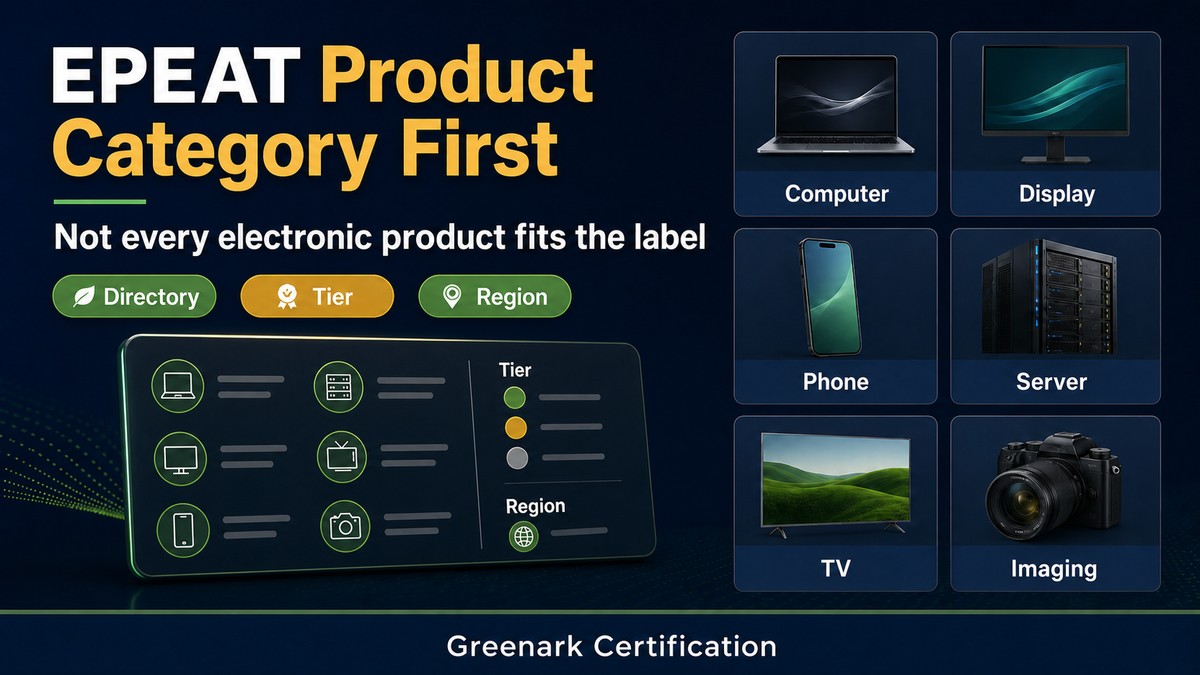
EPEAT is operated by the Global Electronics Council (GEC). It uses product-category criteria to assess environmental and social impacts and lists qualifying products in the EPEAT Registry. The current EPEAT 2.0 criteria apply to Computers & Displays, Imaging Equipment, Mobile Phones, Servers and Televisions, while solar modules and inverters have separate criteria. The applicable category and criteria version determine which requirements can be checked.
Registration does not automatically establish compliance with every country’s mandatory law, a marketplace policy, a private procurement rule or a separate claim about RoHS, REACH, energy efficiency, recycled content or product carbon footprint. Keep those claims tied to their own clauses and product evidence instead of treating EPEAT as a catch-all certificate.
Match the product category with the criteria version
The EPEAT Registry currently identifies both EPEAT 1.0 and EPEAT 2.0 records. For applicable categories, the official criteria page says that EPEAT 1.0 products remain visible during the transition until 1 July 2027. A useful record should capture the product category, product type, manufacturer, model or product identifiers, location of use, criteria version, registration status and relevant date.
Do not infer a category from a broad product name. A display, computer, server, phone, television, printer or other imaging product may be governed by different definitions and criteria. “Electronic product” is not enough to establish EPEAT coverage, and an adjacent product or manufacturer record should not be used as a substitute.
How to read Bronze, Silver and Gold
EPEAT tiers are based on required criteria and optional points. The current official tier explanation states that Bronze meets all required criteria; Silver meets all required criteria and at least 50% of optional points; and Gold meets all required criteria and at least 75% of optional points. The product detail page and applicable criteria version remain the controlling evidence for a particular registration.
Being listed in the Registry and achieving Gold are therefore different facts. If the official record supports Bronze, a product page should not call it Silver or Gold. EPEAT Climate+ is an additional climate-related designation and should be stated separately from the ordinary EPEAT tier.
Evidence to keep for each model
Create one evidence record for each marketed model. At minimum, keep:
- brand, manufacturer, model, series relationship and the link between the registered product and the marketed SKU;
- the EPEAT Registry record, including category, product type, location of use, criteria version, tier, status and date;
- the required and optional criteria for the applicable category, together with supplier evidence for materials, energy, chemicals, repair, end-of-life, packaging and supply-chain topics;
- the exact EPEAT, tier and Climate+ wording planned for the product page, with source links and a review date; and
- a change-control record when the model, configuration, manufacturer or supply chain changes.
EPEAT 2.0 reaches across the product life cycle and supply chain; evidence should not be limited to the final assembly site. The official verification model uses approved conformity assurance bodies (CABs). Brands and manufacturers should follow the current EPEAT process and the applicable CAB requirements.
Three checks before publishing a claim
First, confirm scope. Confirm the product type, category, criteria version and location of use. Do not substitute another model, manufacturer or category.
Second, confirm wording. Make the EPEAT, Bronze/Silver/Gold and Climate+ wording match the official record, and separate EPEAT facts from other laws, procurement policies and voluntary claims.
Third, confirm currency. The Registry is updated and product status, criteria version, model and location details can change. Keep the review date and source link; if the record no longer matches the page, narrow or pause the claim until it is checked again.
Bottom line
A reliable EPEAT check connects the product category, criteria version, official Registry record, tier and page wording. Only after that mapping is complete should you separately assess destination-market law, buyer requirements and evidence for other environmental claims. This keeps the conclusion within what the EPEAT registration actually supports.


