
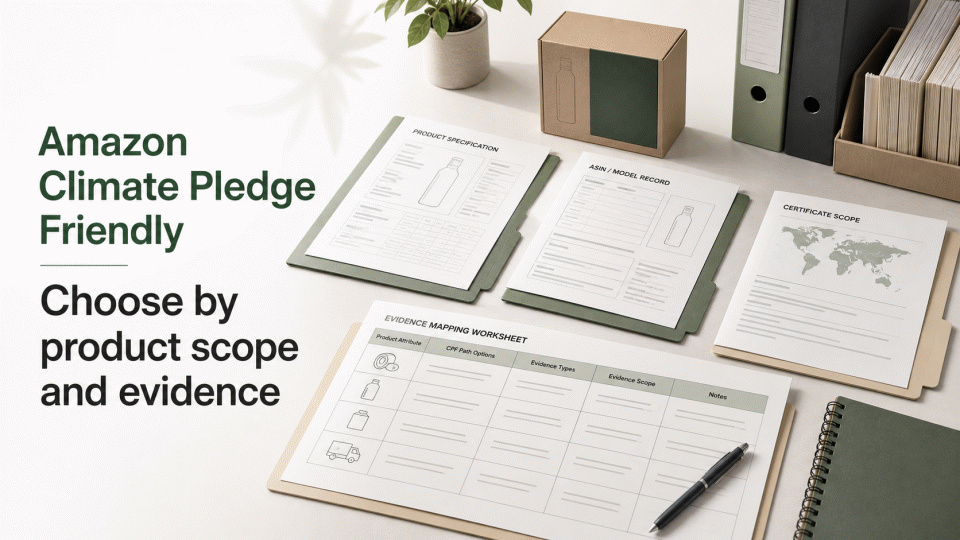
Choosing an Amazon Climate Pledge Friendly (CPF) path is an evidence-mapping exercise, not a search for one universally “best” certification. The available certifications, eligible categories, marketplaces, and submission routes can change. This article does not promise certification approval, badge display, traffic, or sales results.
Use this order: confirm the current CPF rules for the target marketplace and product, identify the product attribute that the evidence actually supports, and then check whether the certificate, test report, or chain-of-custody record matches the specific ASIN, model, and product version.
1. Confirm the current CPF route first
Amazon describes Climate Pledge Friendly as a program that helps customers identify products with qualifying sustainability certifications or program attributes. Whether a certification is accepted, whether a category is eligible, and which Seller Central submission route applies should be checked in the current official guidance for the target marketplace. A third-party list, an old tutorial, or a supplier statement is not enough on its own.
Create a route record for each product with the marketplace, ASIN, brand or selling entity, category, certification name and version, certificate number, certificate holder, covered products or models, validity information, submission route, and review date. Mark anything that cannot be confirmed from the current program guidance or the original certificate as pending verification.
2. Screen candidate paths by the product attribute
Category is only a first filter; it does not replace the scope of a standard. The following examples can help build a candidate list, but they are not a permanent CPF eligibility list:
- Textile harmful-substance safety: review OEKO-TEX® STANDARD 100 for its product classes, component scope, testing conditions, and certificate details. It addresses harmful-substance testing for textiles and components; it is not a recycled-content, organic-fibre, or full supply-chain certification.
- Recycled material and chain of custody: compare standards such as RCS and GRS by their material-claim, chain-of-custody, and organization requirements. The word “recycled” alone does not establish conformity; connect the certificate scope, material type, batch, and transaction evidence to the product.
- Organic or other product attributes: confirm the standard’s definition, product scope, and processing coverage before deciding that an upstream material statement supports a finished-product claim.
- Paper and wood, energy, carbon, or broader environmental attributes: these paths evaluate different objects and require different evidence. Review the relevant standard and then confirm whether the path is currently usable for CPF in the target marketplace.
3. Use an evidence matrix for the actual ASIN or model
Do not use one supplier certificate to cover every SKU. Create one row for each ASIN or model and check:
- Identity: whether the brand, certificate holder, selling-account entity, importer, or responsible entity is consistent or supported by a documented relationship.
- Product: whether the model, SKU/ASIN, colour, size, formulation, material composition, and production version appear within the certificate, report, or attachment scope.
- Scope: whether the document covers a raw material, component, facility, processing stage, or finished product. Do not expand an upstream scope into a finished-product claim.
- Time: whether certificates, reports, and transaction records are valid and traceable at the time of submission.
- Chain: where a chain-of-custody standard applies, whether purchasing, production, sales batches, and transaction evidence connect to the same product and claim.
- Page wording: state only the attribute the evidence covers. Passing a test is not the same as being “fully sustainable,” “risk-free,” or guaranteed to receive a badge.
4. Common mistakes
Treating CPF as one universal certificate. CPF is a platform program; the underlying evidence comes from a specific certification or program route. Check the certification scope and the platform submission requirement separately.
Treating the same category as the same certificate scope. Different materials, components, models, and production sites may require different documents. If the certificate does not cover a part of the product, add evidence or narrow the claim.
Substituting one attribute for another. Harmful-substance testing, recycled content, chain of custody, organic attributes, and carbon-footprint evidence answer different questions. They are not interchangeable.
Turning submission into a result promise. Completing a certification or submitting information does not mean Amazon will accept, display, or continuously retain a CPF feature. Keep submission records, official responses, and status checks, and review them against the current rules.
5. A minimum pre-submission file set
- Product and ASIN/model list, including materials, components, versions, and target marketplace.
- Official scope information for the candidate standard and the reason it was selected.
- Original certificates, reports, attachments, purchasing or transaction records, and verification details.
- Evidence of the relationship between the certificate holder and selling entity, where relevant.
- Draft page wording, evidence-to-claim map, submission route, and review date.
If the evidence supports only a component or batch, keep the claim within that same boundary. If the current CPF rule, product eligibility, or certificate-to-ASIN relationship is not confirmed, pause submission and keep a documented open-items list.
Sources and limits
This framework draws on Amazon Seller Central’s public Climate Pledge Friendly program explanations, Textile Exchange material on RCS/GRS chain of custody, and OEKO-TEX® public information on STANDARD 100 testing and certificate scope. Program eligibility, recognized paths, and submission routes can change; check the current official guidance for the target marketplace before use. 绿色方舟(深圳)认证有限公司 can help organize the correspondence between products, certificates, and page wording, while the relevant standards body and Amazon make the certification and platform decisions under their own rules.


