
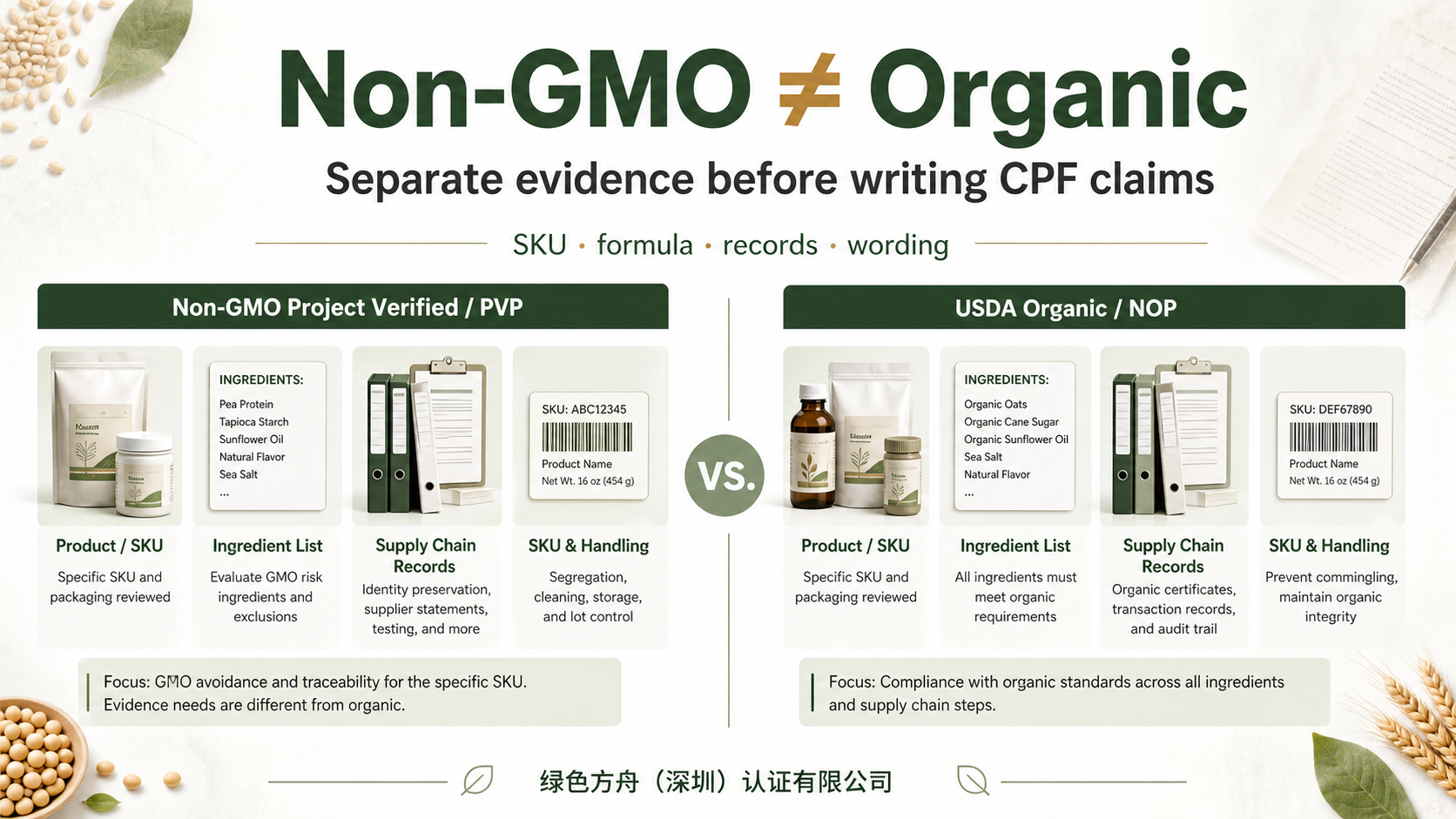
Non-GMO Project Verified and organic certification may appear in the marketing records of food and agricultural products, but they are separate programs. For a Climate Pledge Friendly (CPF) submission or review, align the certification scope, certificate holder, product formula, supply-chain records, and page wording as separate evidence questions.
1. Keep the two programs distinct
Non-GMO Project Verified: The Project describes its Product Verification Program (PVP) as an evaluation against the Non-GMO Project Standard and program rules. The Standard addresses the product and its inputs, including risk and testability, as well as segregation, cleanout, traceability, and quality-assurance controls in the supply chain. The current Standard, program rules, technical-administrator instructions, and product records are the controlling references for a review.
USDA Organic: USDA’s Agricultural Marketing Service administers the National Organic Program, which establishes and enforces U.S. organic production and labeling rules and accredits certifying agents. A supplier statement or a general “natural” or “non-GMO” description is not a substitute for checking the applicable organic category, certifier, and finished-product label.
2. Build two evidence paths for CPF records
For the Non-GMO path, match the product name, brand, formula or inputs, manufacturing details, and label to the current verification record. Keep the program or verification documents, product label, supplier and ingredient records, and any applicable testing, affidavits, traceability, and quality records. Recheck the file when the formula, production site, key input, or label changes.
For the organic path, confirm that the relevant production or handling operation is certified by an applicable certifying agent and that the certificate covers the current SKU, site, and scope. Check the organic-content category, ingredient statement, certifier name, and the labeling rules for the target market. An organic ingredient certificate does not automatically make the finished product an organic product.
Both paths may exist for one SKU, but keep their document numbers, status, scope, review date, and permitted wording separate. Non-GMO evidence does not replace organic certification, and organic evidence does not prove that the product has been verified by the Non-GMO Project.
3. Map each claim to the SKU and page field
For each SKU, record the brand and product name, formula or ingredient version, production and handling sites, suppliers and relevant lots, certificate or verification number, certifier or program owner, scope, status, review date, packaging version, sales market, and proposed page wording.
Every page statement should return to a specific record. If the evidence supports a verified program claim, use the program’s permitted name and mark rules. If only an ingredient is organic, do not describe the whole finished product as organic. If the file supports a Non-GMO claim, do not expand it into “organic” or an unsupported “100% GMO-free” statement. For CPF, check the current platform criteria for the relevant category and marketplace; the presence of a certification mark does not by itself prove platform eligibility.
4. A four-step pre-submission review
- Check the parties: identify the brand owner, manufacturer, handler, importer, and certificate holder, and document how they relate to the listing entity.
- Check the scope: confirm that the product name, formula, site, facility, and market covered by the record match the current SKU and label.
- Check the wording: keep “program verification,” “organic certification,” “organic ingredient,” and “non-GMO” as distinct claims; do not enlarge the certified scope.
- Check the version: use current program rules, certifier guidance, label rules, and platform pages; retain the access date and source files, and reassess after material product or market changes.
5. Sources and limits
This reference uses the Non-GMO Project’s Standard and Product Verification Program overview and Program Rules and Procedures, together with USDA AMS resources for the National Organic Program and U.S. organic-market labeling. Program rules, certification status, platform criteria, and market labeling requirements can change independently. Before submission, use the current source pages, certificates, and product records for the relevant market.
绿色方舟(深圳)认证有限公司 can help organize the product–evidence–page mapping. It does not replace the final determination of the program owner, certifier, regulator, or platform.


