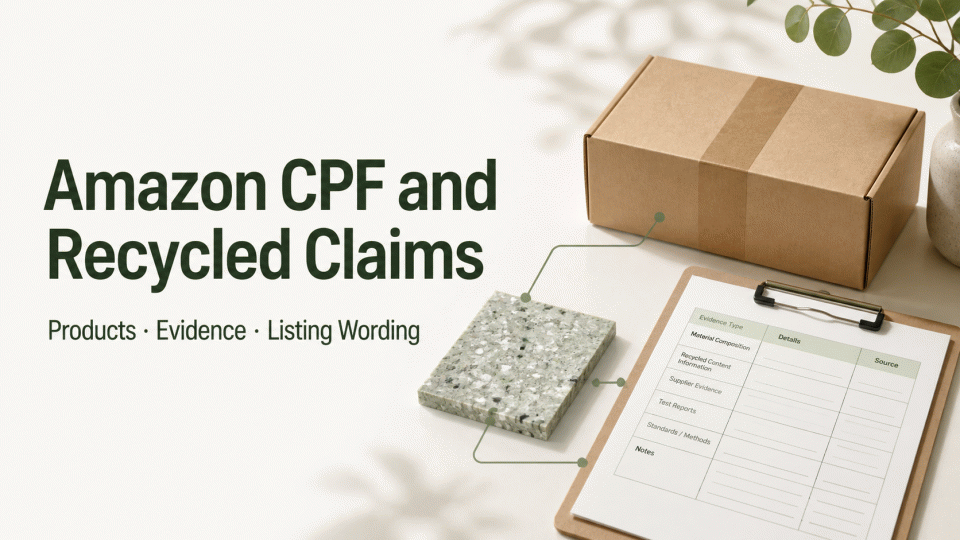
Adding the word “recycled” to a listing does not automatically make a product Climate Pledge Friendly (CPF). Amazon describes CPF as a program that uses qualifying third-party certifications and Amazon-created certifications to highlight a product’s particular sustainability attributes. Whether a product is recognised, in which marketplace, and which feature is displayed must be checked against the current program information and Seller Central record. This article separates material facts, certification or transaction evidence, listing wording and platform recognition; it does not promise CPF recognition, enrollment, traffic or sales results.
1. Separate four objects: material, certificate, page and CPF
“Recycled” may describe the product, its package or one component. Start by fixing the SKU, model, variant, formulation or material composition, package version, marketplace and listing field. Record whether each claim refers to the product, package or component.
Maintain a separate record for the evidence: holder, certificate number, standard, scope, product or material description, transaction chain and document version. A certificate or supplier statement cannot be copied to another SKU without checking the named entity, model, facility, formulation and transaction scope. If those fields do not match, mark the item for review rather than assuming it applies.
CPF is a platform recognition layer, not a universal environmental certificate that replaces other records. Amazon’s program materials explain that the program works with multiple third-party certifications and maintains its certification landscape. The applicable route, submission process and display status therefore need to be checked in the current program materials or Seller Central.
2. Bring the recycled claim back to the material fact
The FTC Green Guides state that recycled-content claims should concern material recovered or diverted from the waste stream during manufacturing or after consumer use. When only part of a product or package contains recycled material, the claim should clearly identify the product, package or component and the supported basis or percentage. Do not replace an incomplete calculation with “fully recycled,” “green product” or “zero impact.”
At minimum, an evidence sheet should record the material, product or package component, source, pre- or post-consumer basis where relevant, calculation method, purchase or batch reference, supplier or manufacturing entity, covered SKU, wording version and review date. The meaning of mass-balance, transaction-certificate or supplier evidence depends on the relevant standard and program rules; one type of chain evidence cannot automatically prove the same physical recycled percentage in every material.
If the listing also uses recyclable, renewable, compostable or carbon-reduction language, review each claim separately. Recyclability depends on collection and processing conditions in the markets where the item is sold. It is not the same claim as recycled content and is not established by green colours or a recycling-style graphic.
3. Connect every document to the SKU and page field
Use an SKU–claim–evidence matrix. Rows can represent a SKU, variant or package version; columns can capture the product or package component, exact page wording, material claim, certification or standard, transaction record, composition or test information, evidence holder, scope, source link and open question. Each customer-facing statement should lead to a specific file and a defined scope.
Supplier certificates, transaction certificates, purchase orders, invoices, bills of materials, formulations and composition records must be checked for entity and version alignment. A document supports the SKU only when the entity, model, material, batch or transaction chain can be connected. Retain older versions for traceability, but mark them clearly when a new package, formulation or marketplace is outside their scope.
Before submission or an update, retain the current listing record, file names, submission date, account or marketplace, platform feedback and manual review result. Successful upload only means that a file was received; it does not by itself prove CPF recognition or complete the factual and legal review of the environmental wording.
4. Keep the page wording within the evidence boundary
Put the specific fact before the environmental shorthand, for example, “the package contains reviewed recycled paperboard” or “this component contains X% recycled material,” but use a percentage only when the product or package scope and calculation basis are documented. Do not turn a package percentage into a claim about the whole product or convert a supplier’s general marketing phrase into a confirmed brand or SKU fact.
Avoid “writing recycled gets CPF,” “submission means approval,” “valid in every marketplace,” “guaranteed display” and “permanently valid certification.” Keep CPF recognition, third-party certification, legal obligations, customs decisions, marketplace status and buyer review as separate questions. Recheck each market, category, material and version when the program page or the product changes.
GreenArk (Shenzhen) Certification Co., Ltd. may help organise the evidence relationship between products, materials, certificates and page wording, but it does not make Amazon, certification-body, regulator or buyer decisions.
5. Manual pre-submission checklist
Confirm that: the wording identifies the product, package or component; the recycled-content source and calculation are documented; the entity, model, scope and version match across the evidence; percentages, comparison bases and qualifiers are clear; the wording does not expand the evidence into a CPF, regulatory or sales outcome; and the current marketplace program materials or Seller Central record have been manually checked.
Keep the source files, versions, evidence links, submission records and discrepancy notes. If the entity is mismatched, the material scope is unclear, the record cannot be traced or the wording exceeds the evidence, pause that claim and resolve the gap instead of substituting a generic certificate, old report or “platform received it” message.
Sources: Amazon Climate Pledge Friendly and sustainability materials, current Amazon Seller Central program records, and the FTC Green Guides on general environmental claims, recycled content and recyclable claims. This is an evidence and listing-wording reference, not a conclusion for a particular SKU, marketplace or account.