
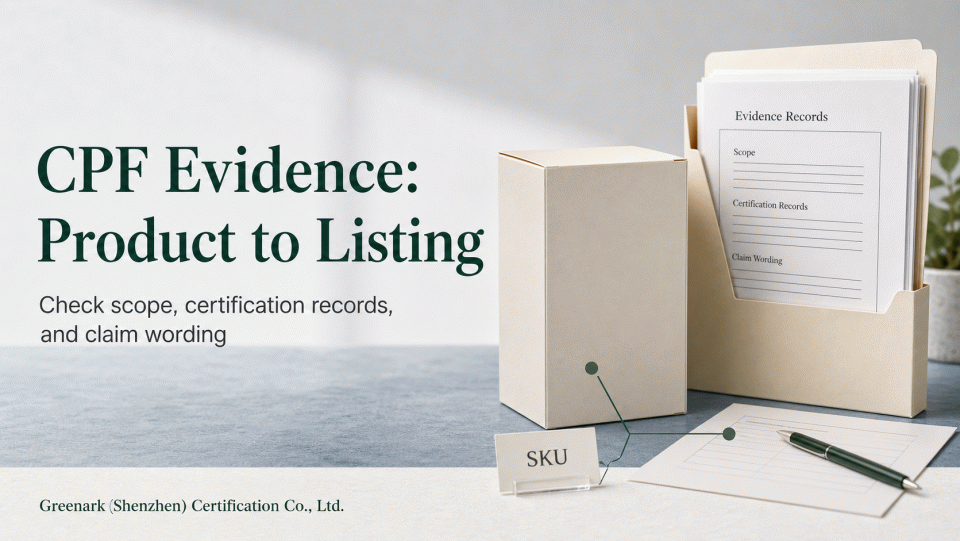
Climate Pledge Friendly (CPF) is an Amazon program that helps customers identify products with sustainability features. Amazon describes the program as working with trusted third-party certifications and Amazon-created programs; product recognition remains subject to the current program rules and the seller workflow available in the relevant marketplace.
1. Define the CPF object
Start a product record for the ASIN, SKU, variation, brand, model or formula, packaging components, marketplace, and responsible entity. Do not treat a supplier certificate, a brand-level statement, or a record for another product as proof for the current ASIN without checking its scope. A change in product, variation, materials, or marketplace may require a fresh review.
Separate three layers in the file: CPF program recognition, mandatory rules in the target market, and customer or retailer requirements. They have different sources, submission routes, and responsibilities; a generic compliance folder cannot replace the distinction.
2. Record what each document covers
Keep the certificate, scope page, transaction or supply-chain record, product specification, BOM, packaging information, and version history together. Check the holder, brand or product scope, material or attribute, marketplace, issue or update information, and stated limitations. Record only what the document supports; leave an unverified field open rather than filling it by assumption.
For recycled content, organic content, chemicals, or carbon-related claims, identify whether the claim concerns the whole product, a component, the packaging, or a supply-chain step. Preserve the applicable calculation basis, batch, or transaction record. A scheme that covers a material or supplier does not automatically support the same wording for the finished product.
3. Map evidence back to the listing
Register each customer-facing sentence as “claim—object—evidence—limitation.” If the file supports a packaging component, do not rewrite it as an unconditional environmental conclusion about the entire product or brand. If the evidence is limited to one marketplace or version, retain that boundary in the review record. Listing language should stay within the evidence and avoid absolute or unqualified environmental-effect claims.
Before submission or an edit, manually compare the ASIN/SKU, images, title, bullets, detail-page claims, certificate scope, and responsible entity. Repeat the mapping review when the product, packaging, supplier, certification scope, or page wording changes.
4. Checklist and boundary note
Organize the file into four groups: product and version records; responsible-entity and brand-authorisation documents; certificates, scope pages, testing or supply-chain records; and listing claims with manual review notes. The exact file set depends on the product, marketplace, scheme, and current Amazon workflow; do not assume one universal validity period or outcome.
Amazon’s CPF program page is a program explanation, not legal advice for every market and not a promise of eligibility, review outcome, or listing duration. For mandatory requirements in the United States, European Union, Japan, or another market, return to the relevant authority, source text, and product scope. Greenark (Shenzhen) Certification Co., Ltd. can help organize the product–document–listing relationship; the responsible entity remains responsible for confirming the submission against current rules.
Source
Amazon, Sustainability Solutions Hub (Climate Pledge Friendly program description and seller entry point, accessed 2026-08-24).


