
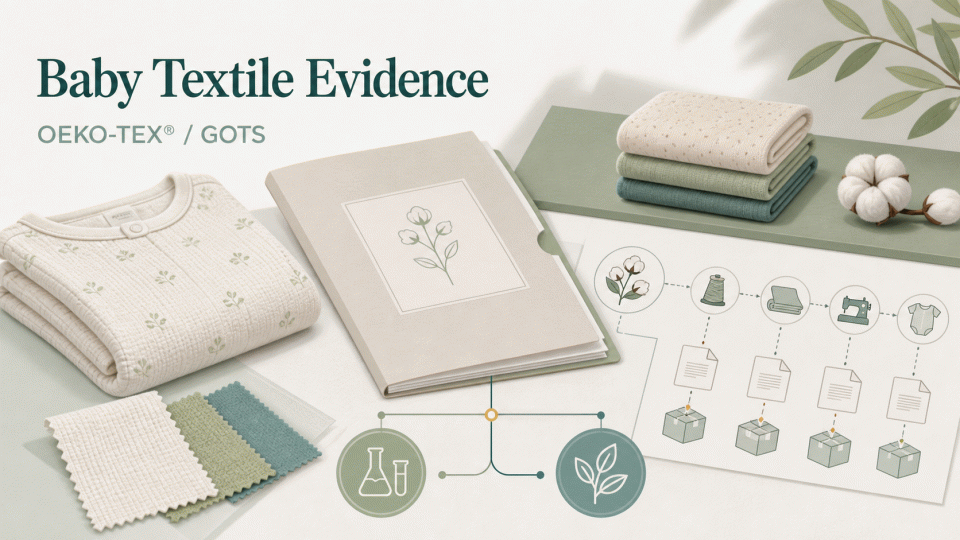
When OEKO-TEX® and GOTS appear on a baby-textile product page, treat them as different evidence paths rather than interchangeable “green certificates.” OEKO-TEX® STANDARD 100 is centered on testing textile articles and accessories for harmful substances. GOTS addresses organic fibres together with requirements across textile processing, manufacturing, trading and labelling. The practical unit for review is the specific product, holder, certificate scope and shipment evidence.
1. What the two programmes address
OEKO-TEX® STANDARD 100 is a testing and certification system for textile raw materials, intermediate products, finished articles and accessories. Its product classes are based on intended use: Product Class I covers products for babies and young children, Class II covers products with direct skin contact, Class III covers products with little or no direct skin contact, and Class IV covers decoration materials. The baby-product class has stricter requirements, but that should not be expanded into an absolute safety statement or a conclusion that every destination-market rule has been met.
GOTS, the Global Organic Textile Standard, covers textile supply-chain requirements linked to organic fibres and qualified processing, manufacturing, trading and labelling activities. A GOTS Scope Certificate lists the certified entity’s product categories and qualified activities; relevant facilities and subcontractors are recorded within the certification scope. It shows what the entity is qualified to handle within the listed scope. It is not a substitute for shipment-specific evidence.
2. Map evidence to the baby-textile SKU
Start with an SKU–material–component–supplier–batch map. A baby sleepsuit, blanket, bib or sleeping bag may include fabric, sewing thread, prints, coatings, filling, buttons, zippers and elastic components. If the page refers to OEKO-TEX® STANDARD 100, check the certificate or label against the article, materials or accessories covered, holder, product class and current status. A supplier’s general promotional image is not enough to extend coverage to another SKU.
If the page refers to GOTS, check the supplier’s Scope Certificate and product appendix, the certified processing or trading activities, the listed facilities or subcontractors, and the relevant Transaction Certificate (TC). Also check whether the final label, packaging and advertising comply with the GOTS Conditions for Use of Signs. A certificate cannot be used for product categories that are not listed in its scope.
GOTS label grades also need a separate review. Official GOTS materials distinguish expressions such as “organic” and “made with organic.” Do not turn an organic-fibre statement into “GOTS-certified,” or combine label grades into “100% organic,” without checking the applicable standard, product appendix and sign-use conditions.
3. Fields for a practical evidence register
Product fields: SKU, product name, intended age group, fibre composition, colour, size, production batch, key components and sales-page reference.
OEKO-TEX® fields: the exact programme name, certificate or label number, holder, product class, covered materials or accessories, issuing institute, status check and the precise wording permitted by the evidence. The official Label Check can be used to check a label or certificate number.
GOTS fields: Scope Certificate number, certified entity, product appendix, processing or trading scope, facilities or subcontractors, Transaction Certificate number, shipment or batch, buyer and seller, label grade, certification body and sign-use record.
Page fields: the programme name used on the page, traceability of certificate numbers, whether a logo is authorised, whether the Chinese and English pages describe the same scope, and which statements are company descriptions rather than certification conclusions.
4. Three common mix-ups
Turning a safety test into an organic claim: STANDARD 100 can support a factual description of the harmful-substance testing scope. It does not, on its own, prove organic farming origin or replace GOTS supply-chain evidence.
Turning a scope certificate into shipment proof: a GOTS Scope Certificate describes the entity and listed scope. It does not, on its own, prove that a particular shipment meets GOTS product requirements; check the TC and its product, quantity and trading-party details.
Turning a programme name into a legal conclusion: neither programme automatically replaces mandatory destination-market rules, children’s-product requirements, labelling rules or platform documentation. Keep any legal-compliance assessment in a separate file and do not infer it from the OEKO-TEX® or GOTS name.
5. Final page review
First, confirm that the title, cover and body refer to the same product scope. Second, open the certificate or official status record and check the holder, number, product appendix, status and relevant batch. Third, archive GOTS SC and TC documents separately. Fourth, align the OEKO-TEX® product class and testing language with the actual certificate. Finally, remove unsupported phrases such as “zero risk,” “absolutely safe,” “automatic approval,” “globally valid” and “guaranteed listing.” For client projects, 绿色方舟(深圳)认证有限公司 can assess whether the available records support the proposed page wording.
Sources: OEKO-TEX® STANDARD 100 official overview and product classes; Global Standard GOTS certification and labelling; GOTS Version 8.0 standard. Use the applicable current official version, certificate and sign conditions at the time of publication.


