
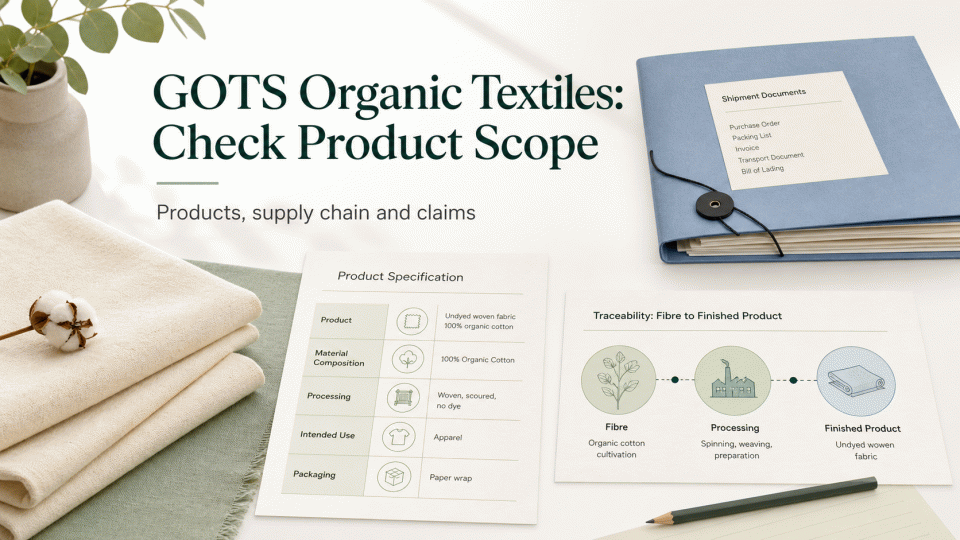
A product page should not rely on a photograph of a cotton field or on a generic supplier certificate. The product, processing steps, certified entity, transaction records and proposed wording need to form one reviewable evidence chain. This reference page uses public Global Organic Textile Standard (GOTS) materials to explain how to check organic-textile product scope.
1. Separate organic fibre from a GOTS product
Organic cotton describes a raw-material attribute. GOTS is a voluntary standard covering relevant processing and trading activities from organic fibre through textile manufacturing, finishing, sewing, packing and labelling. A photograph of the field does not establish that a particular garment, fabric or home-textile item falls within GOTS certification scope.
Start with a product register: product name, style or SKU, fibre composition, colour and processing, production and trading entities, and the proposed label or page claim. If the item contains other fibres, trims or processing at another site, check each element against the applicable certificate and product appendix. GOTS does not replace the laws of the destination market; safety, labelling and market-entry requirements still require separate review.
2. What Scope Certificates and Transaction Certificates show
A Scope Certificate states that a certified entity is able to process or trade the listed product categories under GOTS. It is not, by itself, proof that a particular shipment contains GOTS-certified goods.
A Transaction Certificate relates to a specific shipment or transaction. It can identify the listed products, batches, quantities, buyer and shipment details, and is used to attest the GOTS status of those goods. On receipt, compare the TC with the invoice, packing list, transport records, product marking, batch information and the actual supplier.
A useful evidence register records the legal name and status of each certificate, certificate number, product category, processing or trading scope, facilities or subcontractors where relevant, product SKU or batch, the SC-to-TC relationship, and destination-market checks that remain outside the certificate.
3. Map the product from fibre to finished item
- Product: retain the specification, fibre composition, BOM or trim list, colour and process description. State whether the claim concerns the raw fibre, fabric or finished item.
- Entities: match the brand owner, manufacturer, processor, trader and shipper to the relevant records. Do not treat a supplier’s scope certificate as a certificate for every downstream product.
- Processing: map spinning, weaving, dyeing, printing, sewing and packing to the certificate product appendix and facility information. Re-check when a site, subcontractor or process changes.
- Transaction: keep the purchase order, invoice, packing list, transport record, batch information and TC together, and compare quantities, parties and product descriptions.
- Page wording: use only wording supported by the evidence. Without matching scope, product records or sign approval, do not turn “contains organic cotton” into “GOTS-certified finished product.”
4. Review GOTS signs and page claims separately
GOTS signs and references to GOTS certification are subject to programme conditions. The official labelling guidance states that product marking must include the applicable label grade, the certifier information and the certified entity’s licence number or name, and that labelling should be approved by the certification body before use. The same discipline applies to web pages, catalogues, packaging and advertising.
Keep a claim-to-evidence table: what is the claim about—raw material, process, product or shipment; which SC, TC, product appendix or approval supports it; and does the wording add an unsupported percentage, performance, market-access statement or certification outcome? GreenArk (Shenzhen) Certification Co., Ltd. should base customer-facing guidance on verified certificates and product records, without promising a certification result.
5. Version and document checks for GOTS 8.0
Global Standard’s public materials state that GOTS 8.0 was released in 2026 and that audits and assessments conducted from 1 March 2027 are to follow version 8.0. During the transition, confirm the applicable version with the certification body and the current official documents. Do not automatically treat an old certificate, label artwork or page screenshot as current evidence.
Repeat the scope and document mapping when the fibre composition, processing site, supplier, trading relationship or page claim changes. A complete file should answer four questions: who is certified, what does the certificate cover, which transaction record maps to the shipment, and which evidence supports each sentence on the page.


