
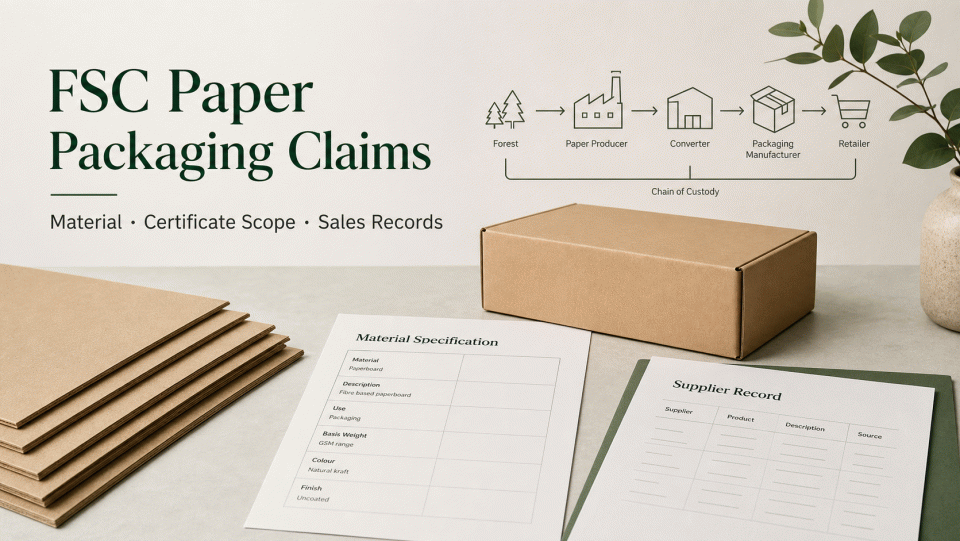
A paper box cannot be described as FSC-related merely because a supplier has shared a certificate or a mark appears on artwork. The specific packaging product, material category, supply-chain parties, sales documents and proposed wording should be reviewed as one evidence chain. This article is a reference for organizing evidence and wording for forest-based packaging. It does not replace a certification body's assessment and does not extend a packaging-material claim to the product inside the package.
1. Separate the packaging from the product
FSC chain of custody controls the identification, handling and sale of relevant forest-based material through the supply chain. A box may be reviewed as a packaging product, but that does not automatically establish an FSC scope for the item inside, the brand owner or the entire packaging system. A working record should separate the packaging SKU, paper or board type, forest-based components, production and printing steps, selling entity, and the exact object described on the page.
Where a package includes a box, insert, hangtag or paper sleeve, review each component and supplier separately. Evidence covering a paper box does not replace evidence for a plastic insert, metal accessory or the packaged product. Only components supported by the relevant certificate scope, product classification and sales records should be included in the related claim.
2. Check certificate scope, not just the certificate name
FSC Chain of Custody requirements address the sourcing, processing, identification and sale of FSC-related material. Review the certificate or public certificate information for the certificate holder, sites, status, product classification and included activities. The entity that buys, prints, converts or sells the packaging should be checked against the relevant scope.
Common material claims include FSC 100%, FSC Mix, FSC Recycled and FSC Controlled Wood, but these terms are not interchangeable marketing labels. FSC 100% refers to FSC-certified virgin material from FSC-certified forests or plantations that has not been mixed with another material category in the supply chain. FSC Mix may involve FSC-certified, controlled and/or reclaimed sources, with the output claim depending on the applicable control system and supply documents. FSC Controlled Wood is a controlled material category and is not the same as an FSC 100% product. The final wording should follow the actual sales documents, product group and approved trademark use.
3. Build a packaging–entity–document map
Keep one evidence row for each packaging SKU. It should normally identify:
- Artwork, dimensions, material composition, quantity and production batch;
- Supplier and site, selling entity, certificate holder and certificate number;
- Purchase orders, invoices, delivery or transport records, and the FSC claim on sales documents;
- Applicable product classification, control system, label or trademark approval record;
- The exact wording proposed for the product page, package and customer materials.
The records should point to the same material or product. A supplier certificate may help establish the supplier's scope, but it does not by itself prove that every packaging SKU sold by a brand can carry an FSC claim. Compare the sales-document claim, quantity, product description and entity. If a name, site, product category or batch does not match, hold the page wording and obtain clarification from the supplier or certification body.
4. Set boundaries for packaging and page wording
Make the object of the claim explicit. “This box uses material identified as FSC Mix in the supplier's records” is not the same as “this product is FSC certified.” The first still requires a check of the sales record, product scope and trademark rules; the second may incorrectly extend a packaging claim to the whole product. Do not use wording such as “the complete product,” “the entire set” or “all brand SKUs are certified” unless the evidence supports that exact scope.
FSC trademarks, labels and promotional wording are governed by dedicated requirements. Before using them, confirm who is authorized, which product the mark represents, whether artwork approval is required, and whether the page accurately states the FSC claim. Without supporting evidence, describe the box's material, specification and document status instead of presenting a broad “sustainable” statement as a certification conclusion.
5. Minimum review before publication
Before publication, answer five questions: Is the claim about the box, paper, packaging combination or packaged product? Do the certificate holder, site and supply-chain activities match? Does the product classification and FSC claim appear in the relevant sales or delivery records? Does the artwork use an approved label and trademark expression? Do the Chinese and English title, summary, body and images point to the same packaging scope? If any answer is unsupported by the available records, keep it as an open verification item rather than replacing it with “certified,” “fully compliant” or another predetermined outcome.
绿色方舟(深圳)认证有限公司 can help organize packaging SKUs, supply-chain records and page wording. The applicable FSC scope, trademark use and assessment outcome remain subject to FSC requirements, certificate-holder records and the formal review of the relevant certification body.


