
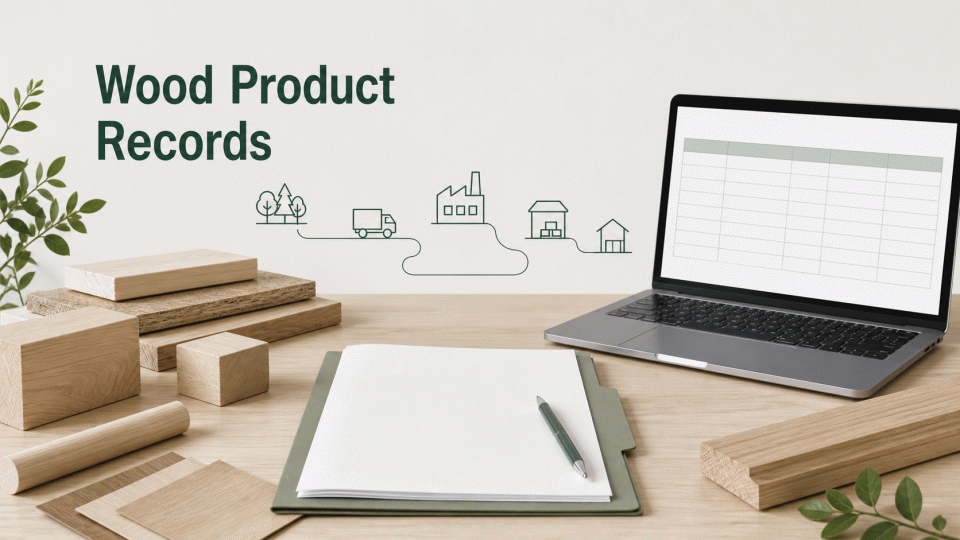
Before writing “FSC” on a wood-product page, connect the product, supply chain, certificate scope, sales documents and web wording in one evidence record. FSC Chain of Custody (CoC) is about identifying, tracking and communicating forest-based material through the supply chain. It is not an automatic claim that every wood product is natural, sustainable, or accepted in every market.
This reference page focuses on FSC record review for wood products. The usable claim still depends on the certificate holder, product group, transaction documents, applicable FSC requirements and trademark permissions for the actual case.
1. Define the review unit
Build a mapping of SKU, wood-based component, supplier, processing site, selling entity and target page. A finished product may contain solid wood, wood-based panels, paper packaging and non-forest materials. A supplier certificate should not automatically be extended to every SKU, material, site or brand.
Whether a seller needs its own CoC certification depends on facts such as taking legal ownership, manufacturing, repackaging or relabelling, and making an FSC claim in sales documents. FSC explains that organisations involved in processing, manufacturing or distribution and making FSC claims generally need the relevant chain-of-custody coverage; a retailer that only promotes finished, labelled products may have a different licensing route.
2. Check the holder, scope and status
Record the legal name of the certificate holder, certificate or licence code, certificate type, certification body, status, site, product category or product group, relevant wood or paper materials, and the actual trading parties. A supplier, brand owner, importer and store operator may be different entities; the file title alone does not prove coverage.
Use the official FSC certificate search to check an organisation name, certificate code or licence code, and retain the search date and a record of the result. A public record helps confirm status and scope, but it does not replace checking the current SKU, invoices, delivery documents and batch records.
3. Separate FSC 100%, FSC Mix and Controlled Wood
FSC 100% indicates that the relevant forest-based material in the labelled product comes from FSC-certified forests. FSC Recycled indicates recycled material. FSC Mix indicates an allowed combination of FSC-certified forest material, recycled material and/or FSC Controlled Wood. These are different claims and should not be replaced with the vague phrase “FSC wood.”
Controlled Wood is a material category within the FSC system; it is not the same as material from an FSC-certified forest. Its claims and permitted uses depend on FSC rules, product groups and the sales context. Do not describe Controlled Wood as FSC 100%, or describe FSC Mix as entirely sourced from certified forests.
4. Match transaction documents to the product
For each transaction or batch, retain purchase orders, invoices, delivery documents, product descriptions, quantities, dates, supplier certificate codes and the applicable FSC claim. Check that the product group covers the actual wood components and that the claim on the sales document aligns with the supplier record and the seller’s own scope. An FSC certificate is not a generic green-label document that can stand alone without product and transaction evidence.
When a supplier, processing site, material mix, packaging or SKU changes, review the product group, certificate scope, transaction documents and label version again. A prior review for another SKU is not automatic evidence for the new product.
5. Keep page and trademark wording within scope
A page should identify the product, the relevant material scope and the precise FSC claim supported by the records, such as “the relevant wood material for this product was purchased with an FSC Mix claim,” where the evidence supports that wording. Do not treat FSC evidence as an automatic extension of claims such as natural, sustainable, zero-deforestation, environmentally friendly or compliant with every law.
FSC labels, trademarks and promotional wording are subject to FSC requirements and licensing arrangements. Before adding a graphic mark, modified label or wording that could make consumers misunderstand the product scope, verify the applicable permission, label version and approval route.
6. Minimum review checklist
Record: (1) the SKU and each forest-based component; (2) supplier, processing site and selling entity; (3) certificate code, status, product group and certification body; (4) the exact FSC 100%, FSC Mix, FSC Recycled or Controlled Wood claim; (5) purchase, delivery and sales documents; (6) versions of packaging, labels, product pages and promotional material; and (7) the FSC source links, search date and retained evidence.
绿色方舟(深圳)认证有限公司 may help organise a review table based on the customer’s SKUs, supply chain and evidence files. The availability of a certification, trademark permission or product claim remains determined by the applicable FSC requirements, independent certification body and actual records.
Source basis: FSC Chain of Custody, What the FSC Labels Mean, and FSC Certificate Search. This is a record-review reference and does not replace a legal or certification assessment for a specific product, market or transaction.


