
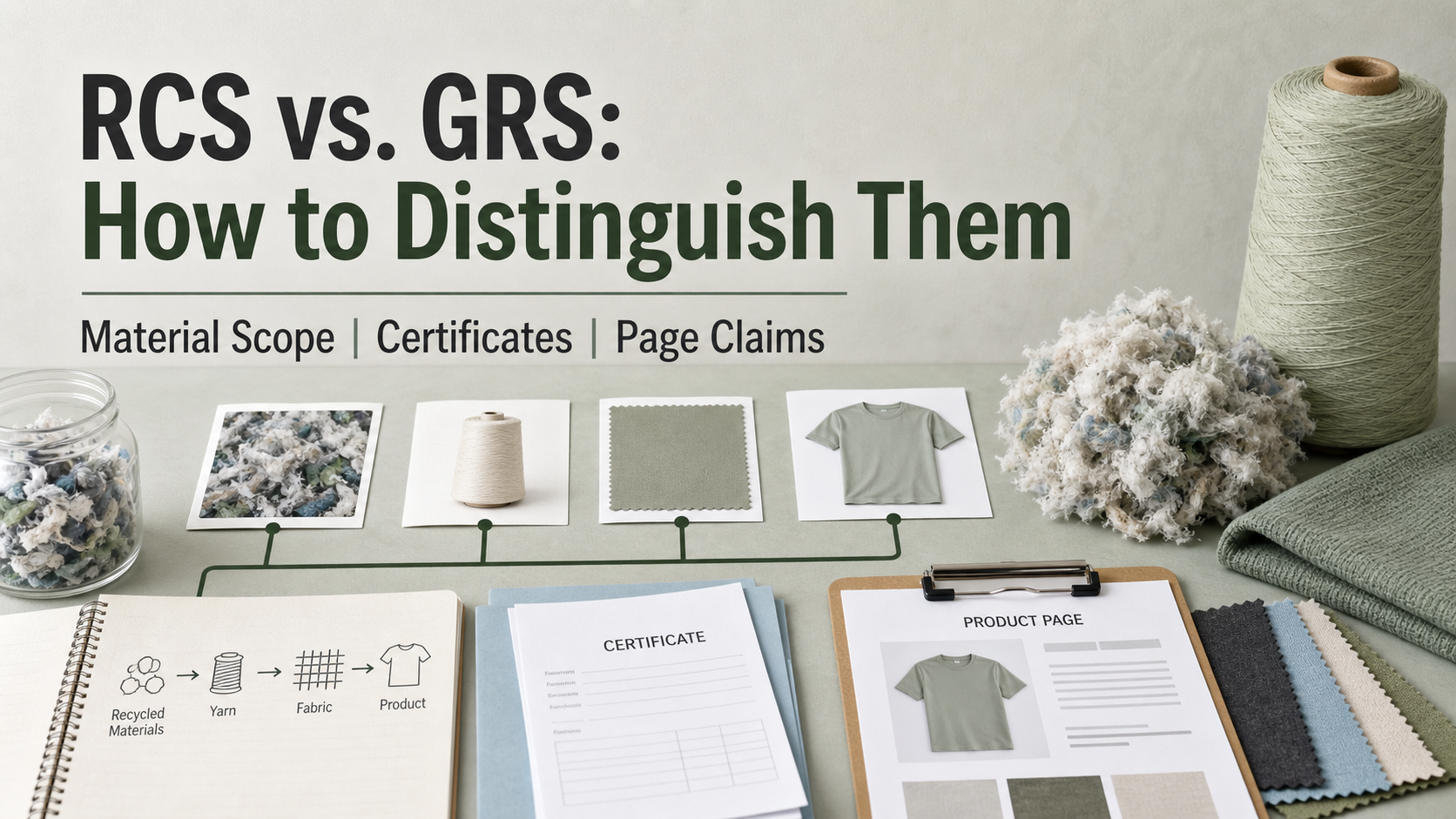
The Recycled Claim Standard (RCS) and Global Recycled Standard (GRS) both use third-party verification and chain-of-custody controls for recycled materials, but they do not cover the same requirements. Start with the product, certified sites, certificate scope and transaction records before deciding what a product page can say.
1. What RCS and GRS actually review
RCS is centered on recycled material and chain of custody. The review follows the recycled input, the handling or processing stages, and the route into the finished product. RCS does not assess social, environmental or chemical performance beyond the integrity of the recycled-material claim.
GRS also verifies recycled material and chain of custody, while adding social, environmental and chemical requirements at relevant processing sites. The applicable sites, processes and products must still be checked against the actual certificate scope and certification-body records.
Both are voluntary standards. They are not market-entry permits and do not establish that a product satisfies every platform or buyer requirement. A product-page statement should connect the standard name, the covered product and the supporting records in one product-to-evidence register.
2. Build a product-to-evidence register
Create one row per SKU or product family. Record the product and model, recycled material type, pre- or post-consumer input where relevant, formulation or components, production and trade stages, certified entity and site, standard, certificate scope, transaction-document reference and proposed page wording.
Do not treat a supplier's PDF as a universal credential. Check the certificate holder, certified sites, product categories or processes, status, applicable period and transaction coverage. If the supplier certificate does not cover your product or transaction, it cannot by itself support your product claim.
3. Keep SC, TC and chain-of-custody records distinct
Scope Certificate (SC): identifies the organization, sites, processes or product scope included in certification. It answers “which entities and activities are covered”; it does not, by itself, prove that a particular shipment completed a particular transaction.
Transaction Certificate (TC): links a defined transaction of certified material or products to chain-of-custody records. Reconcile it with purchase orders, invoices, shipping records, batches and product information. The need for a TC and the issuing process depend on the applicable standard and certification-body procedure.
Where material passes through several processing or trading stages, review every relevant certified site and document in sequence. One SC is not a substitute for all stages, and an unrelated TC cannot support arbitrary SKUs.
4. Keep the product-page wording within the evidence
Every sentence should trace back to the product-to-evidence register. A page may describe a product as containing recycled material verified under a relevant standard only after confirming that the product is within the certificate and transaction scope. Do not expand “contains recycled material” into “fully sustainable,” “zero impact” or “meets all regulations.”
RCS and GRS names, marks and consumer-facing statements are also subject to separate claims and labeling requirements. Before publication, confirm the applicable version, any mark-approval process, the claim subject and the display context. Do not add unverified percentages, grades, origins or environmental outcomes.
5. Manual pre-publication checklist
① Keep the topic limited to RCS or GRS instead of blending in unrelated laws, platforms or schemes. ② Match product, material, SKU, site and certificate holder. ③ Reconcile SC, TC, purchase, invoice and shipping records. ④ Do not attribute GRS social, environmental or chemical requirements to RCS. ⑤ Keep page wording within the certificate, transaction evidence and claims policy. ⑥ When a version, threshold or transition point is uncertain, return to the current Textile Exchange document and the certification body.
绿色方舟(深圳)认证有限公司 can help organize product scope, supply-chain records and page wording in one review table. The applicable scope, certification decision and claim approval remain subject to the relevant standard, certification body and target-market requirements.
Source basis: Textile Exchange materials on RCS and GRS, the RCS and GRS FAQs, the RCS/GRS Quick Guide and the Standards Claims Policy. Documents and versions may change; confirm the current applicable version before use.


