
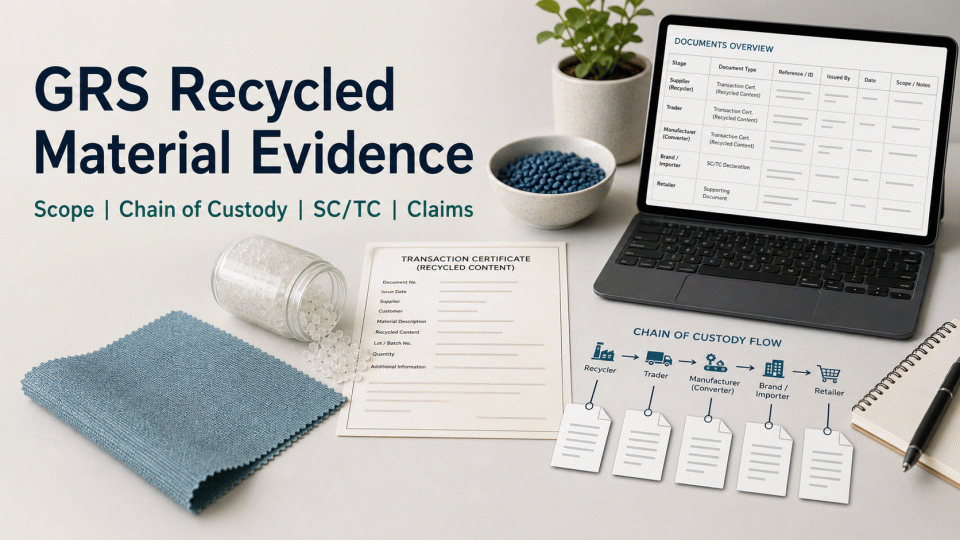
The Global Recycled Standard (GRS) is not a standalone “recycled material sticker.” A sound review connects the certified entity, product scope, material flow, transaction documents and the wording used on a product page or label.
1. Define what the GRS review covers
GRS is a product standard that uses the CCS chain of custody to track recycled material through the supply chain. The working unit should be specific: certified organization, site, product category, material description and shipment or product record. “The brand has GRS” or “the supplier has a green certificate” is not a sufficient evidence description.
Separate three questions: Is the entity within the certification scope? Is the product or material covered by the relevant scope and transaction documents? Does the proposed product claim have the required chain of custody and claims basis? One generic certificate cannot answer all three questions.
2. Scope Certificates and Transaction Certificates
A Scope Certificate (SC) confirms that an organization is qualified to produce or handle certified products. Review the holder, site, product category, material and standard scope. It answers: “What is this organization qualified to do within the system?”
A Transaction Certificate (TC) confirms that specific products or materials in a transaction or shipment are certified to the stated standard. It answers: “What specific transaction is supported?” A TC from a mid-supply-chain stage does not by itself prove that the chain continues beyond the supplier who issued it, and it does not remove the buyer’s own claims responsibilities.
Use a three-column product–certificate–transaction register. Map the product name, SKU or internal reference, material description and quantity to the SC product scope, then to the TC number, seller, buyer, shipment information and standard named on the document. If names differ, retain a written explanation and supporting evidence rather than treating similar names as automatically identical.
3. Do not merge GRS and RCS evidence
Textile Exchange explains that RCS and GRS both verify and track recycled materials that meet the ISO definition of recycled. GRS has a broader set of requirements, including social, environmental and chemical-processing criteria. Holding a GRS certificate does not automatically mean that an organization holds an RCS certificate; the named standard on the actual certificate and transaction documents controls the review.
The intended use also matters. Textile Exchange’s public FAQ describes GRS as a business-to-business tool for products containing at least 20% recycled content. For consumer-facing product claims such as hangtags, website claims or sewn-in labels, the FAQ states that at least 50% recycled input is required, together with the applicable claims policy and chain-of-custody requirements. The percentage is not an automatic permission for every product or wording; check the applicable version, scope and claim type.
4. Preserve evidence for pages, labels and buyer communication
A product claim should point back to a defined product and evidence record. Keep the product and material specification, supply-chain entities and sites, applicable SC, relevant shipment TCs, purchase or sales records, approved wording versions, label or packaging artwork, and any required brand-certification or approval record.
When a brand or retailer makes a product-related claim on a consumer page, hangtag or sewn-in label, confirm its role and certification requirements first. A supplier’s TC can support the receipt of a specific certified shipment, but it does not replace a complete chain of custody or the brand’s responsibility for the final claim and artwork.
Keep the company name, product name, material content, standard name and any logo use consistent with the certificate and approved claim materials. If the evidence does not support wording such as “certified product” or “GRS product,” narrow the statement to what the records actually establish or pause the wording until the evidence is complete.
5. A working checklist for procurement and content teams
1) Confirm the certified organization, site and product scope; 2) match the material name, recycled source and product/SKU; 3) check that the SC covers the relevant processing or trading stage; 4) retain the TC and transaction record for each claimed shipment; 5) test whether the chain of custody is continuous through the final claim; 6) separate B2B evidence communication from consumer-facing page or label claims; 7) link each published sentence to an evidence ID and version; 8) when 绿色方舟(深圳)认证有限公司 assists with the review, use the applicable standard, certificate text and actual transaction records as the basis for the conclusion.


