
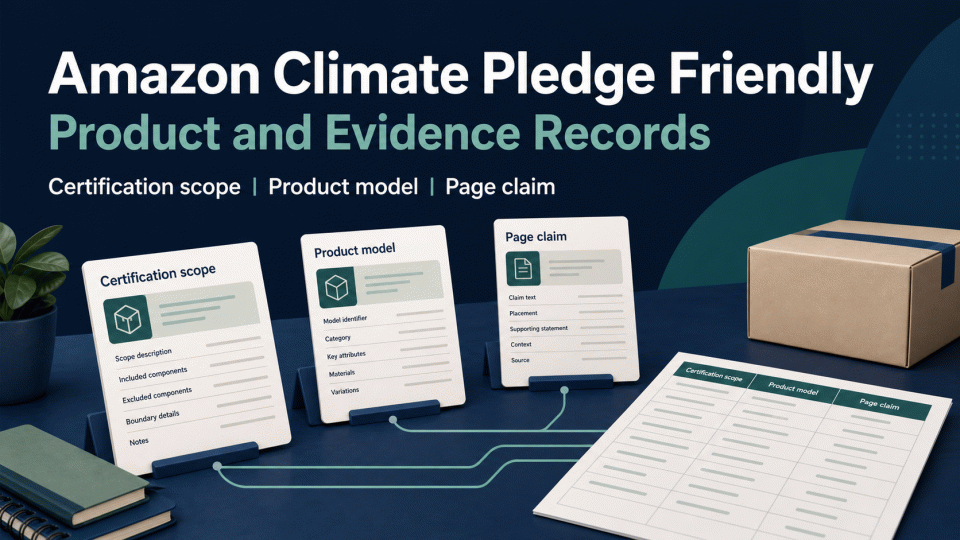
Amazon Climate Pledge Friendly (CPF) helps shoppers discover products with sustainability features. It relies on the relationship between third-party certifications or programmes and a specific product. This reference separates programme eligibility, the underlying certification, and page wording so that document preparation is not presented as an awarded certification or a guaranteed Amazon outcome.
1. Separate the three objects
Start with the product: ASIN, brand, model or variation, category, materials and packaging scope. Then record the supporting pathway: certification or programme name, certificate holder, certificate or registration number, covered product, site or location, status and market. Keep the proposed page sentence, placement and supporting evidence as a separate record.
Amazon’s public descriptions say that Climate Pledge Friendly features are supported by third-party certification standards or programmes. A corporate certificate, supplier file or page for another product does not automatically cover the current ASIN. Amazon’s programme rules, marketplaces and submission routes can change, so check the current Seller Central and official programme materials at submission.
2. Bring certification scope down to the model
Use one row per SKU: ASIN/model, brand and responsible entity, certification name, certificate number, scope, category, materials or key attributes, production site, covered variations, document version and verification date. If a document covers only a site, material, product family or variation, record that boundary rather than extending it to every product under the brand.
For products with multiple components, separate the product, accessories, packaging and the attribute used on the page. If a document concerns only a material or packaging, the page claim should stay within that object. Do not turn “contains a specified material” or “has a packaging attribute” into a general environmental conclusion about the whole product.
3. Assemble four record groups
Entity records: brand, manufacturer, seller or responsible entity, with evidence of any authorisation or relationship.
Product records: ASIN, model/variation, specifications, materials, composition or key attributes, with product and packaging images where useful.
Certification records: certificate or registration number, scheme, scope, status, market, public verification information from the issuing or programme body, and applicable mark or claim rules.
Page records: proposed title, bullets, A+ content, images and attribute wording, placement, submission date, version and linked evidence. Add test, footprint, supply-chain or transaction files only when the relevant pathway requires them; a large file bundle is not a universal proof package.
4. Write page claims within the evidence boundary
A page may describe a specific attribute supported by the available records, while retaining the same object, scope and source. If the evidence supports a material or a defined certification scope, describe that limitation. Do not turn it into “fully sustainable,” “applies to every product,” or an automatic badge claim.
“The product has a certification record” and “Amazon has recognised the ASIN as Climate Pledge Friendly” are different states. Do not copy Amazon icons, certification-body marks or certificate-like visuals into a cover or page unless the relevant permission and usage basis are documented. Do not describe preparation, submission or manual review as approval, display, traffic or sales results.
5. Six checks before submission
- Reconcile the ASIN, model, variation and page product with the certificate scope.
- Confirm the relationship between certificate holder, brand, manufacturer and seller.
- Check scheme, scope, status, market and mark rules against current official material.
- State the boundaries of product, packaging, material and supply-chain evidence accurately.
- Link each page sentence, image text and attribute to a traceable source.
- Remove wording that turns preparation into certification, CPF recognition, display or a commercial outcome.
Sources and boundaries
This article refers to Amazon’s Sustainability Solutions Hub, Amazon Business sustainability information, and Sustainability Features information. Recognised pathways, marketplace rules, entry points and display conditions may change; return to the current official materials before submission. 绿色方舟(深圳)认证有限公司 provides document organisation and review support and does not replace Amazon, a certification body or a regulator in making a decision.


