
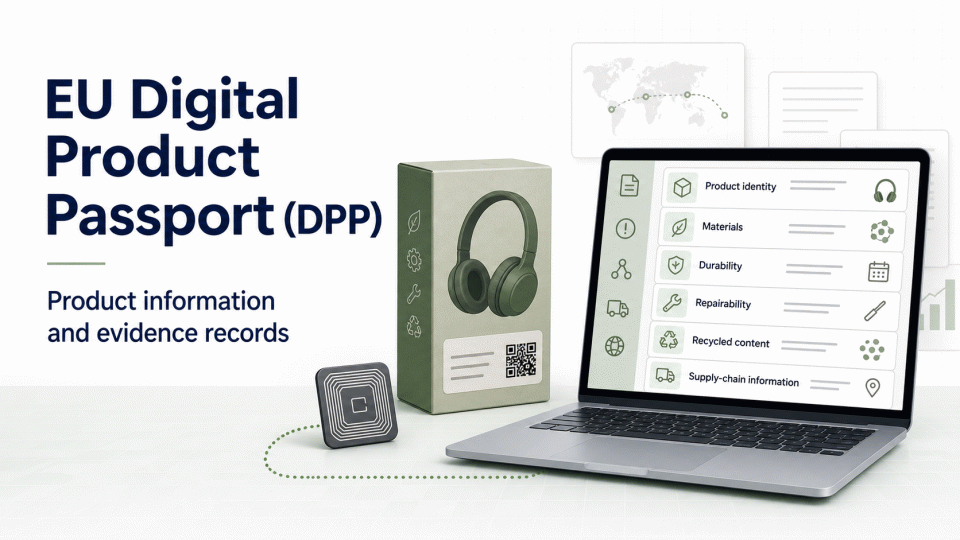
A Digital Product Passport is not a stand-alone certificate that can be separated from a product or its legal scope. Under the Ecodesign for Sustainable Products Regulation (ESPR) and the product-group delegated acts made under it, a DPP is a way to provide product information in an accessible and traceable form. The required fields, data carrier, access rights and timing depend on the applicable product-group rules.
This article treats DPP as a product-data governance task. First identify whether the product is covered by an applicable product-group requirement. Then map product identity, materials and performance, value-chain information and supporting evidence. A generic data sheet should not be presented as a universally mandatory DPP where the relevant delegated act has not been established.
1. Confirm the legal scope first
Record the product group, model, materials or critical components, destination Member State or market, and the roles of the manufacturer, importer and other economic operators. The ESPR is a framework regulation; later product-group delegated acts specify the information requirements. The word “DPP” alone is not enough to decide that a SKU already needs a complete passport.
Batteries require a separate review of Regulation (EU) 2023/1542 and its product and timing rules. A battery passport must not be merged into a universal template for every other product group. PPWR, EUDR, CBAM and marketplace documentation requirements should also be tracked as separate matters; similar data topics do not make the regimes interchangeable.
2. Organize the main information layers
The exact fields come from the applicable delegated act. As a preparation structure, organize the source records into these layers:
Product identity: model, batch or item level, persistent unique product identifier, data-carrier location, and the link between the carrier and the product, packaging or accompanying documents.
Materials and performance: composition, durability, reparability, recycled content or other environmental attributes. Record only information supported by a stated method, test record or supplier declaration, with its boundary noted.
Value chain and responsible operators: manufacturer, importer and relevant facility or supply-chain identifiers. Mark who supplied each data point, which model or batch it covers, and when it was updated.
Access and updates: define which data is intended for customers, operators, repair or recycling actors, or competent authorities. ESPR requirements address persistent identifiers, interoperable data and role-based access.
3. Map product, evidence and claims
For each model or batch, create a controlled record containing the product identifier, applicable product-group rule, field name, value, source, file reference, responsible operator, coverage, version or date, and review history. BOMs, specifications, test reports, repair instructions, material declarations and supply-chain records should not merely sit in folders; each must resolve back to the same product identity.
If a page says “contains recycled content,” “repairable” or “durable,” define the product scope and supporting basis. A DPP record does not by itself prove compliance with every EU law, create a green certification, establish marketplace eligibility or guarantee a market outcome.
4. Five checks before making records available
1. Have you identified the applicable product group and delegated act instead of using a generic DPP template?
2. Do the model, batch or item level match the data carrier and product records?
3. Does each material data point have a traceable source, responsible operator and version record?
4. Have you separated customer, value-chain and authority access, while avoiding unnecessary personal data?
5. Do the product, packaging, manual, webpage and customer materials use the same scope and meaning for each attribute?
5. Use careful customer-facing wording
It is reasonable to say that product identity, material and supply-chain records have been organized against the applicable product-group rules. Avoid wording such as “a DPP guarantees customs clearance,” “a DPP equals EU compliance” or “all SKUs are green-certified.” Where a regulation, delegated act, technical standard or marketplace requirement is not yet clear, mark the field as pending confirmation and retain its source and review date.
Greenark (Shenzhen) Certification Co., Ltd. can help align products, documents, responsible operators and page wording. The applicable legal duties and required fields still depend on the relevant EU legal text, product-group delegated act and the company’s actual product records.
Source basis: Regulation (EU) 2024/1781, especially Articles 9–13 and Annex III; and the battery-passport provisions of Regulation (EU) 2023/1542. This is a preparation reference, not product-specific legal advice.


