
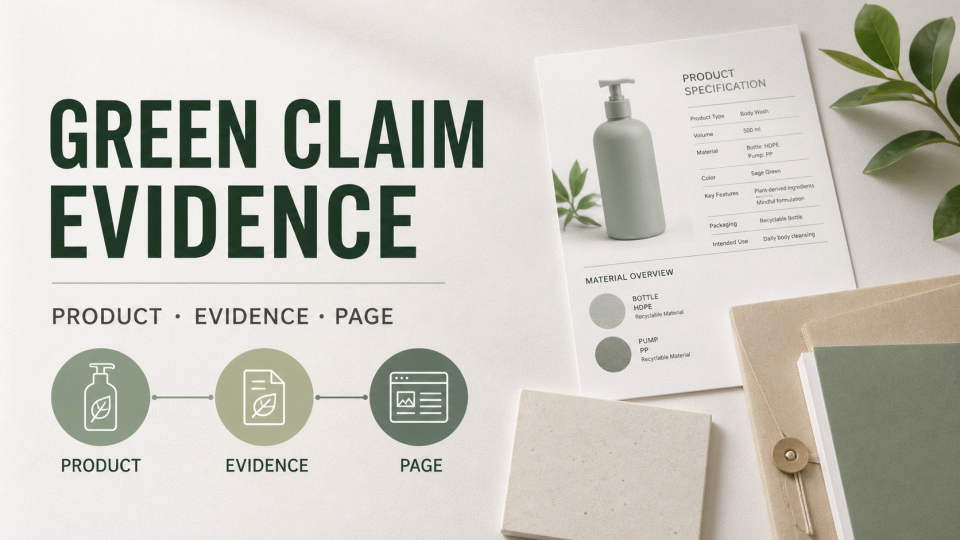
A “green label” is not a stand-alone pass for a product, a market, or a listing. A usable review asks three separate questions: which product or package does the claim describe, which record supports it, and what exactly will the customer see on the page? This article offers a working record structure. It does not replace market-specific law, platform requirements, or certification-body instructions.
1. Define the claim object and use case
Start with a product register covering the SKU, model, version, materials or formulation, packaging components, supplier or production information, target market, and every page, label, image, or advertisement where a claim may appear. Keep product, packaging, and company-level claims separate: the same word can communicate a different scope when attached to a different object.
Classify each statement by a checkable attribute, such as recycled content, recyclability, compostability, replaceable parts, energy information, carbon information, or the scope of a certification or label scheme. Do not begin with a broad word such as “green,” “eco-friendly,” or “sustainable.” First identify the specific attribute, comparison, and conditions that the evidence can actually address.
2. Make the evidence answer the same claim
Create one Product–Evidence–Page record for each statement. Depending on the claim, the evidence set may include product specifications, a BOM or material declaration, supplier records, test or assessment reports, lifecycle or calculation records, local collection information, or certification and labelling documents. Record the issuer, covered product or lot, method, scope, version, and date. A general supplier statement should not automatically be treated as proof for the seller’s own SKU.
The evidence should explain the exact sentence shown to customers. A partial recycled-content statement should identify whether it concerns the product or package and which material is covered. A recyclability statement should be checked against the relevant collection and processing conditions in the target market. A certification or label reference should be checked against the holder, covered products or activities, mark rules, and any authorization. The FTC Green Guides also explain that third-party certification does not automatically substantiate every express or implied advertising claim.
3. Write page copy that can be verified
Register the exact page sentence, image text, label copy, and search snippet. Avoid unqualified broad environmental-benefit claims such as “green,” “eco-friendly,” or “zero impact.” When the evidence supports only a limited attribute, state the attribute, object, comparison, and relevant conditions in the visible claim area. Do not hide the essential limitation in a footnote, or turn material information into a statement that the product has obtained a certification.
Market rules and guidance are not identical. The European Commission describes reliable, comparable, and verifiable environmental information as a policy objective. The U.S. FTC Green Guides address consumer interpretation and substantiation of environmental marketing claims. In China, the use of green-product certification and marks should also be checked against the Measures for the Administration of Green Product Certification and Labelling and the applicable certification documents. These sources should not be combined into one global threshold; confirm the applicable rule for the market, product, and claim type.
4. Manage changes with versions
- Product: SKU, specification, material or formulation, packaging, and supplier version.
- Evidence: document title, issuer, method, scope, lot or sample, date, and storage location.
- Page: URL or content version, exact wording, image text, language, and placement.
- Boundary: excluded products, regions, materials, components, or treatment conditions.
- Review: change reason, reviewer, open questions, and resolution.
Recheck the mapping when the product, material, formulation, supplier, packaging, target market, or page copy changes. Keep replaced records and prior page versions so the team can explain when a statement was used and which evidence supported it.
5. Pre-publication checklist
- Is the claim object clear: product, package, or company?
- Do the evidence entity, model, material, lot, and scope match the page object?
- Does the test, calculation, or assessment support this specific sentence?
- Are the comparison, conditions, and market limitations clear?
- Does any certification or mark use have the required documents and authorization without enlarging its meaning?
- Do Chinese, English, image, and mobile versions express the same boundary?
- Has the record been updated after a product or page change?
绿色方舟(深圳)认证有限公司 can help organize the correspondence between product, evidence, and page wording. Applicable law, certification scope, and mark conditions should still be confirmed against official market sources, certification-body documents, and the company’s actual records.
Sources
FTC: Environmental Claims: Summary of the Green Guides; European Commission: Green claims; SAMR and departments: Measures for the Administration of Green Product Certification and Labelling.


