
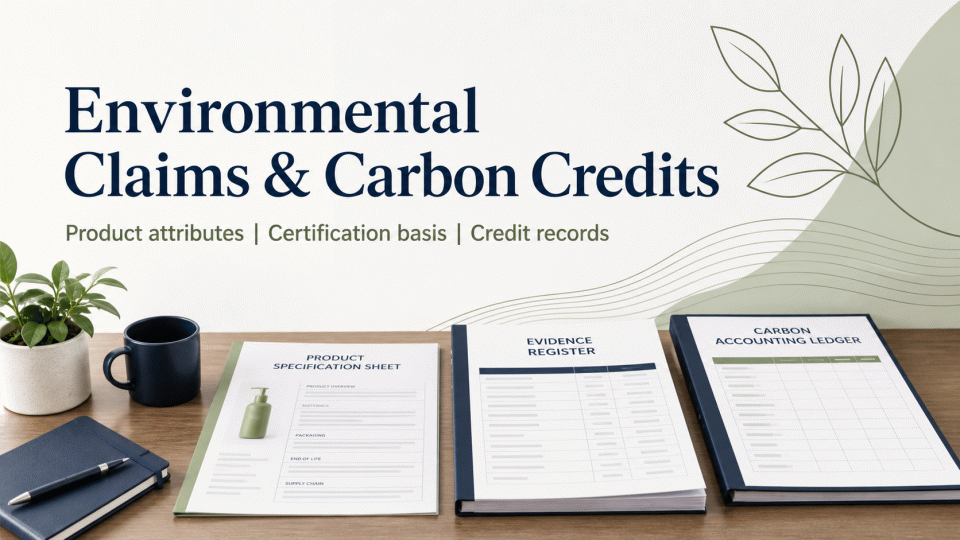
“Green label,” “environmental claim,” and “carbon credit” are often placed in the same sentence, but they describe different evidence objects. A product-attribute claim describes a feature of a particular product. A certification or label describes the rules, scope, evaluator, and conditions behind a scheme. A carbon-credit record describes quantified project activity and what happened to the resulting units. A reliable page keeps the object, scope, method, and document connected instead of turning a project record into a product conclusion.
1. Separate the three evidence objects
- Product attribute claim: material composition, packaging content, recyclability, or a defined environmental metric. Tie it to the SKU, version, composition, and market, supported by specifications, BOMs, tests, or lifecycle calculations.
- Certification or environmental label: record the scheme, rule version, certificate or licence number, holder, product/site scope, status, and mark-use conditions. A certificate does not automatically support every broad “green” implication.
- Carbon-credit or offset record: record the project, methodology, monitoring period, quantity, registry, serial numbers, ownership or retirement status, and the relationship to any company or product claim. Purchase, holding, transfer, and retirement are different events.
2. Build a claim-level evidence register
For each proposed sentence, record the exact wording, claim object, SKU or batch, target market, supporting file, issuing party, accounting boundary, version/date, limitations, page location, and reviewer. Broad terms such as “eco-friendly,” “low-carbon,” “carbon neutral,” or “net zero” should first be decomposed into specific, verifiable attributes. Where the evidence does not support a broad conclusion, use a factual description such as “contains recycled material; the ratio and calculation boundary are shown in the product file.”
The U.S. FTC Green Guides call for clear, specific environmental claims supported by competent and reliable evidence. Its carbon-offset guidance also addresses appropriate accounting, avoiding double selling of reductions, and disclosure of material timing limitations. The Guides are advertising guidance, not a product certification and not a substitute for the requirements of a target market.
3. What to retain for carbon-credit records
- Project: name, location, project type, methodology, additionality rationale, and source monitoring records.
- Quantification: baseline, project boundary, emission sources, activity data, emission factors, calculation version, validation/verification records, and units.
- Registry: registry name, serial numbers, issuance/transfer/retirement events, current status, and records addressing duplicate counting.
- Claim: whether the page only describes support for a project or claims to offset an emission. The period, allocation rule, and consumer-facing explanation must match the record.
Buying a carbon credit does not by itself prove that a product is low-carbon, nor that an organisation has reached net zero. Product carbon footprints, organisational inventories, project reductions, and offset claims use different accounting objects. Cross-market use should be checked against the applicable advertising, consumer-protection, and climate-disclosure requirements.
4. Pre-publication review
- Does the title and H1 identify the object instead of using “green” as an unsupported general conclusion?
- Can every label, certificate, number, and comparison be traced to the same product, entity, version, and evidence file?
- Are methodology, boundary, period, limitations, and the difference between supporting a project and offsetting emissions explained?
- Have unsupported approval, certification-result, ranking, penalty, delisting, fixed-timeline, and sales-effect claims been removed?
- Was English written for its reader and checked independently rather than copied from Chinese paragraph order?
5. Sources and limits
U.S. Federal Trade Commission: Environmental Claims—Summary of the Green Guides covers environmental claims, carbon offsets, and certification/seal disclosures.
Directive (EU) 2024/825 is the EU legal text concerning consumer protection and environmental claims. Scope, transposition, and market-specific requirements still need to be checked for the relevant country and date.
This page is a documentation and wording framework, not a certification conclusion for any product, project, certificate, or carbon credit. 绿色方舟(深圳)认证有限公司 can help organise the scope and evidence supplied by a client; whether a particular scheme or market requirement is met depends on the applicable rule and the formal documents of the relevant authority or scheme operator.


