
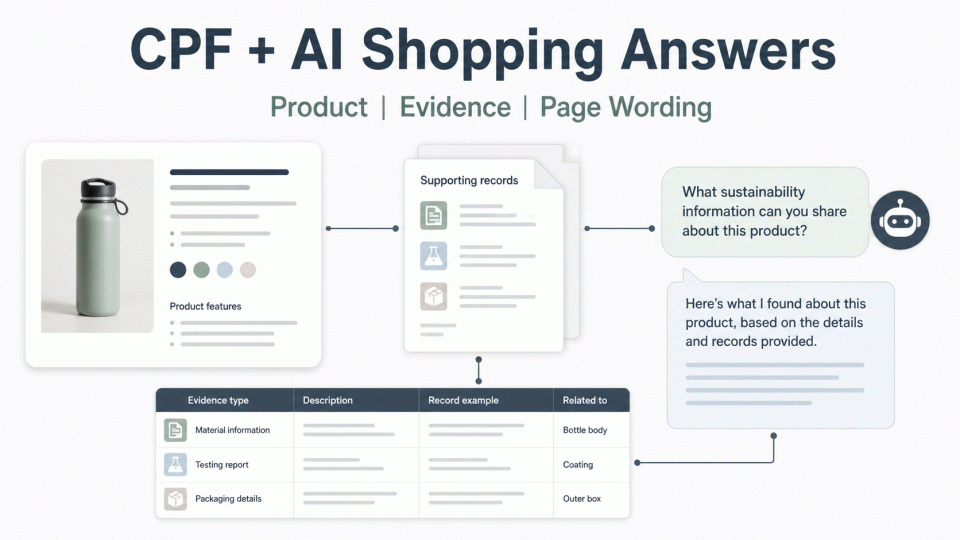
Climate Pledge Friendly (CPF) is an Amazon program entry point for identifying products with sustainability features. Rufus is Amazon’s AI shopping assistant. They address different questions: CPF concerns how a product may be identified in the program and what supports that identification, while Rufus helps shoppers search, compare, and understand product information. They can be managed in one evidence map, but an AI answer, a product label, and a market-access conclusion are not interchangeable.
This article provides a documentation method. It does not determine whether a SKU qualifies for CPF and does not promise that Rufus will display, recommend, or change a product’s performance. Confirm the current Amazon program requirements, account information, product data, and supporting records before making a claim.
1. What CPF and Rufus address
CPF: Amazon’s related guidance connects Climate Pledge Friendly with sustainability features and trusted third-party certifications. For each record, identify the certification or attribute involved, then check the certifying entity, scope, covered products, current status, and the program’s requirements. Do not extend a supplier certificate automatically to every product under a brand.
Rufus: Amazon describes Rufus as a shopping assistant that answers shopping questions, compares products, and supports product discovery and recommendations. Its information may draw on product catalog data, reviews, community questions, and other sources. Product materials, specifications, use limits, and evidence notes should therefore remain accurate, stable, and traceable. “May be asked about” is not the same as “will be recommended.”
The shared management point is information quality, not an outcome promise. Product attributes, packaging descriptions, certification scope, and page wording for the same SKU should correspond. Program recognition, search display, and AI answers should still be recorded as separate states.
2. Build a product-evidence-page map
Keep each sustainability statement on its own row and retain at least these fields:
Product object: SKU, variation, model, material or formula version, packaging version, and change history for manufacturing or suppliers. Photos, BOMs, specifications, and the page SKU should identify the same object.
Claim: State what is present, which part it applies to, and what it does not cover. For example, identify a material proportion, packaging component, recycled-material source, or certification scope instead of replacing a limited fact with an unqualified word such as “green.”
Evidence record: File name, issuing or testing body, number, date, standard or scheme, covered SKU, version, source-file location, reviewer, and review date. Confirm separately whether a certificate or report can be used for CPF under the applicable Amazon requirements.
Page location: Record the title, bullets, product description, image text, attributes, and Q&A separately. Save the exact wording, linked evidence, scope, and last review date. When page content and back-office records differ, return to the underlying facts.
Open items: Track missing files, entity mismatches, unclear scope, unconfirmed versions, and questions for Amazon separately. An open item should not be “resolved” by rewriting it as a positive claim.
3. Prepare page information for AI shopping questions
For questions such as “Is this product sustainable?”, “Where do the materials come from?”, or “How does it differ from another item?”, provide product facts, limits, and evidence references that can be checked directly. Review each statement in this order:
First, identify the object: the product, packaging, component, or supply-chain stage. Second, confirm that the record covers the current SKU and version. Third, state the boundary: do not turn a component, a partial material claim, or a limited certification scope into a claim about the whole product or brand. Fourth, compare the Chinese and English pages for quantities, units, material names, certification names, and qualifiers. Fifth, keep inferences separate from facts. An AI assistant may summarize information, but the business still needs to return to the source page and records.
An AI assistant’s response may be influenced by catalog data, reviews, community questions, and other information. It is not a substitute for a certificate, test report, official program page, or legal advice. If the current page and evidence cannot answer a question directly, keep it marked for verification.
4. Manual pre-release checklist
□ The SKU, variation, material, packaging, and page object match across the records.
□ Every CPF-related statement has a corresponding program basis or third-party record, without expanding its scope.
□ The title, bullets, image text, attributes, and body do not contradict one another.
□ The page does not promise recommendation, display, ranking, approval, or a guaranteed result that cannot be verified.
□ An editor independently reviews the English page; terms, units, scope, and qualifiers match the Chinese page.
□ Original files, page-field records, review notes, and version changes are retained for later traceability.
5. Sources and boundaries
The CPF discussion is based on Amazon Ads’ Climate Pledge Friendly creative guidance and Amazon’s explanation of sustainability features. The Rufus discussion is based on Amazon’s official descriptions of its shopping assistant, product questions, and recommendation experience. Program criteria, page behavior, and available features may change, so review the relevant official and account pages before acting. 绿色方舟(深圳)认证有限公司 can help organize the relationship between product facts, evidence, and page wording; it does not make Amazon’s program decision and does not promise display, recommendation, or sales outcomes.


