
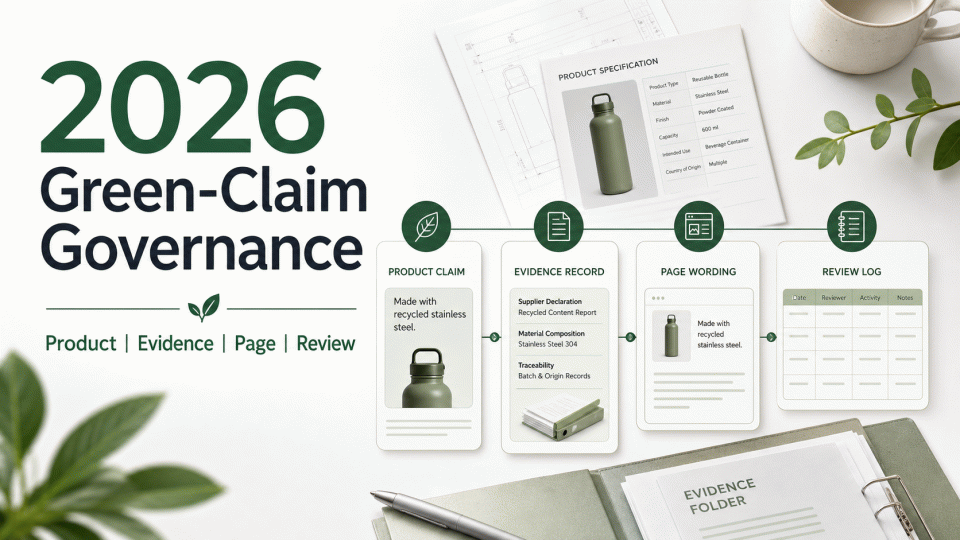
Terms such as “green,” “low carbon,” “recyclable,” and “recycled content” can describe a product attribute, a packaging attribute, a supply-chain program, a certification scheme, or a company objective. They do not share one certificate or one marketing statement merely because they use similar language. This reference page sets out a claim file map for tracing each customer-facing statement to a defined product, supporting evidence, page wording, and review record.
1. Define the claim object before selecting a “green label”
The first field in a claim register should identify the object: a material or durability attribute of the product, a packaging composition or disposal condition, a supply-chain characteristic, or a company-level environmental target. Bind the claim to the relevant SKU, version, batch, and market. A brand, factory, product family, and individual SKU are not interchangeable units. Changes to formulation, construction, suppliers, or packaging require a fresh scope check.
Use base fields for claim object, scope, responsible entity, market, and date. “Has a certificate” or “meets environmental requirements” is not a complete conclusion. Record what the certificate or report establishes, what it does not establish, and whether the available basis supports the proposed page wording.
2. Keep three types of requirements separate
Legal obligations: These arise from laws, regulations, standards, or official requirements in the target market. Confirm product scope, responsible parties, technical files, labels, filings, or supply-chain records from the primary source. A platform notice is not a substitute for the legal text.
Platform programs: A platform may request particular fields, evidence formats, enrollment records, or wording. A platform review condition is not a universal legal conclusion, and one upload or review outcome cannot be extended to every market or SKU.
Buyer or brand standards: Retailers and brand customers may require questionnaires, audits, material declarations, or traceability records under a contract. Identify the requesting party, contract, and version; do not merge these requirements with legal compliance or a platform program.
3. Four evidence areas for the claim file map
1. Product and scope: SKU, model, formulation, key components, packaging layers, target market, sales channel, and change history for production or suppliers. Product images, specifications, and the BOM should describe the same item.
2. Evidence and source: Record document title, issuer, document number, issue date, applicable standard or program, sample and batch, test method, data basis, and primary source. A third-party document does not automatically authorize every page statement; a supplier document does not automatically cover the brand owner or importer of record.
3. Page wording: Preserve the exact statement, placement, language version, SKU, and evidence reference. Distinguish “contains a material” from “made entirely from it,” “designed for recyclability” from “is recyclable everywhere,” and program enrollment from product environmental performance.
4. Review record: Note reviewer, date, scope checked, findings, decision, and triggers for the next review. New materials, packaging, suppliers, markets, source versions, or evidence dates can all trigger another review.
4. Connect evidence to the exact page statement
Every environmental statement should answer five questions: What object does it describe? What is the scope? Which document supports it? Do the document data and page wording match? Could the overall presentation imply more than the evidence supports? If a document covers one material, component, batch, or market, the page should use the same boundary.
Keep original files and page-version records for review, but do not place internal IDs, audit labels, or production notes in customer-facing copy. Use certification, label, program, and institution names only according to verified authorization and current rules; where authorization has not been checked, do not place official graphic marks on the cover or page.
5. Common errors and safer rewrites
Combining several laws or platform programs into a “global green-label solution” hides differences in scope and evidence. Use separate rule cards for market, product scope, responsible entity, evidence type, page limits, and source link.
Applying a supplier’s general certificate to every SKU can create mismatches in entity, model, material, or date. Check the issuer and holder, product scope, batch, document version, and permission to use the claim. If a field is missing, mark it as pending; do not turn an empty field into an approval.
Absolute claims such as “recyclable,” “low carbon,” “recycled,” or “free from” can overstate the evidence when used as headlines. Describe the verified attribute and add the needed qualifier for component, calculation basis, handling condition, or market. Remove a strong conclusion that cannot be supported.
6. Pre-publication claim-file checklist
□ SKU, material, packaging, market, and responsible entity are defined; □ each claim has a document number or primary source; □ evidence scope matches the page statement; □ legal obligations, platform conditions, and buyer standards are separate; □ dates, versions, batches, and permissions are checked; □ Chinese and English do not widen or narrow the same claim differently; □ outcome promises, fixed timelines, unsupported percentages, and unverified institutional marks are removed; □ reviewer, date, decision, and next trigger are recorded.
Source boundary: Verify specific requirements against the target market’s primary law, official authority pages, current platform program terms, certification rules, and contract documents. 绿色方舟(深圳)认证有限公司 can help map product, evidence, and page wording, but it does not replace the company’s final confirmation of applicable law, platform conditions, or buyer contracts.


