
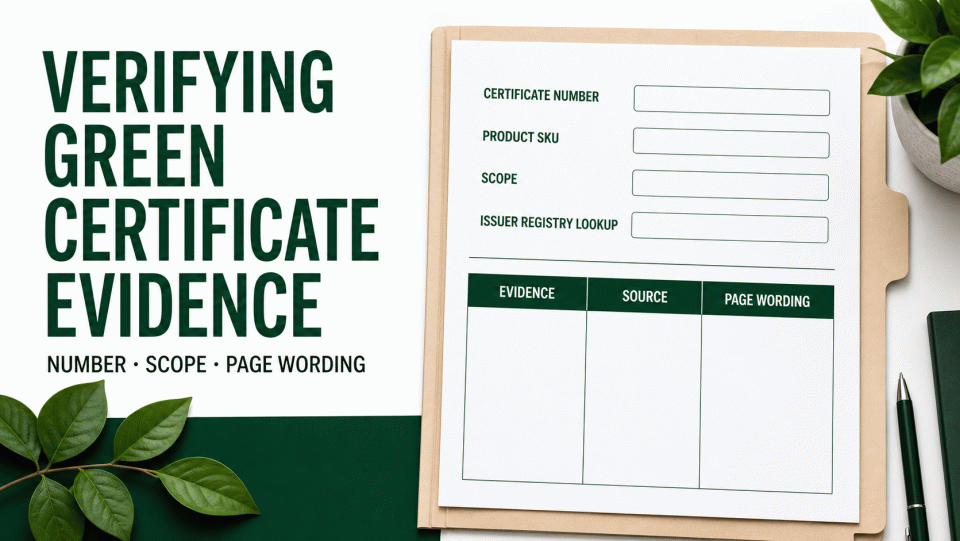
Having a certificate does not mean that the certificate supports every sentence on a product page. The review target is a traceable relationship: who issued the record, what it covers, which product or batch it relates to, and what the page actually says. This is a documentation and wording framework, not a substitute for a scheme-specific certification plan, marketplace rule or legal opinion.
1. Define what the record actually covers
Start with the certificate or scheme document, not with the sales copy. Capture the certificate type, issuer, certificate holder, number, issue or update date, scope wording, covered products, sites or processes, and any stated limitations. If the record covers one product family, material, site or transaction, do not extend it to the whole brand, factory network or SKU catalogue.
Separate three evidence layers. A certificate or declaration describes the issuer’s recorded scope. Test, sourcing, transaction or supplier records support a particular fact. Product specifications, bills of materials, packaging files and page snapshots identify the object being promoted. These layers can support each other, but one supplier document is not automatically a substitute for all of them.
2. A four-part review: number, holder, scope, page
- Check the number and issuer. Transcribe the number from the full document or the issuer’s lookup route, together with the name, status fields and lookup date. Keep the original file and lookup record; do not rely only on a screenshot.
- Check the holder. Compare the exact names of the certificate holder, manufacturer, brand, importer or page-responsible party. A similar name, group relationship or supplier statement does not prove identity.
- Check the scope. Split the scope into product name, model/SKU, material or formulation, site, process or transaction boundary, and limitations. Compare each item with the product file.
- Check the page. Preserve the title, claims, image text and dated page version. Annotate each sentence with its supporting file. Review any badge, label name or environmental term against the scheme’s own use rules.
3. Build an evidence–product–page map
Use one row per reviewable claim, such as “this SKU uses this material” or “this site falls within the stated certificate scope.” Useful columns include the exact claim, object identifier, certificate number or filename, issuer or source, scope excerpt, product-file version, page location, review date, owner and open item. For environmental marketing, the FTC Green Guides emphasize competent and reliable evidence and caution around broad, unqualified “green” or “eco-friendly” impressions. Page copy should therefore name the specific attribute and its boundary instead of implying an overall benefit.
If a page mentions certification, recycled content, carbon information, renewable material or packaging attributes, treat them as separate claims and collect evidence for each. The existence of one certificate does not extend to uncovered attributes. Nor does a certificate by itself establish marketplace approval, customs treatment, market access or a sales outcome.
4. Common mismatches and controlled responses
- The number is searchable, but the holder is a supplier while the page speaks for a brand or seller: preserve the difference and obtain the relationship evidence required by the scheme; do not write that the brand is certified before the scope is established.
- The record covers a product family, while the page says all models: remove uncovered models from the claim or add product-level scope evidence.
- The certificate, test report and page have different versions or dates: keep the version chain and assess whether a new formula, package, site, supplier or SKU changes the review.
- Only a badge image or marketing page is available: treat it as a lead, not as the certificate itself; request a traceable number, scope and use condition from the issuer or scheme rules.
5. Wording and maintenance checklist
The title and H1 should describe the review topic accurately, for example “Verifying Green Certificate Evidence,” rather than promising approval, universal validity or coverage of every product. The summary should state the evidence boundary. Use the document’s own naming for a certificate. Where status is not confirmed, say that it remains subject to issuer records; do not add pass, compliant, certified-result or fixed-validity language. When the company is named in customer-facing copy, use 绿色方舟(深圳)认证有限公司.
- Recheck the map when a formula, material, site, package, supplier, SKU or core page claim changes.
- Keep the original certificate, lookup record, product files, page snapshot and review notes with version and date.
- Follow the specific scheme’s renewal, surveillance or reassessment wording; do not impose one universal validity period on every scheme.
Sources and boundaries
This general framework refers to ISO/IEC 17065, Conformity assessment — Requirements for bodies certifying products, processes and services, and the U.S. Federal Trade Commission Green Guides and its environmental claims summary. The current status, mark use, scope and documentation rules for a particular scheme remain controlled by its issuer and the latest applicable source.


