
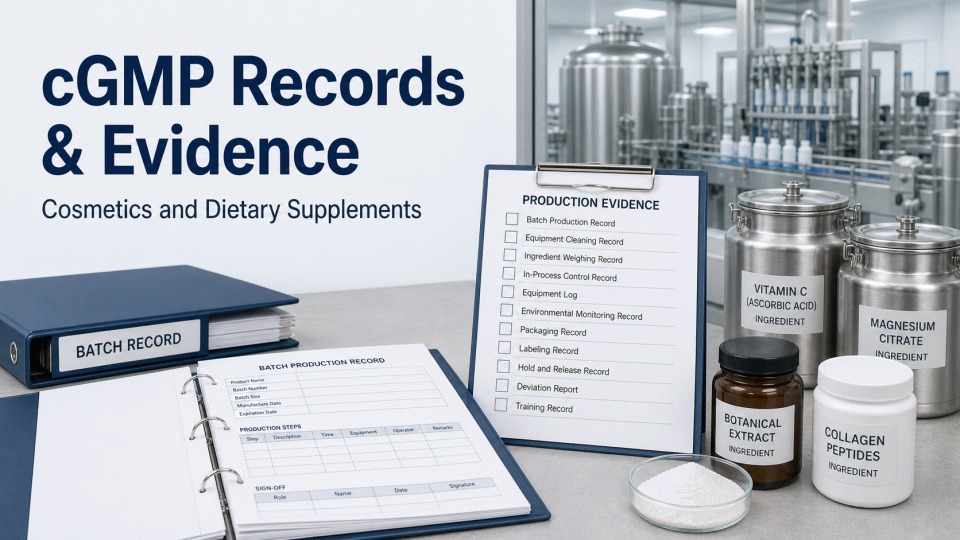
“cGMP certification” is not one universal certificate for every cosmetic or dietary supplement. Start by identifying the product category in the target market, the manufacturing or holding facility, and the responsible party. This reference uses publicly available U.S. FDA material to explain how to index cGMP-related records; other markets require separate review.
1. Separate the product category from the rule set
For cosmetics, FDA’s GMP checklist addresses facilities, equipment, personnel, raw materials, production, laboratory controls, and records. FDA also distinguishes cosmetics GMP from drug cGMP. MoCRA added requirements concerning facility registration, product listing, serious adverse-event reporting, and safety substantiation records, and directs FDA to establish cosmetic GMP regulations.
For dietary supplements, 21 CFR Part 111 focuses on manufacturing, packaging, labeling, or holding operations that ensure product quality and consistency with the master manufacturing record and specifications. The record set can include ingredient identity, specifications, batch production, packaging and labeling, deviations, complaints, returns, and recordkeeping. If product claims place an item in a different regulatory category, reassess the applicable rules.
At minimum, index the SKU or product name, dosage form or use, formula or ingredient version, lot number, facility, responsible party, target market, label version, and the scope of every supporting document. A customs code, platform category, or supplier statement that a site is “cGMP” is not a substitute for classification.
2. What to review for cosmetics
Use the FDA cosmetics GMP checklist as a record map:
- Facilities and sanitation: cleaning, maintenance, ventilation, water, drainage, personnel hygiene, and contamination controls.
- Equipment and materials: clean and maintained contact surfaces; material identity, lot, status, storage, and rejection records.
- Production and packaging: formulation, processing, transfer, filling, weighing checks, batch identification, label verification, and finished-product codes.
- Laboratory and retained samples: appropriate examination or testing against established specifications, with the scope of retention and water controls documented.
- Complaints and deviations: returned products, complaints, investigations, deviations, and corrective actions linked to the relevant product or lot.
These records describe how a process is controlled. They do not, by themselves, prove that FDA issued a “cosmetic cGMP certificate.” Sufficiency depends on the product, facility, risk, and market.
3. Build a Part 111 index for dietary supplements
A practical index has four groups: (1) ingredients and suppliers—identity verification, specifications, supplier approval, and incoming records; (2) the master manufacturing record—formula, batch size, process steps, theoretical yield, packaging, and labeling requirements; (3) the batch production record—actual ingredients and quantities, critical steps, equipment, personnel, in-process controls, yield, and deviations; and (4) quality and distribution—finished-product specifications, examinations or tests, disposition, complaints, returns, and retention.
Link each file to the product version, lot, facility, responsible party, and date, while preserving the original file and revision history. A supplier certificate limited to one facility or product range does not automatically cover every brand SKU. A report that does not identify the sample, method, specification, or product should not be given a broader interpretation.
4. Match labels and claims to the evidence
FDA labeling requirements differ across cosmetics, drugs, and dietary supplements. Product names, ingredients, net quantity, directions, warnings, and benefit claims on packaging or a product page should be checked against the applicable category and label version. A facility quality certificate does not justify claims such as “safe,” “effective,” “certified,” or “valid for every market.”
Prefer verifiable wording, such as “the batch record identifies the formula version, ingredient lots, and in-process controls,” with the document date, scope, and responsible party clear. Environmental, natural, contamination-free, or health-related claims need their own factual and labeling review; cGMP records do not replace it.
5. Pre-publication record checklist
- Confirm the product category, target market, facility, and responsible party.
- List product versions and lots; reconcile formula, specifications, labels, and master/batch records.
- Check the issuer, product scope, sample or lot, method/specification, date, and revision status of every document.
- Link cleaning, equipment, materials, process controls, testing, deviations, complaints, and disposition to the relevant product.
- Map every factual page statement to a source or document location; omit anything that cannot be verified.
Scope note: This is a records-review reference based on public FDA material. It is not a certification conclusion from FDA, a third-party body, or a market regulator. The responsible party should confirm the product, destination, and latest official requirements for the specific project.
Sources: FDA, “Good Manufacturing Practice (GMP) Guidelines/Inspection Checklist for Cosmetics”; FDA, “Modernization of Cosmetics Regulation Act of 2022 (MoCRA)”; FDA, “Small Entity Compliance Guide: Current Good Manufacturing Practice ... for Dietary Supplements”; and FDA, “Is It a Cosmetic, a Drug, or Both?”


