
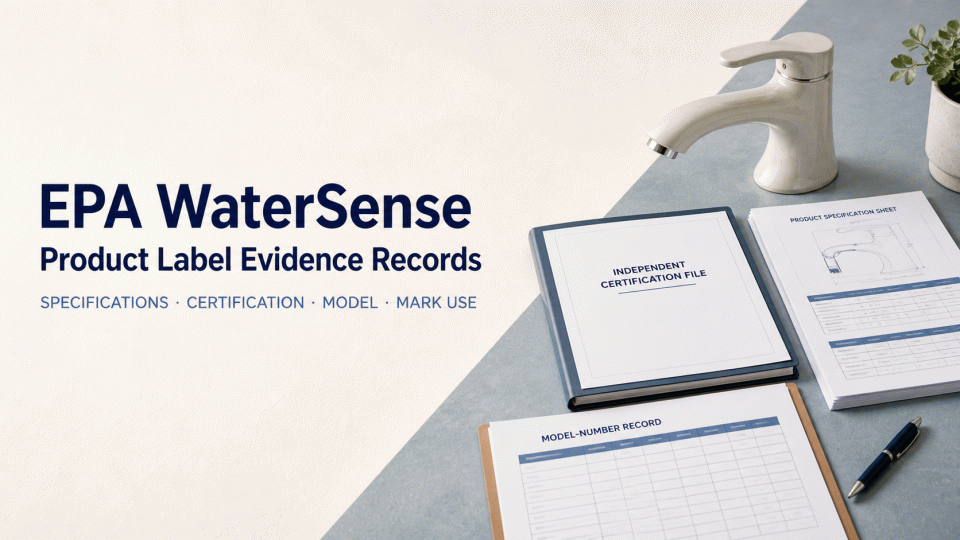
WaterSense is a U.S. Environmental Protection Agency (EPA) water-efficiency program. For products, the WaterSense label is not a generic green certificate that can be applied across every SKU. It connects a specific product category to an EPA specification, independent certification, and mark-use requirements.
This reference page organizes preparation into three decisions: confirm eligibility, connect the evidence to the model, and review the wording used on packaging and product pages. It supports evidence organization and claim review; it does not replace an EPA specification, a certifying body’s decision, or other requirements in the target market.
1. Confirm that the product is in scope
EPA’s product-specification materials list categories with issued specifications, including tank-type toilets, lavatory faucets, flushing urinals, showerheads, weather-based irrigation controllers, soil-moisture-based irrigation controllers, spray sprinkler bodies, and point-of-use reverse osmosis systems. The list and specifications are maintained by EPA, so “water-saving,” “low-flow,” or a marketing name alone does not establish WaterSense eligibility.
The first record should capture the brand, manufacturer, product category, model, configuration or version, intended sales market, and applicable WaterSense specification. If a product is not in an EPA-listed category, ordinary efficiency testing or an internal claim should not be presented as evidence of WaterSense label eligibility.
2. Connect the specification, certification, and model
EPA technical specifications set the efficiency and performance requirements for labeled products. EPA states that WaterSense-labeled products must meet the applicable specification and be independently certified. A general ISO, laboratory, or supplier document is not automatically a substitute for the WaterSense certification system.
Keep an itemized file: the applicable specification and version; model and configuration; technical sheets and drawings; test or evaluation reports; certifying body, scope, and file number; manufacturer and private-label relationships; product information submitted to EPA where required; and the places where the label appears on packaging, websites, and sales materials.
EPA’s product certification system directs manufacturers to apply through an EPA-licensed certifying body accredited for the relevant WaterSense specification. Private-label products have specific procedures. A brand authorization, supplier certificate, or similar model should not automatically be treated as evidence for the current SKU.
3. Review claims on websites and packaging
Break each claim into four fields: object, model, basis, and placement. For example, “this model bears the WaterSense label” should trace to that model’s certification record. A separate “water efficient” or “performs well” statement should identify whether it reflects the WaterSense program, a specification requirement, or the company’s own test result.
The WaterSense label and program logo do not have the same purpose. EPA’s mark guidance distinguishes the product label, promotional marks, program logo, and partner logo. External materials should use only the mark and wording that match the verified status and permitted use. Do not redraw, recolor, or place an EPA graphic in a company cover without checking the applicable guidance.
4. Practical review sequence
Review the file in this order: (1) confirm the category and current specification on EPA’s product-specification materials; (2) match brand, manufacturer, model, and configuration to the certification file; (3) confirm that the certifying body covers the relevant WaterSense scope; (4) compare packaging, product pages, and distributor materials with the certified model and permitted mark use; and (5) set a human review point when a model, configuration, private-label arrangement, specification, or conformity requirement changes.
If the file only shows that a product underwent water-efficiency testing, record the difference between that evidence and certification to the applicable WaterSense specification. WaterSense also does not automatically cover drinking-water, building, energy, import, marketplace, or state and local requirements; assess those separately for the product and market.
5. Minimum fields for the evidence table
Product: brand, manufacturer, model, category, configuration, and market.
Rule: applicable EPA specification, version, key efficiency/performance requirements, and mark guidance.
Evidence: test or evaluation file, certifying body, scope, file number, model coverage, and document date.
Page: product-page URL, packaging artwork, label or logo placement, claim wording, evidence link, and review record.
绿色方舟(深圳)认证有限公司 can help organize an evidence index linking products, models, specifications, certification files, and page claims. Applicability, certification decisions, and mark permissions remain subject to EPA program documents and the formal requirements of the relevant certifying body.


