Core Concepts & Scope
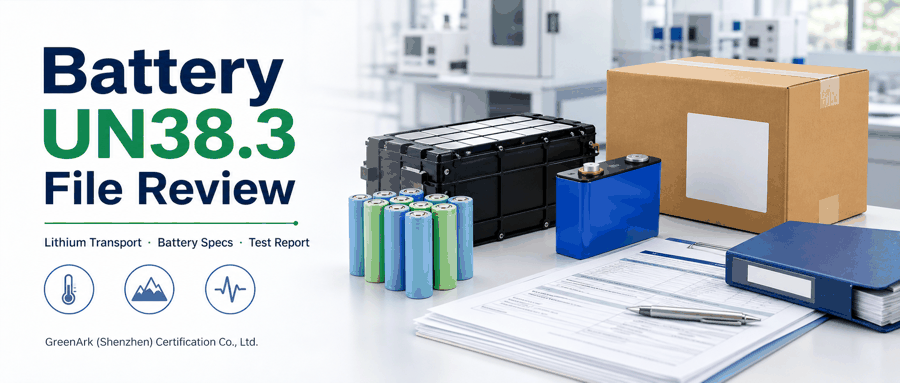
Section 38.3 of Part III of the UN Manual of Tests and Criteria universally shortened to UN38.3 forms the mandatory transport safety baseline for every lithium and sodium cell moving across borders. The 8th revised edition published in November 2023 formally introduced sodium-ion testing clauses for the first time.
Amendment 1 released in 2025 further clarified that sodium-ion batteries with organic electrolyte fall under IATA DGR 66th edition starting 1 January On the ocean side, IMDG Amendment 42-24 reclassified sodium-ion organic-electrolyte batteries as Class 9 Miscellaneous Dangerous Goods from 1 January 2026 and simultaneously retired the legacy UN3171 catch-all for sodium-powered vehicles.
Lithium-ion batteries still require the full T1 through T8 test cascade, whereas sodium-ion chemistry is exempt from T8 forced discharge, although the T6 impact or crush protocol must instead run at 100% state of charge and every test summary must still list the ten mandatory fields defined in 38.3.5 for cross-reference by ICAO TI, IATA DGR, IMDG Code and ADR or RID.
Air cargo provisions move in lockstep with DGR66 and the updated DGR67 for Two new UN numbers appear for standalone or packed sodium-ion units UN3551 and UN3552 with corresponding Packing Instructions PI976, PI977 and PI978 that largely mirror the lithium-ion PI965 through 967 logic but remove PI976 Section IB and drop the SOC state-of-charge cap plus 3-metre stack-test requirements on PI977 and 978.
Every sodium-ion battery pack manufactured after 31 December 2025 must bear its Watt-hour rating permanently legible on the outer casing. PI977 Section II caps cells at 20 Wh and packs at 100 Wh, while PI976 mandates a Cargo Aircraft Only label and enforces SOC at or below 30%.
Key Rules & Regulatory Points
Ocean carriers Maersk, CMA CGM and MSC have already deactivated the UN3171 booking path on sodium-electric vehicle SKUs and migrated bookings to the newly assigned UN3558 classification.
Regulatory provenance always traces back to official publications issued by the UN Committee of Experts on the Transport of Dangerous Goods. Primary anchors include Section 38.3 of the 8th revised edition of the Manual of Tests and Criteria dated 27 November 2023, Amendment 1 2025 updates on Special Provisions 188 and 230 for sodium-ion chemistry, IATA DGR 66th 2025 and 67th 2026 subsections 3.9.2.7, the 2025-2026 ICAO Technical Instructions, IMDG Amendment 42-24 effective 1 January 2026 introducing UN3551 through UN3558, CAAC Announcement Number 4 of 2024 on DGR66 adoption for domestic Chinese transshipment, and Chapter 3.3 SP188 or SP230 of EU ADR 2025.
The audience covered by this guidance spans cell manufacturers with proprietary chemistries, 3PL providers bundling battery supply for cross-border sellers, brand owners listing battery-powered ASINs on Amazon, Fruugo and Walmart power banks, power tool packs, e-bike integrated batteries and watch coin cells all feature, EPC contractors exporting sodium-ion storage cabinets to Europe and the Middle East, and forwarder compliance departments that need to issue transport appraisal reports for their customers.
Categories explicitly outside scope are sodium-ion batteries with aqueous alkaline electrolyte classified as UN2795 wet batteries governed elsewhere, miniature coin cells inside pacemakers and other active implants handled under medical device specific rules and in-factory work-in-progress batteries that never cross a customs frontier.
Landed obligations diverge significantly across transport modes. Air corridors impose the tightest SOC restrictions and Test Summary accompaniment rules, with Class 9 lithium or sodium hazard labels required on every unit over 35 kg. Ocean lanes permit higher Wh rated Section I packagings but require Class II performance packaging and a full maritime dangerous goods declaration.
Practical Checklist
European inland movement under ADR or RID additionally requires the driver to hold an ADR licence and the vehicle to carry an emergency information package. a designs service bundles for combined multi-modal routings. When a client ships from a Chinese factory by sea to Rotterdam then inland by truck to warehouses across Poland and Czechia, the team prepares three separate dossier variants aligned with origin, transit and destination jurisdiction requirements.
Port-of-call label language mismatches that historically caused interceptions at eastern EU borders are therefore addressed before the container leaves China rather than during roadside inspection.
Another recurring misjudgement is cross-using a lithium-ion report for sodium-ion products. Operators argue that T1 through T7 steps are identical and therefore the paperwork is interchangeable, yet sodium-ion requires T6 performed at full charge, a formal T8 exemption declaration on the summary front page referencing Special Provisions 188 and 230, and amendment-specific nomenclature throughout the document.
Ignoring those differences exposes shipments to full consignment return and falsification penalties. Sellers frequently assume that PI977 Section II small-battery relief means no paperwork at all, but in practice every cell over the 4-cell or 2-battery de-minimis threshold still needs a durable Battery mark on packaging plus the airfreight shipper declaration, otherwise airlines reject the consignment outright at security screening.
An explicit boundary must be stated upfront: UN38.3 Test Summaries carry no globally uniform expiry date. Industry convention accepts five years from report issue, but any change to electrochemistry, casing construction, or protection-board IC model triggers an immediate retest requirement regardless of the five-year window.
Common Pitfalls
A number of forwarders began enforcing a three-year-from-issue rule in 2026 as a commercial tightening; that operational policy must not be misinterpreted as the UN regulation shortening validity.
A second boundary covers component cell test relief. Component cells that are never shipped separately and only travel inside larger assembled battery packs may be restricted to T6 plus T8 only or T6 only for sodium-ion. The relief is conditional on the parent battery pack having passed the full eight-test cascade AND a traceable quality agreement existing between the cell manufacturer and the pack assembler.
When a evaluates component-cell relief, the BOMs for the cell and the finished pack are verified line by line. Any material code mismatch results in an immediate refusal to issue a relief opinion, because customs audit teams use the BOM as the primary evidence chain.
The firm also declines to advise clients whether the manufactured after 31 December 2025 threshold for Wh marking applies to a specific consignment; that determination requires the battery pack laser-etched date code and the manufacturer batch production record to be read together, which falls outside pure document-compliance work.
Preparation on the brand owner side should begin with a mapping register that links every cell model to every finished pack SKU and records the UN number, packing instruction, Wh rating, SOC restriction and Test Summary file identifier for each combination.
Consequences & Tips
The register should be reconciled against procurement records once per quarter to catch new cell suppliers introduced without compliance sign-off. For sodium-ion new product introductions, allow 4 to 6 weeks of testing lead time: five cells sampled at the first cycle and five after 25 cycles for T1 through T5, two equal groups of five cells for T6 impact at full charge, and T7 overcharge at twice rated current for 24 continuous hours, with T8 explicitly marked as not-applicable on the summary.
Labelling and packaging readiness is equally material. Airfreight PI976 outer cartons need the Class 9 hazard label plus Cargo Aircraft Only sticker. Ocean Section II shipments require a documented 1.2-metre drop test record. For sodium-ion energy products bound for Australia, RCM electrical-safety and GEMS energy-efficiency registration files should be prepared in parallel because the Australian Border Force cross-references against the DCCEEW energy-product database at import clearance.
a recommends clients launch UN38.3, RCM and GEMS work streams jointly at the pilot-production stage instead of sequencing them one after the other. Two IEC 17025 laboratories the firm works with in Shenzhen offer joint scheduling that cuts total turnaround by roughly 22 percent compared with commissioning each scope separately.
The same laboratories accept a common sample pool for overlapping test items, further reducing the number of prototype cells that need to be manufactured.
Not sure which CPF pathway fits your product?
Send us your product category, materials and current certificates. We will review the available certification pathway.