Core Concepts & Scope
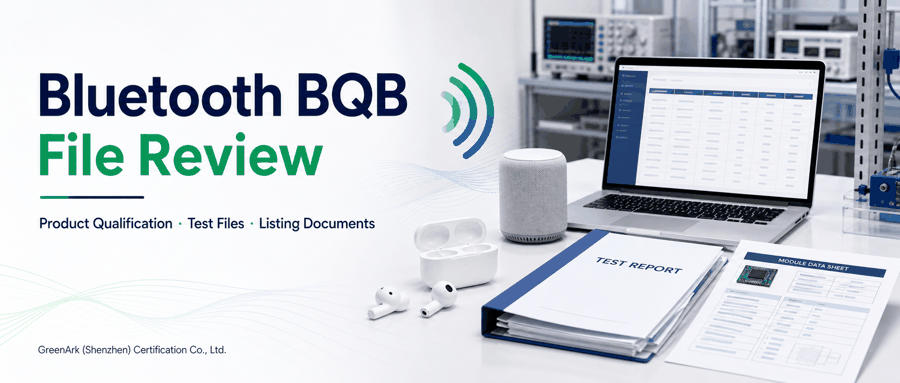
2026 brings the most sweeping SIG rule tightening in a decade across four axes. From 1 Jan 2026 all new applications must follow Core Specification 5.4, as the SIG no longer accepts brand-new filings under 5.3 or older, so brands sourcing 5.3-era modules must switch silicon or budget a costly migration.
In parallel, SIG TCRL Package 103 moves LE Audio from optional to mandatory: any 5.2+ hardware with LE Audio capability must fully test BAP, CAP and LC3 regardless of default-firmware enablement. LC3 codec delivers roughly 50% power savings at equivalent audio quality versus SBC.
a recommends legacy QDID brands run a 2026 database refresh, updating primary contacts and each listed product status so they never miss a review-cycle email.
In 2026 the SIG qualification menu still offers four tracks with shifted applicability boundaries. Full Certification produces a standalone QDID for self-designed or heavily customised platforms in four to six weeks, SIG administration fees from USD 12,000; it remains the choice for brands with RF architectures deviating from reference designs.
End-products on an already-qualified module can use Listing or End Product Listing plus QDL to reuse the module's existing QDID, collapsing lead time to one to two weeks with Listing fees around USD 8,000 per model, the most cost-effective 2026 path for volume brands.
Component Certification is the upstream track for chip and module vendors, obtained once and enabling unlimited downstream Listings. Upgrade Certification tracks minor firmware or hardware revisions below the tightened significant change bar. a key sourcing insight: if a module already holds complete 5.4 + LE Audio certification, the end-product can take the QDL route saving 12,000 US dollars or more in Full costs; otherwise the terminal brand absorbs both the Full fee and the longer four-to-six-week Full cycle.
Key Rules & Regulatory Points
Sourcing purely on unit price without auditing BQB status can reveal only during scoping that the module still sits on Core Spec 5.3 forcing a last-minute swap or unexpected Full spend and a four-to-eight-week go-live slip.
Core test blocks: RF performance, PTS protocol conformance, IOP interoperability and info security / encryption. Audio-class products additionally test LE Audio / BAP / CAP / LC3 / Auracast; IoT products test AoA / AoD positioning accuracy and low-power endurance.
Marking requirement: the QDID number and the official Bluetooth logo must appear on both the product body and retail package, verifiable via the SIG Qualified Product Database public query.
Sources include the 2026 SIG Bluetooth Qualification Program Rules revision; SIG TCRL Package 103 LE Audio mandatory notice; the Sep 2025 Core Spec 5.4 mandate Policy Decision (1 Jan 2026); Jan 2026 significant change and antenna-swap rule tightening; RN validity and periodic-review rules; four-path fees (Full $12K+, Listing $8K+ per model); 2026 SIG PTS user guide; SIG Qualified Product Database query instructions; and 2026 Amazon / AliExpress / Temu / eBay BQB / QDID verification rules.
The a BQB database is refreshed bi-weekly against SIG announcements.
This overview applies to manufacturers, brand owners, ODM / OEMs, chip / module vendors and e-commerce sellers commercially distributing Bluetooth products or using the Bluetooth trademark globally. Coverage includes TWS headsets, speakers, Auracast terminals, LE Audio devices, Bluetooth peripherals, smartphones, tablets, laptops, in-vehicle Bluetooth, IoT sensors / Beacons, smartwatches / wearables, medical Bluetooth terminals and industrial Bluetooth gateways.
Practical Checklist
Products using proprietary 2.4G non-Bluetooth protocols without Bluetooth trademark or claims are outside mandatory scope; national radio approvals (TELEC, KC Radio, SRRC, FCC, CE RED, etc.) are not covered here. a recommends scheduling BQB and national radio approvals as one multi-certificate campaign from scoping.
Common misconceptions: assuming a BQB-qualified chip / module alone exempts the end-product (EPL + QDL Listing still required to obtain own RN); assuming new 5.3-based applications survive 2026 (SIG stopped accepting them); assuming LE Audio off in default firmware avoids BAP / CAP / LC3 tests (5.2+ hardware capability alone mandates); assuming an antenna swap qualifies for Upgrade only (2026 rules may reclassify as RF adjustment triggering Full); assuming QDID inside the manual suffices (must appear on product + package with the official logo); assuming RN numbers require no maintenance (periodic review now active); sourcing modules purely on price without verifying 5.4 + LE Audio BQB status (forcing the end-product side to absorb Full costs).
a runs a full briefing plus baseline review at kick-off.
This 2026 general guide to BQB qualification, QDID Listing and RN management does not supersede SIG case-specific rulings; it does not cover national radio approvals, electrical safety, EMC, REACH / RoHS or battery transport rules, nor does it constitute legal advice.
Trademark usage details, membership tier differences, Auracast commercial licensing specifics and FDA / NMPA medical registration for Bluetooth medical devices require separate assessment. a always defers to the live Bluetooth Qualification Program Rules, SIG Policy Decisions and Qualified Product Database status.
A well-run BQB project begins during sourcing, when the team should confirm the SoC or module BQB status in writing verifying Core Spec 5.4 coverage plus the LE Audio triplet (BAP, CAP, LC3) and embed this into the procurement technical-acceptance clauses.
Common Pitfalls
If the chosen module has not been upgraded, the 12,000-US-dollar-plus Full administration fee must be budgeted upfront, combining BQB compliance cost and sourcing cost into a single total-cost-of-ownership calculation so go-live never stalls on a late-raised budget.
Once sourcing is locked, SKUs are grouped by PCB revision, firmware revision and identical RF front-end / antenna configuration so test results can be shared within each group. Mis-grouping visually identical SKUs that carry antennas from different suppliers remains a frequent rework trigger, resulting in SIG rejection followed by mandatory retest.
The correct track is then for deeply custom self-designed platforms, EPL plus QDL for end-products on qualified 5.4 + LE Audio modules, Upgrade for minor revisions, and Component Certification for chip or module vendors.
A SIG-accredited lab is engaged with samples reserved (two to four units each for RF and PTS) plus a curated IOP reference-device panel covering the phone and OS combinations the brand prioritises. Dossier preparation runs in parallel, assembling the declared Profile inventory, BAP / CAP / LC3 configuration for audio-class products, AoA / AoD algorithm notes for indoor-positioning SKUs, Auracast capability notes where relevant, and the version-traceability set, reviewed before submission.
On qualification day, nameplate, package, manual and e-commerce detail pages are updated immediately with the QDID and Bluetooth logo, and the SIG Qualified Product Database is checked for public visibility. The QDID certificate, RN number, report summary, Profile list and marking artwork are then archived into a single compliance binder and uploaded to the Amazon, AliExpress, Temu and eBay compliance back-offices.
a supports the full workflow from sourcing verification through to final marketplace archiving.
Consequences & Tips
The a BQB practice combines end-to-end project delivery with deep Bluetooth domain expertise. Scoping begins with a four-path qualification assessment and independent chip / module Component QDID status verification covering Core Spec 5.4 readiness plus the three LE Audio mandatory blocks paired with sourcing recommendations; brands on legacy 5.3-era filings receive transition reminders and remediation plans.
The mandatory LE Audio workstream under SIG TCRL Package 103 is handled as a dedicated dossier-preparation exercise, pulling together BAP / CAP / LC3 configuration, firmware logic and LC3 parameters for clean PTS review. During lab execution the team handles SIG-accredited laboratory introduction, scheduling, weekly progress and technical review across RF, PTS, IOP and encryption core tests.
For change-control grey areas, a delivers a 2026-tailored significant change pre-assessment covering antenna swaps, RF adjustments and Full vs Upgrade judgement, de-risking disputes before filing. Operations-wise the team budgets SIG official fees (12K Full, 8K-plus Listing) and runs payment workflows, plus QDID dossier translation, consolidation and submission tracking.
Long after certificate award, a supports RN periodic review and SIG database refresh, specifies and reviews QDID plus Bluetooth-logo marking artwork, compiles e-commerce BQB / QDID onboarding packages, pushes SIG policy update alerts and prepares compliance-investigation response docs.
Clients may reach the team for time-sensitive queries alongside regular email channels. Critically, a does not issue official QDID certificates on behalf of the SIG, perform hardware, firmware or antenna rectification, or participate in SIG arbitration or judicial proceedings; exact deliverables are defined in the signed service agreement.
Not sure which CPF pathway fits your product?
Send us your product category, materials and current certificates. We will review the available certification pathway.