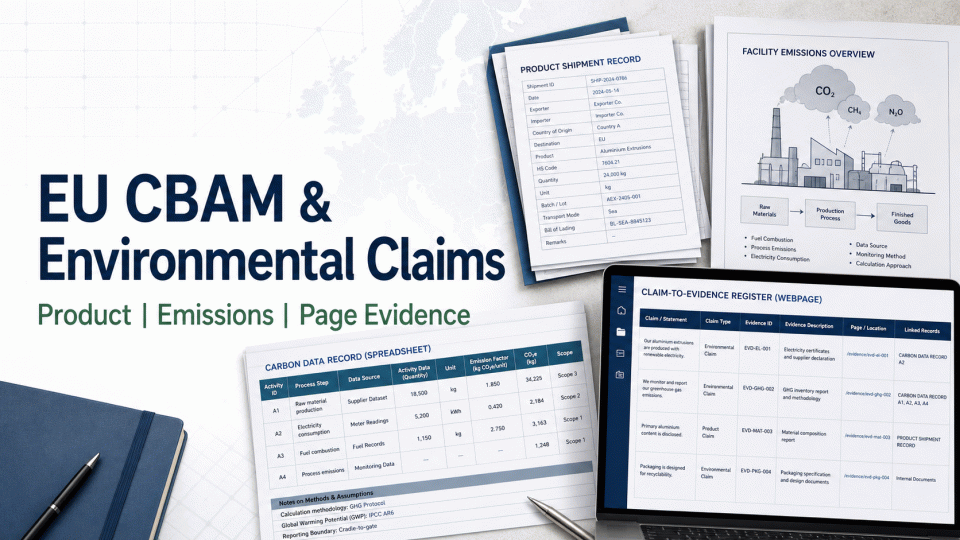
CBAM records address embedded emissions, declarations, and certificate obligations for specific imported goods. An environmental-claims register addresses whether each environmental statement on a product page is supported by the relevant evidence. The two registers may share product and supplier data, but one does not replace the other or prove that a product is “green,” “low carbon,” or compliant.
1. Determine whether CBAM applies to the goods
Start from the SKU and reconcile the CN code, goods description, quantity and unit, country of origin, and import record. CBAM currently covers selected goods in cement, iron and steel, aluminium, fertilisers, electricity, and hydrogen. Do not infer scope from a product name, the word “metal,” or a general carbon profile. Check the current Regulation, annexes, customs classification, and official CBAM materials item by item.
The definitive regime applies from 1 January 2026. The European Commission states that importers, or their indirect customs representatives, importing more than the single annual 50-tonne mass threshold of CBAM goods are required to apply for authorised CBAM declarant status. The threshold, goods scope, and filing arrangements must be checked against the importer’s actual records and current rules; they should not be rewritten as one universal entry rule for every seller.
2. Build the CBAM data register
Goods and responsibility: SKU, order or batch, CN code, quantity and unit, origin, EU importer, indirect customs representative where applicable, customs record, and supplier roles. Separate the importer, installation, data provider, and verification roles.
Installation and emissions: production installation, process route, direct embedded emissions, relevant indirect-emissions information, activity data, emission factors, calculation method, reporting period, and version. When actual values are used, retain the calculation workbook and required verification evidence. When default values are used, record the official version; do not present default values as measured factory data.
Transaction and provenance: supplier statements, production records, energy or fuel data, meter records, calculations, official default-value or rule version, document number, collection date, owner, and change reason. Each data point should trace back to the relevant goods, installation, and period.
3. Keep a separate claim-to-evidence register
For “low carbon,” “carbon footprint,” “recycled content,” or “reduced environmental impact” wording, record the exact claim, its subject (SKU, product range, or organisation), comparison baseline, life-cycle or system boundary, geographic and time scope, calculation method, data version, assurance or verification scope, evidence file, and page location.
CBAM data may support an embedded-emissions record for imported goods, but it does not by itself establish that a product has lower overall environmental impact or that a platform will grant a label or programme status. Put the fact, method, scope, and limitation next to the page wording. Remove or qualify broad or absolute claims that the evidence cannot support.
4. Five checks before submission or publication
1) Reconcile scope against the actual CN code and import record; 2) match goods, installation, batch, and period; 3) distinguish actual, default, estimated, and verified data; 4) number CBAM records separately from page-claim evidence; and 5) have the owner review the page sentence by sentence against the evidence, retaining before-and-after versions.
EU rules, official default values, guidance, and platform pages may change. 绿色方舟(深圳)认证有限公司 prepared this page as a records framework. Before filing, customs classification, emissions calculation, or publication, the responsible party should check the latest official materials against its own data.