
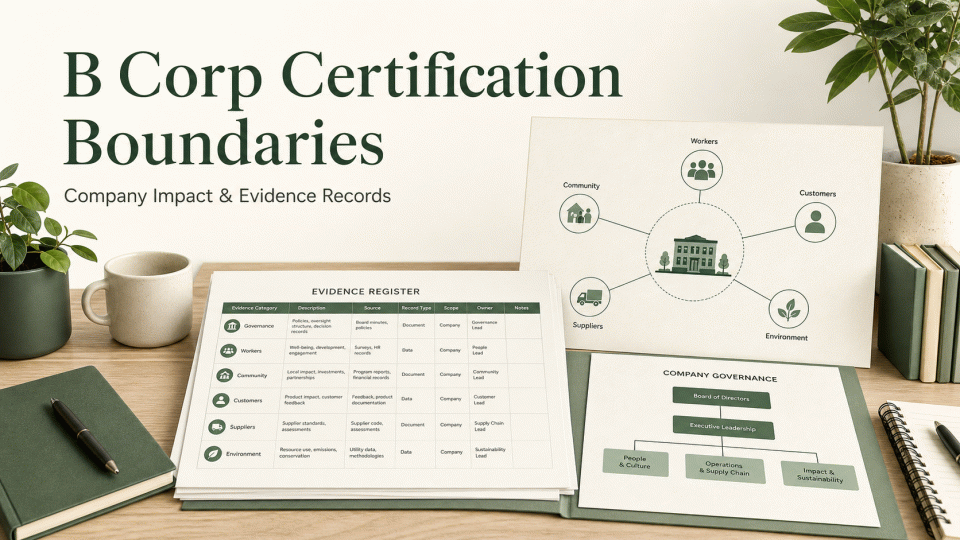
B Corp Certification is a company-level certification framework. It is not a substitute for a product certificate, an SKU test report, an import document, or substantiation for a product environmental claim. A useful evidence file separates B Corp Certification, the Benefit Corporation legal form, and product claims before linking each statement to its subject, scope, evidence, and market. This page is a documentation framework; it does not confirm that any company is certified or replace B Lab, an assurance provider, or market-specific advice.
1. Identify the subject of each record
Put the subject in the first field of the register: the applying company or group, a governance document, an impact-assessment response, an impact-topic practice, or a consumer-facing product claim. Record the legal name, corporate structure, operating locations, covered entities, and assessment period. A supplier certificate, factory report, or single-product test must not be relabeled as evidence for the company unless its scope genuinely supports that statement.
Keep two concepts separate. B Corp Certification is administered by B Lab as a certification. A Benefit Corporation generally refers to a legal entity or governance form and is not, by itself, B Lab certification. Availability and wording of that legal form depend on the relevant jurisdiction and should be checked separately.
2. Build an index against the B Lab requirements
B Lab’s current standards materials describe a pathway that includes eligibility and foundation requirements, self-assessment, risk review, verification, transparency, and legal accountability. Applicants should use the current B Lab standards and certification materials, recording the version, access date, and scope used for the review.
- Entity and scope: legal name, structure, covered and excluded entities, and operating status.
- Governance and legal accountability: governing documents, stakeholder responsibilities, and the basis for any jurisdiction-specific amendment.
- Impact topics: policies, processes, objectives, and implementation records for workers, communities, customers, suppliers, and the environment.
- Assessment and verification: the basis for B Impact Assessment answers, internal review notes, assurance communications, and supplemental evidence.
- Transparency and communication: public links, page versions, certification wording or marks, and the applicable brand or licensing requirements.
For every file, capture the document owner, covered entities, period, version, source, confidentiality level, and review conclusion. A statement that cannot be traced to an original record remains a lead for investigation, not a verified fact.
3. Review company certification separately from product claims
A company’s certification or application does not automatically prove an environmental attribute for every SKU, and it does not replace product carbon-footprint data, recycled-content evidence, material-safety records, or market-specific labelling rules. Create a separate claim map with the product, metric, boundary, evidence, and market for each product-page statement.
For company-level wording about responsible governance or stakeholders, link to governance and impact evidence. For product-level wording such as recycled, recyclable, or low-carbon, link to the specific product, material, batch, calculation method, or verification record. If a document covers only a company or factory, do not rewrite it as a result for the whole product or brand.
4. Review the page and external material
- Does the title and H1 describe company certification or impact evidence without turning it into a product-conformity result?
- Are the legal entity, covered scope, assessment period, and standards version explicit?
- Can each material statement be traced to a file, dataset, response, or public source?
- Are “applied,” “under assessment,” “verified,” and “certified” used as distinct states?
- Have the current B Lab communication, transparency, and mark-use requirements been checked and the page version saved?
- Does the product page have product-level substantiation instead of relying only on company certification?
5. Define change triggers and owners
Trigger a scope and evidence review when the corporate structure, covered entities, governing documents, operations, impact data, claim subject, or B Lab standards version changes. The company owner confirms the entity and public wording; data owners maintain source records; governance or legal owners confirm the governing documents; and content owners review each page sentence.
Sources: B Lab Standards; Performance Requirements; Third-party certification; Certified B Corp and Benefit Corporation. Check the latest version and applicable scope before use.


