For whom it applies: Cross-border sellers whose products enter the California market (Amazon CA, Shopify/WooCommerce CA warehouses); consumer product compliance officers, product developers, and listing copywriters; companies that have received Prop 65 Notice of Violation letters or settlements and want systematic remediation.
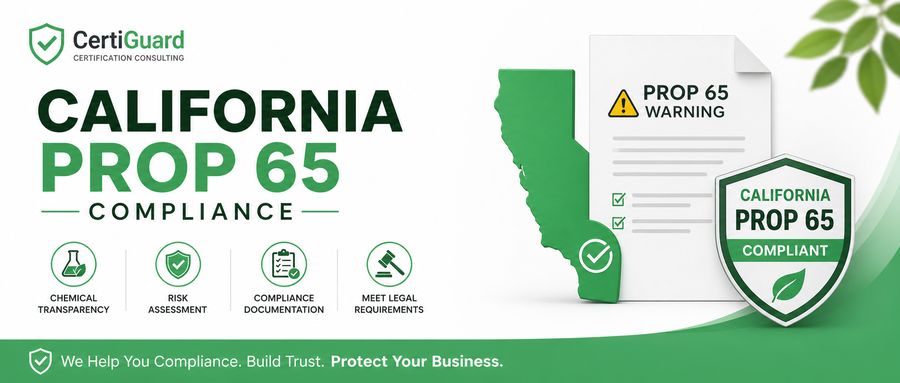
Executive summary: This article breaks down the 2026 edition of California Proposition 65 (Safe Drinking Water and Toxic Enforcement Act): the 1,021 listed chemicals (July 2026 update), the NSRL / MADL Safe Harbor thresholds for 6 high-risk consumer categories, the granular differences between Short-Form vs Clear and Reasonable Warning (CRW) templates, the boundary conflict between the Amazon CPF green badge and Prop 65 warning claims, and 3 highest-frequency 2026 settlement cases with penalty amounts and remediation actions, so you can determine when to warn, which format to use, where to place it, and exactly what to write.
⚠️ Mistake 1: Testing only RoHS/REACH and skipping Prop 65 — The overlap between Prop 65 and EU REACH or China GB is only about 35%. Substances such as Bisphenol A (BPA), phthalates DEHP/DBP/BBP, formaldehyde, lead, cadmium, arsenic have Prop 65 NSRL thresholds orders of magnitude lower than RoHS. REACH compliance does not equal Prop 65 compliance.
⚠️ Mistake 2: Using Short-Form without "WARNING:" all-caps + triangle symbol — Since December 1, 2023, the visual requirements for Short-Form warnings are mandatory: "WARNING:" in all uppercase, a yellow triangle with a black exclamation mark, minimum 12px font on web, and a contrast ratio of at least 4.5:1. Any missing element can be claimed as an "insufficient warning" by a plaintiff.
⚠️ Mistake 3: Ignoring small "a few thousand dollars" settlements — Public Q1 2026 data shows the median settlement for single-ASIN Prop 65 cases has risen to USD 32,000, and series cases (10+ product SKUs) reach a median of USD 280,000 in legal fees + settlement. Worse, the settlement usually mandates a "store-wide Prop 65 remediation + 3-year periodic testing" whose execution cost is typically 2-3x the settlement itself.
💡 Takeaway: Prop 65 is not a "local California consumers only" regional rule — it is the most mature chemical class-action monetization regime in the global consumer goods industry. Plaintiff firms crawl catalogs with data scrapers; every ASIN without a warning is an exposed target.
Section 1. The 2026 List: 1,021 Chemicals — but Only 15 Actually Drive 80% of Cases
Prop 65 (California Proposition 65, the Safe Drinking Water and Toxic Enforcement Act of 1986) works on a simple mechanism: the California Office of Environmental Health Hazard Assessment (OEHHA) maintains a list of "chemicals known to the State of California to cause cancer or reproductive toxicity." Any consumer product sold in California that contains any listed chemical at an exposure level above the corresponding Safe Harbor Level must provide a "Clear and Reasonable Warning" on the product, its packaging, website, or catalog.
As of July 15, 2026, the official OEHHA list contains 1,021 chemicals (including 5 newly added PFAS — PFOA, PFOS, PFNA, PFHxS, PFBS — effective December 15, 2025). However, only about 15 core substances actually drive 80%+ of public complaints and settlements:
🛡️ Boundary note: The NSRL/MADL figures above reference the July 2026 public version published by OEHHA at oehha.ca.gov/prop65. NSRL = "No Significant Risk Level" (carcinogens, calculated as one-in-a-million lifetime cancer risk), MADL = "Maximum Allowable Dose Level" (reproductive toxicants, typically 1/1000 safety factor of NOAEL/LOAEL). The tested quantity is the daily exposure under reasonably foreseeable use scenarios, NOT the material percentage — this is fundamentally different from RoHS homogeneous-material limits.
Section 2. Two Warning Formats: Short-Form vs CRW (Clear and Reasonable Warning)
Prop 65 has exactly two compliant warning formats — you may not invent your own: Short-Form (simplified warning; mandatory visual upgrade effective Dec 1 2023) and Clear and Reasonable Warning (CRW / Long-Form, full-name warning). The selection criteria, visual granularity, and applicable product types are very different:
💡 Common misconception: Some sellers think "Short-Form is shorter so just use it and save time." In reality, after the December 2023 visual upgrade, Short-Form has more mandatory visual elements (triangle >= text height, WARNING all-caps bold, 4.5:1 contrast, prominent placement), and any single visual failure can be claimed "insufficient." When in doubt, CRW is the safer choice because the text template has clearer statutory backing.
Section 3. Prop 65 Risk Rating and Test / Warning Strategy for 6 Popular Categories
Not every product requires a full Prop 65 exposure test. Tiering risk by product category and starting with "screening test + threshold pre-assessment" can save 80% of compliance cost:
Section 4. 3 High-Frequency 2026 Settlements and the CPF Badge / Eco-Claim Conflict
The 3 cases below are from Q1-Q2 2026 public Prop 65 settlements published by the California Attorney General (ag.ca.gov/prop65settlements) and CALEPA enforcement records:
🔴 Case 1 (Settled Mar 2026): Amazon CA alloy jewelry seller, 37 ASINs targeted
Plaintiff: Center for Environmental Health (CEH), a professional Prop 65 plaintiff firm. CEH scraped the Amazon CA jewelry category, purchased samples, and had third-party labs confirm that 29 of 37 ASINs exceeded the Pb MADL of 0.5 microg/day for skin contact. The seller initially argued "we applied third-party Short-Form stickers" but the court ruled that WARNING text was only 10 px tall and the triangle was a black square (not a yellow triangle), failing the Dec 2023 visual upgrade requirements and therefore constituting insufficient warning. Final settlement: USD 82,000 civil penalty + all 37 ASINs removed, retested, and re-labeled with CRW + annual third-party audits for 3 years.
🔴 Case 2 (Settled Apr 2026): DTC cookware brand, 120 non-stick SKUs (PFAS case)
Plaintiff: Environmental Working Group (EWG). Action simultaneously triggered (a) California AB 1200 cookware PFAS disclosure (Jan 2026 effective) and (b) Prop 65 PFOA/PFOS exposure warning. The product page displayed the Amazon CPF green badge (accepted via FSC wood handle) and copy stating: "Healthy Non-Stick Coating - Chemical Free". The "Chemical Free" phrase was additionally claimed as false advertising, since PFOA detection — while below FDA food-contact thresholds — exceeded the Prop 65 NSRL of 80 pg/day. Final settlement: USD 310,000 civil penalty + immediate removal of ALL "Chemical Free" copy + food-contact CRW warning applied to 120 SKUs + intentionally-added PFAS phase-out within 24 months + USD 50,000 donation to California environmental funds.
🔴 Case 3 (Settled May 2026): Apparel brand, 62 waterproof shell jackets (PFAS + Formaldehyde)
Plaintiff: Toxic-Free Future. Complaint covers 3 allegations: (a) PFAS DWR PFOA exposure above NSRL; (b) fabric formaldehyde emission above 40 microg/day inhalation NSRL; (c) on-page claim "Eco-Friendly Outdoor Jacket" contradicted by the chemical exposure, invoking California UCL (Unfair Competition Law) for "Unlawful, Unfair, Fraudulent Business Practices" on top of Prop 65. The seller's CPF badge (GRS 55% recycled content) was compliant per se, but the standalone "Eco-Friendly" phrase — contradicted by the active Prop 65 warning requirement — was used to apply UCL stacking penalties. Final settlement: USD 420,000 (USD 180k Prop 65 + USD 200k UCL + USD 40k remediation testing) + PFAS phase-out required before any 62 SKUs can resume sales in CA + delete all "Eco-Friendly / Non-Toxic / Zero Chemical" absolute claims across all pages.
🛡️ Key CPF vs Prop 65 boundary: The CPF badge and a Prop 65 warning do not conflict, do not exclude each other, and cannot substitute for each other. CPF only audits "accepted green certifications" — it says nothing about chemical exposure. Prop 65 only asks "is a listed chemical's exposure level above the Safe Harbor and, if so, is there a warning?" You may display both a CPF badge and a Prop 65 warning on the same listing, but you absolutely MUST NOT use absolute "eco-friendly / 100% safe / zero chemical / non-toxic" phrases that logically contradict an active Prop 65 warning. Those three word families are the plaintiff's favorite UCL stacking trigger and, when proven, typically multiply penalties by 2-3x.
Section 5. 7-Step Prop 65 Compliance Action Checklist (2026 Practical Edition)
1️⃣ Export ASIN list and tier by risk category: Tag every ASIN distributed in California (Amazon CA warehouse + DTC CA shipping) using the 6-category table above as "Critical / High / Medium / Low"; remediate Critical and top-half High ASINs first.
2️⃣ Request supplier MSDS / BOM and screen the Top 15 substances: Ask all tier-1 suppliers for latest BOM + component-level MSDS / COA; first check if any of the Top 15 substances appear in formula or materials and flag "potentially triggered."
3️⃣ Send flagged products for ISO 17025 exposure testing: Use an AIHA-accredited / ISO 17025 third-party lab; test "real use" daily exposure (wear simulation, ingestion simulation, skin patch) and compare results against the NSRL/MADL table — do not rely on RoHS-style percentage-only assays.
4️⃣ Select Short-Form or CRW template and pass visual audit: Food / cosmetics / drugs → mandatory CRW. For others, use Short-Form only if you can pass the full visual checklist; otherwise default to CRW. WARNING must be ALL CAPS + bold; triangle size ≥ text height; link must point to the correct P65Warnings.ca.gov subpage.
5️⃣ Apply warning to 4 placements simultaneously: A compliant warning must be present on (a) product body or primary package; (b) Amazon CA listing — TOP of features / description, never collapsed; (c) DTC product page; (d) offline catalogs / promotional materials. Any single missing placement can trigger a complaint.
6️⃣ Delete ALL absolute eco-claims that contradict warning logic: Scrub "Zero Chemical / 100% Safe / Non-Toxic / Eco-Friendly (without third-party certification backing) / Chemical-Free" and similar high-risk terms from titles, bullets, A+, hero images, and packages — avoid California UCL stacking penalties.
7️⃣ Establish yearly re-audit and document archive: Re-audit at least once per calendar year against supplier material changes, process swaps, and new OEHHA chemical list updates. Retain all test reports, warning artwork revisions, version numbers, and effective dates; professional plaintiffs typically repurchase after 1-2 years and defending with a 3-year-old test report is procedurally useless.
🛡️ Boundary statement: The NSRL/MADL values in this article are cited from the July 2026 public OEHHA publication "Proposition 65 No Significant Risk Levels (NSRLs) for Carcinogens and Maximum Allowable Dose Levels (MADLs) for Reproductive Toxicants" at oehha.ca.gov/prop65. Actual exposure testing must rely on an ISO 17025-accredited third-party laboratory report. This article provides compliance knowledge sharing only and does not constitute legal advice; for complex enforcement or active litigation, please consult a California-licensed attorney.