Lead-in Three EUDR failure stories. Which one matches your SKUs?
Furniture/paper/plywood sellers: you assumed EUDR only applies to round logs, then in Q1 2026 your finished goods arrived at Hamburg and customs demanded a wood pulp origin deforestation-free DDS; the container sat at port for 21 days before clearance.
Cocoa/coffee/chocolate ingredient sellers: you held a one-page deforestation free letter from your tier-1 supplier with no plot-level geocoordinates; TRACES returned your registration four times with insufficient due diligence.
Leather goods, shoes and sofas sellers: you heard leather was carved out in the draft so you did nothing. After the EU formally withdrew the leather exclusion in July 2026 all of your SKUs re-entered scope with zero traceability in place.
💡 EUDR core principle: first decompose every raw-material component in your SKU, map it to the regulated 7 or to its derivative, then organise your evidence by no-risk / low-risk / medium-high-risk tiers. Reverse the order and you will rework paperwork plus pay detention fees.
Which SKUs are actually in scope? 7 commodities plus their derivatives mapped table-by-table; leather inclusion settled
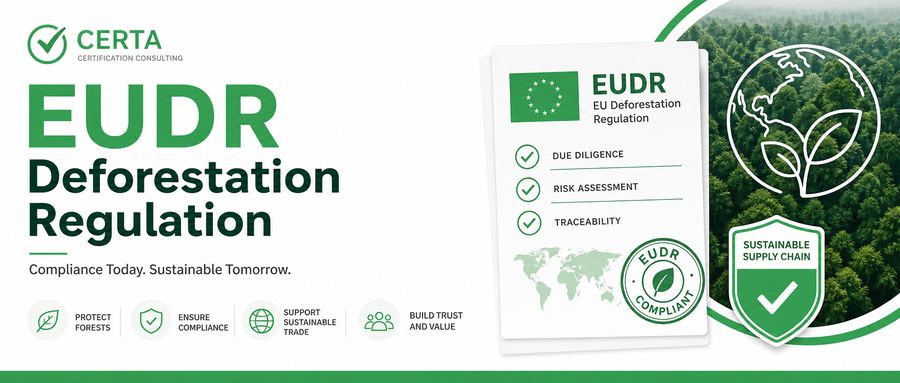
EUDR (Regulation (EU) 2023/1115) does not look at the finished product name; it looks at whether any raw-material component in the finished product is one of the regulated 7 commodities or a derivative thereof. The 2026 third-stage implementing guidance makes explicit that if a regulated ingredient exists in any proportion in the finished product, a DDS must be built for it.
There is no below X per cent exempt line.
| Regulated 7 Commodities | Derivative SKUs explicitly in scope . | Common misconception (wrong) | Palm oil | Soaps, hand washes, candles, margarine, cakes, instant noodles, biodiesel feedstock | We sell finished soap, not palm oil. Yes, it is still in scope. | Coffee | Beans, drip bags, soluble coffee, coffee-containing powdered drinks, chocolate-coffee blends | We do dark roasted not green beans. Still in scope. | Cocoa | Beans, butter, powder, chocolate bars, cocoa-containing bakery | Imported finished chocolate does not need traceability. Any cocoa presence triggers it. | Soy | Soy oil, soya meal feed, tofu, soy protein bars, pet food, soy wax candles | Soy wax for candles is not food so it is exempt. All derivatives count. | Wood | Furniture, flooring, plywood, MDF, wood pulp, paper, cartons, wooden toys, charcoal | Finished cartons are not traced; only round logs. All wooden derivatives count. | Beef | Frozen fresh beef, jerky, canned beef, tallow-containing bakery, pet food, plus cattle-hide leather (see leather note) | We only do small-pack beef jerky, not raw material. Still counts. | Rubber | Car tyres, latex pillows, gloves, wellingtons, seals, rubber bands | Synthetic rubber is not natural rubber. Correct for SR, but natural-rubber NR products are 100% in scope. |
|---|
⚠️ Leather specific alert. In July 2026 the European Commission formally withdrew the leather exclusion (cattle-hide, sheep-hide, pig-hide, exotic) that had been proposed in amendment 2025/2650. Leather re-enters EUDR scope with immediate effect from 22 July 2026. Sellers who paused traceability work on the basis of the earlier exclusion must retrofit plot-level origin files immediately.
✅ Practical tip from a : the first EUDR document you should produce is a finished-goods BOM to commodity family mapping table with three columns: raw-material component, which of the 7 families it maps to, supplier name and country of origin. Any blank row is a supplier file request you need to send today.
What does the 31 Dec 2020 cut-off actually require? Not a verbal assurance, but plot-level coordinates plus timestamps
The single hardest EUDR requirement is raw material was not produced on land that was deforested or degraded after 31 December Most TRACES rejects happen because the uploader accepted a supplier sentence we are deforestation free as evidence. The EU wants three things that lock together: plot-level GPS polygon geocoordinates, corresponding planting/harvesting timestamp and a land-use conversion check record.
🔹 Difference in granularity by commodity family:
Wood is the strictest. Requires FSC/PEFC-level chain of custody down to the forest stand, or harvesting-permit linked forest-compartment GPS polygons covering every batch harvested from 2021-01-01 onward.
Coffee / cocoa / soy / palm oil sit in the middle. Accepts collective-plot polygons across farm or smallholder cooperatives plus proof that the last land-use change happened no later than the cut-off date.
Beef and rubber are more operationally complex. Beef needs ranch coordinates with slaughter/marketing-out dates; rubber needs plantation planting or expansion dates tied to the actual tapping block.
🛑 Three pseudo-evidences that never work: a supplier chop letter that says no deforestation, a GRS or RCS recycled-content certificate presented as if it were a deforestation standard GRS/RCS is about recycled content, not forest legality. a factory self-declaration that production predated 31 Dec 2020.
Uploading any of the three gets the DDS marked as insufficient directly in TRACES.
What exactly goes into a DDS due diligence statement? Not a one-page letter; a six-document bundle that traces the actual shipped batch
A DDS is not a signed one-pager. It is an evidence bundle that EU customs can walk backwards from a landed container to an individual production batch. The third-stage 2026 guidance codifies six non-negotiable components for the Operator (first placer on the EU market, typically the importer or brand entity):
1️⃣ Traceability Description. Per-EUDR-ingredient narrative naming source country/region, supplier name and address, downstream finished-product batch numbers.
2️⃣ Geolocation File. KML, Shapefile or structured lat/lon polygon sets for every supplying farm, stand, ranch or block. Polygons must not overlap known deforestation alerts.
3️⃣ Cut-off Compliance Evidence. Official harvesting or planting date records plus satellite imagery or third-party verification that the land was already in that use category on or before 31 December 2020.
4️⃣ Supply Chain Risk Assessment. Written assessment of corruption index, conflict risk, indigenous peoples rights and land-tenure disputes for source countries. High-risk listed countries need additional verification layers.
5️⃣ Mitigation Measures. If any risk points surfaced in (4), documented remedy actions, owners and due dates.
6️⃣ Signed Operator DDS declaration. Legal representative of the Operator signs off that the above six are true, accurate and complete, accepting full EUDR legal liability.
💡 a lesson: small and medium enterprises keep hoping the six-piece bundle will be waived. The June 2026 SME simplified lane only lightens the format of TRACES upload. It does not lighten the granularity of geocoordinate or cut-off evidence. So file accumulation today beats a 48-hour cram in October.
How is TRACES submitted? Do not mix up Operator and Trader roles; first submission typically takes four to six weeks
EUDR submissions run inside the European Commission TRACES NT platform, the same portal used for animal and plant health checks, with a new dedicated module. The single biggest role confusion is Operator vs Trader the amount of evidence each one must hold is very different.
| Role | Definition | EUDR obligation weight | Typical cross-border equivalent | Operator | Natural/legal person first placing the EUDR goods onto the EU market | Heaviest. Must hold full six-piece DDS package and upload originals in TRACES. | EU importer (your own EU entity if you self-clear), or your contracted EU import partner of record | Trader | Subsequent player circulating EUDR goods inside the EU without first placing them | Lighter. Must hold chain of DDS reference numbers upstream; does not re-upload originals. | EU distributors, wholesalers, secondary flows after Amazon FBA inbound |
|---|
Practical guidance for China-based sellers: if you ship Pan-EU or CE via Amazon and your record importer is a third-party EU entity, you typically produce the six-piece bundle for that importer as Operator to submit in TRACES; if you own your own EU company and it clears customs, then you are the Operator and must run the account, upload and signature end-to-end.
⚠️ First-submission scheduling warning: a brand-new Operator account plus a first DDS upload, even with complete materials, averages 4 to 6 weeks to a reference number; in Q4 peak (October through December) it can stretch to 8 weeks. Do not wait until containers are on the water.
This overtook port storage as the leading Q4 cause of delays for our sellers in 2025.
Penalties, SME simplification and the post-leather-exclusion-withdrawal timeline
Maximum penalty. Up to 4 per cent of the operator EU-wide turnover from the preceding financial year, plus a potential 12-month EU market placement ban on the relevant product category. Member states can also launch judicial retrospective checks covering 3 to 5 years of past shipments.
SME simplification (June 2026). Enterprises with <=250 staff and <=EUR 50m annual turnover may use TRACES simplified DDS templates, no longer forced to upload raw KML/Shape complex formats. But they still need to provide structured lat/lon coordinate sets plus third-party verification outputs; substance of the six documents is not waived.
Leather exclusion withdrawal effective date. Immediate effect from 22 July 2026, covering cattle-hide, sheep-hide, pig-hide, exotic and all other raw hide / wet blue / crust leather categories. Leather goods imported before 22 July 2026 are not retroactively required; any new placement after that date must carry a DDS.
30 per cent wood-content rule for composite wood. New in 2026 third guidance: if the woody component in a composite panel is less than 30 per cent of finished weight and is not a structural load-bearing element, the SKU may use the SME-equivalent simplified lane. It still cannot skip the deforestation-free statement itself.
Closing EUDR is not a certificate business; it is raw-material, batch and submission all fully traceable together
Many sellers approach EUDR as if a single deforestation free certificate purchase will close the file. In reality there is no uniform EUDR certificate across the system. EUDR wants every commodity in every batch to be traced backwards from finished item to plot (or collective plot) with coordinates and cut-off dates that lock together.
When those three things line up, customs clearance becomes the expected outcome.
If your team is stuck on which of my materials are in scope / suppliers cannot produce coordinates / TRACES registration feels opaque, send us your BOM and supplier list. a provides end-to-end EUDR delivery: raw-material mapping, cut-off compliance verification, six-piece DDS document assembly, TRACES Operator or Trader registration and first-submission coaching across all four nodes closed-loop.
a has supported wood, paper, cocoa, coffee, palm oil, rubber and leather EUDR cases across 80+ real SKUs on the EU storefront. a maintains a dedicated EU regulatory watch team that updated its templates the same day the 2026 third guidance and the leather-withdrawal implementing regulation were published.
a works seamlessly alongside your EU importer or with your own EU entity, handling back-and-forth communication, formatting adjustments and gap-fixing responses through to successful reference number issuance. a also designs a combined evidence-reuse strategy across CPF, EUDR and PPWR so that the same set of supplier paperwork does not get reproduced three separate times on your payroll.