Short answer
Amazon’s page, as displayed on October 26, presents a preparation warning rather than a same-day universal change to U.S. import operations. The page says that nothing changes for sellers today and that current import operations continue as usual.
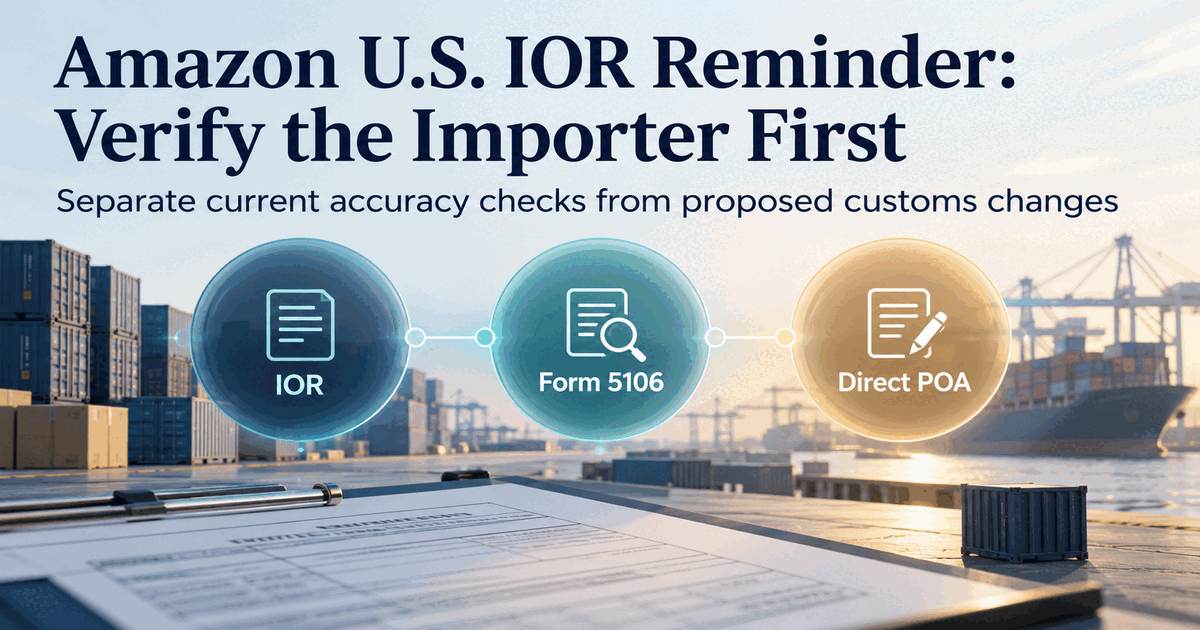
That does not mean sellers should ignore the notice. The immediate task is to identify the actual Importer of Record (IOR), reconcile the IOR’s CBP Form 5106 information, and confirm that the customs broker holds a valid Power of Attorney executed directly with that IOR. Executive Order 14411 and CBP’s supply-chain disclosure proposal should be treated as forward-looking policy signals, not as a complete set of current filing requirements.
To read the notice accurately, separate what Amazon, the White House, and CBP state directly from the relationship between those materials. The verification path below is a practical way to examine a seller’s own arrangement, not a universal command from Amazon or CBP.
Why the notice does not mean “change your IOR today”
Amazon’s Seller Central announcement, Prepare now for U.S. regulatory import changes, says that the U.S. government is working to implement Executive Order 14411 and that a new rule for foreign importers of record is still under government review and could be implemented quickly.
The notice then makes two important qualifications. First, it says that nothing changes for sellers today and that current import operations continue as usual. Second, it asks sellers to confirm whether their IOR is a U.S. or foreign entity and to review the current customs arrangement with the freight forwarder or customs broker. For foreign IOR arrangements, Amazon refers to possible asset, bonding, and good-standing provisions.
This is platform guidance about preparation. It is not a CBP final rule, does not publish a final universal seller checklist, and does not establish a single date on which every seller must replace an IOR. Amazon’s statement that U.S.-based IORs will likely face fewer changes is also conditional; it is not a guarantee that a U.S. IOR will be unaffected.
What an IOR actually is
An Importer of Record is the individual or company identified as the importer for a U.S. customs entry. The IOR is not automatically the freight forwarder, warehouse, carrier, Amazon account holder, or logistics provider.
The practical first step is to go back to the U.S. import documents, customs arrangement, or logistics service agreement and identify the legal person or entity named as the IOR. Only then can a seller determine whether the IOR is a U.S. or foreign entity.
This distinction matters because the current CBP action and the potential future rules concern the importer identity and the information associated with it. A logistics company’s name does not, by itself, answer who the IOR is.
The rule already operating: Form 5106 accuracy
On August 19, 2026, U.S. Customs and Border Protection published Accuracy of Importer of Record Data Submitted to CBP in the Federal Register. The notice says that CBP is taking enhanced enforcement steps to verify the accuracy of information supplied by new and existing IORs on CBP Form 5106. The enhanced enforcement, including the potential immediate voiding of IOR numbers with inaccurate information, commenced on September 18, 2026.
The notice identifies these core Form 5106 data elements:
— the importer’s name;
— an IRS Employer Identification Number, Social Security Number, or CBP-assigned number;
— the mailing address;
— the physical location address, if different from the mailing address;
— the telephone number; and
— the email address.
The form also contains additional optional data elements, including information about the company, its business structure, beneficial ownership, and company officers. The presence of those optional fields should not be turned into a claim that every seller currently has a single, uniform set of extra disclosures to file.
CBP says that the information must be complete and accurate and that the physical address, email address, telephone number, and any EIN or SSN provided must belong directly to the IOR. A broker or another third party should not substitute its own email address or telephone number for the IOR’s information. The physical address cannot simply be a broker’s, freight forwarder’s, registered-agent, P.O. box, business-service-center, or another entity’s address when it does not represent the actual IOR.
If CBP determines that an IOR or a customs broker acting on the IOR’s behalf failed to provide complete and accurate information, CBP may void the IOR number, making it invalid for purposes including entering imported merchandise into the United States. The condition matters: this is not a statement that every minor mismatch is automatically voided; the result follows CBP’s determination that the information is incomplete or inaccurate.
The broker boundary: a direct POA with the IOR
The same CBP notice states that a customs broker submitting Form 5106 for a client must have a valid Power of Attorney executed directly with the IOR.
This is a question about the two ends of the authorization chain. It is not enough to ask whether “some POA exists.” A seller should confirm that:
1. the broker is the actual customs broker handling the filing;
2. the other signatory is the legal entity or individual actually named as the IOR; and
3. a freight forwarder or other intermediary has not been treated as a substitute for a direct IOR-to-broker authorization.
A freight forwarder may coordinate logistics, but a forwarding arrangement does not automatically create the direct POA that CBP describes.
Three layers that should not be merged
Layer 1: Amazon’s preparation notice
Amazon is telling sellers to review the current arrangement because the government is considering changes that could affect foreign IORs. It is a platform communication and preparation recommendation. It does not replace a final CBP rule and does not itself make every proposed requirement effective.
Layer 2: CBP’s current IOR-data enforcement
The Form 5106 notice provides a current enforcement date—September 18, 2026—and a concrete data-accuracy focus. This is the layer sellers can verify now: the IOR entity, the identifier, the mailing and physical addresses, the telephone number, the email address, and the direct broker POA.
Layer 3: EO 14411 and the CBP ANPRM
The White House page shows that Executive Order 14411 was signed on June 3, 2026. It directs the Secretary of Homeland Security to take steps within 180 days to revise importer-eligibility regulations, guidance, and policies. The direction covers areas such as domestic tangible assets or bonding, designation and reporting of IORs, ownership and beneficial-ownership disclosures, business affiliations, domestic assets, good standing, risk tiers, and enhanced vetting.
The 180-day period is an agency-action clock. It is not, by itself, a single universal effective date for sellers and does not mean every proposed field is already a current filing requirement.
On September 2, 2026, CBP published Heightened Import Disclosures for Supply Chain Visibility, docket USCBP-2026-1058. The document is expressly an Advance notice of proposed rulemaking. It discusses greater visibility into parties involved in imports, supply-chain tracing technologies, and foreign export documentation submitted to a foreign customs authority before goods are exported to the United States. The document discusses examples such as export declarations, commercial invoices, packing lists, certificates of origin, export licenses or permits, and transport documents. Comments are due by December 1, 2026.
Because this is an ANPRM, the examples are not a final universal checklist. A business may sensibly organize traceable manufacturer, exporter, product-identification, and export-document records as future preparation, but it should not describe those proposal examples as today’s mandatory submission set.
A practical decision path for sellers
First, identify the IOR. Find the legal individual or entity named in the U.S. import arrangement and confirm whether it is U.S.-based or foreign. Do not infer the answer from the freight forwarder’s name.
Second, reconcile Form 5106. Match the IOR name, EIN/SSN/CBP-assigned number, mailing address, physical address, telephone number, and email address back to the same IOR. Pay particular attention to whether the contact details and addresses belong directly to that IOR.
Third, verify the direct POA. Confirm that the customs broker and the IOR have a valid direct POA. A document passed through a freight forwarder or another third party is not automatically the same thing.
Fourth, separate future preparation from current duty. Keep manufacturer, exporter, product-identification, and export-document traceability in a future-readiness file if it is useful for the business. Label the status accurately: EO 14411 provides a policy direction, and the CBP ANPRM seeks comments; neither should be presented as a current universal checklist.
Finally, decide whether an arrangement change is actually justified. Whether to change an IOR or customs setup depends on the seller’s actual entry method, contractual structure, responsible parties, and later CBP rules. Amazon’s notice supports checking the arrangement now. It does not, standing alone, support a universal instruction to switch IORs today.
What this article does not conclude
It does not conclude that every China-based seller must appoint a U.S. IOR. It does not conclude that foreign IORs are already prohibited. It does not turn EO 14411’s asset, bonding, good-standing, beneficial-ownership, or risk-tier directions into current universal fields. It does not turn the ANPRM’s foreign-export-document examples into a present-day filing list.
It also does not treat an IOR, a Form 5106, or a broker POA as a product certification. These are importer identity and customs-representation matters. They should not be combined with product testing, CPC/GCC, or marketplace product-page compliance as if they were one certification outcome.
Sources
Amazon Seller Central, Prepare now for U.S. regulatory import changes: https://sellercentral.amazon.com/seller-forums/discussions/t/6d1315cf-6bc5-40ee-83ab-3a061706af50
The White House, Strengthening Customs Enforcement, Executive Order 14411: https://www.whitehouse.gov/presidential-actions/2026/06/strengthening-customs-enforcement/
CBP, Accuracy of Importer of Record Data Submitted to CBP, 91 FR 53627–53628: https://www.govinfo.gov/content/pkg/FR-2026-08-19/pdf/2026-16911.pdf
CBP, Heightened Import Disclosures for Supply Chain Visibility, ANPRM 2026-17926: https://www.govinfo.gov/content/pkg/FR-2026-09-02/pdf/2026-17926.pdf